Labels

Showing posts with label travels. Show all posts

Monday, May 19, 2014

slot canyons and sweet desert spring.

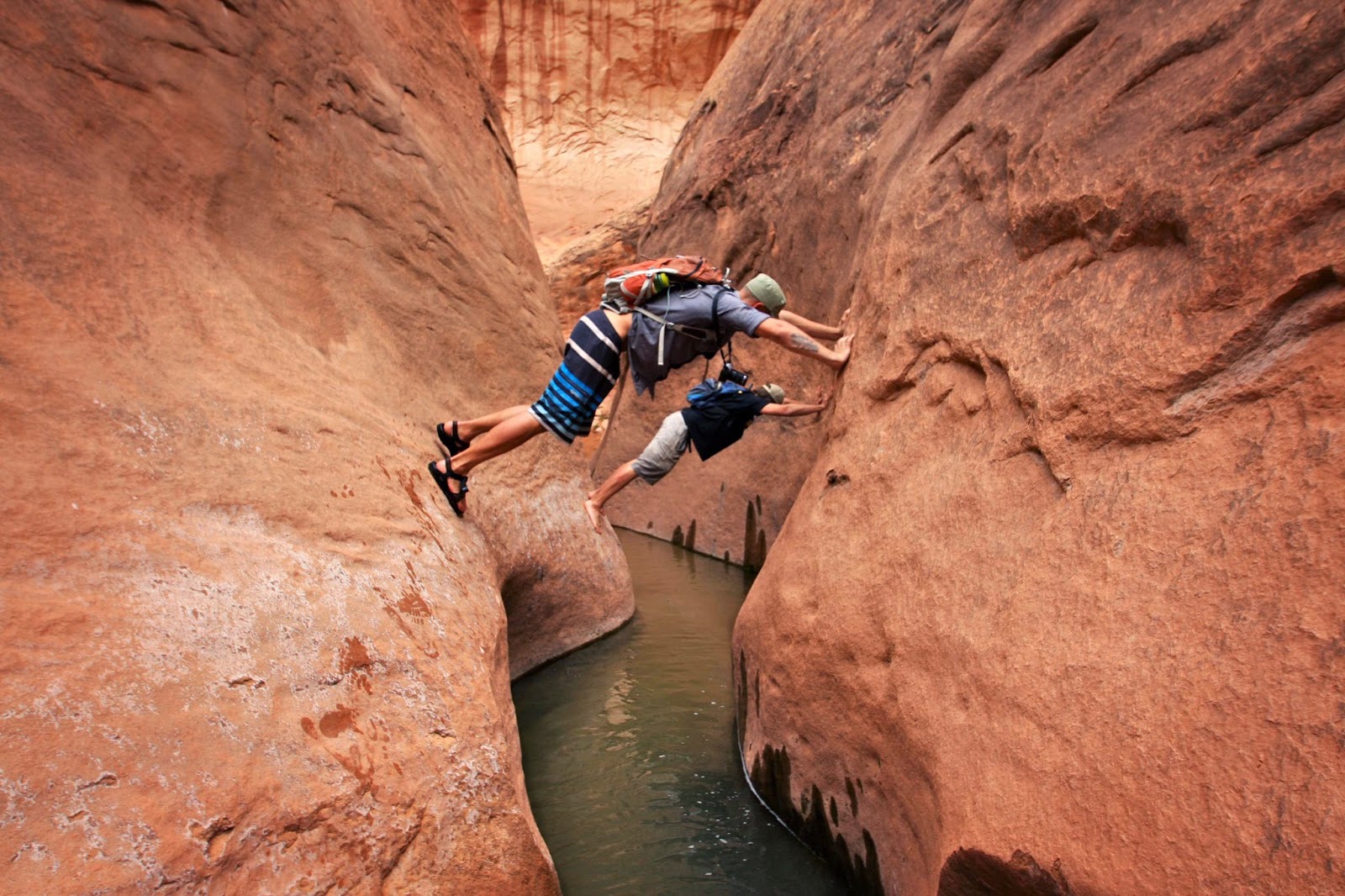
 Some long overdue photos from Easter weekend in Grand Staircase-Escalante National Monument, Utah.


Tuesday, April 15, 2014

Utah river journal

Day 1: travel

J. and I meet at a free climbers' camp near Moab, and though I don't climb – the very idea of hanging off that red monolith in the distance makes my heart beat fast – I like the climbing culture. There are probably 30 people here and last night everything was silent, a handful of fires burning under the stars, the bobbing headlamps of some stragglers coming off the approach in the dark. I slept in a cocoon of warmth and happiness and woke this morning to the bright blue skies of a desert spring, flowers unfurling in the morning sun, a man strumming a guitar beneath a juniper. J. has left to meet some friends for a kayaking trip to the north and I'm leaving soon to drive south and meet another group of friends on the banks of the San Juan River. Our paths intersect where they can, sleeping on a bed of dirt under the stars, and I love it. I love it all.

I dreamt last night that I climbed a tree – a very large, very gnarled old tree. I hung from a branch with my arms and legs wrapped around it like a sloth. I hung for a long time; for months maybe. Time passed in a gloomy gray light with no distinction between day and night. One day, I made the choice to swing my arms up in the kind of all-or-nothing move that a climber makes to reach a just-out-of-grasp fingerhold. I can't recall now whether I fell or climbed higher.


Day 2: river

A river is a living thing, a vein pumping the muddy blood of the desert. Early in the spring of a year with little snow, we hardly have to dip our paddles into it except to steer. We drift downstream, watching the landscape change from sandy floodplains crawling with cottonwoods to undulating hills of red sand to sheer canyon walls pocked with shadows and studded with sage. Across it all, the sky is tugged like a sheet snapped tight. We are on river-time now; dream-time.

It feels like the most natural thing in the world to float down this river with friends, surprising stock-still herons in the shallows, trailing my fingers in the water. But I can't help knowing that the tamarisk choking the banks aren't supposed to be there; that the dam upstream allowing more people to live in this scorched country has tamed the spring floods and prevented the river from reaching its natural floodplain, an area once farmed by ancient people now blowing dry with tumbleweeds, another non-native plant. But what's native, anyway? Everything comes from someplace else, and most things move on after they pass through here.

We climb high above the river to an ancient cliff dwelling, to the stone rooms and windows of the ancestral Puebloans, the Anasazi. The ones who left. We find potshards and thousand-year-old corncobs gnawed clean, and – tucked away in a secret alcove away from prying eyes and potential vandals – a piece of skin placed gingerly on a rock, with a lone stitch that's withstood centuries of wind and sand. A scrap of fabric from another world, another time. It humbles me. 


Day 3: rock

Even in March, the desert is a land of extremes. At night the water turns to pans of ice, and I curl in my sleeping bag with my hands jammed between my legs, waiting for the kiss of sunlight. And then in a blink it's afternoon and we're scrambling for shade beneath a blazing sky.

The desert is defined by water, by the river devouring the land. Yet twenty minutes of walking later it's as if such a thing never existed, and you're in a canyon so dry it cracks your lips and crumbles at your touch. Each rock is as distinct as a snowflake. In places it's hard and smooth, strata of glass and molten rock poured over grainy substrate, sensuous tendrils of black and red. In places it's terraced, so many layers in a single vertical foot that to look up at the towering walls is to comprehend millions of layers. Alone, each is flaky and unsubstantial, but together they comprise monuments.

Elsewhere, the canyon walls are dripping with an alkaline water that builds into coral-like globules, nubs of stalagmites sprouting from the earth. Sometimes the rock is green, tinted by minerals or slimed by algae. In places it's crumbled into billions of pebbles, each a different color and shape; and in places it's been pulverized to sand, sometimes white, sometimes red. Under certain overhangs, the rock is gray and rotting, and stepping beneath it is like walking on the dry ash of a fire that's burnt out and gotten cold.

How slowly do you have to move to learn the shapes and colors of a landscape, to memorize its names and absorb its mysteries? Here, I think, it would take forever: a lifetime of lifetimes. Even at our leisurely downstream pace, we miss much. Walking, I can see more, but sometimes I think the only way to see anything at all is to stop moving. When I'm still, I see two birds couple in midair, almost violently, and I don't know whether they've fought or made love. They freefall together for a brief moment and break apart before they fall to the earth. 


Day 4: wind

More extremes: This time, wind. Last night was much warmer but windy, and this morning's blue sky was swiftly replaced by a soft-gray cover of clouds. Made it four miles through the biggest rapid of the trip before getting slammed with wind. Absolutely pummeled. The kayak and canoe could've pushed on, but the raft was getting nowhere. We pulled off and ate lunch huddled next to a rock while watching the wind blow whitecaps upstream. Then we found a flat-ish spot and killed four hours drinking whiskey, putting up a giant tarp and abandoning it, sitting a cave, drinking more, getting silly and wondering if we'd be forced to spend the night there. Luckily, just before dark the wind died down and we scrambled to pack the boats and shove off. Made it a mile before getting slammed with another wall of wind. It's good to be out with four other guides – when we need to get shit done or make decisions, there is no mucking about. That night, our boats were unpacked, camp set up, fire crackling and dinner cooked in under 40 minutes. Our faces and hands are raw with wind-burn. There is sand in my teeth and up my nose. Tomorrow we'll make an early start to get off the river. 


Day 5: home

Back home in Colorado, a red-wind terror sweeps the valley, knocking branches of trees and whipping freshly-plowed fields into the sky. The sky is red with Utah sand, kicked up hundreds of miles away and now sticking to our windshields, traveling on currents of air across state boundaries. Utah follows me home; the desert won't let me go so easily.

So this is spring in this part of the world. Dry and violent, a kiss of fire. Tomorrow, I will plant peas, and I think I'll stay home for a while. 


Wednesday, June 26, 2013

my last day in durango.

 
All day today I'd planned on going to the gym with Margaret, because my "Welcome to Durango" packet had included a free pass and I needed the exercise. But after many hours at home pretending to be a writer while actually wasting vast amounts of time online, Margaret showed up and we decided that happy hour downtown sounded far more appealing than a session at the gym. It was a good choice. One cocktail led to another, and eventually I found myself walking home happily buzzed through the warm, friendly streets of Durango.

I saw Willie sitting in front of the Bookcase, in the same place where I'd met him a couple weeks ago. He's a local homeless musician, and he reminds me of my Dad, though I doubt my Dad would take kindly to the comparison. After meeting Willie for the first time, I felt so bad for him and at the same time liked him so much that I thought about bringing him some cookies or a card on Father's Day, since his own daughters have cut off all ties with him. But one thing led to another, and I never did.

Tonight Willie and I shared a cigar and he told me with a humble openness about his alcoholism, the 30 years he spent drunk without a hangover, and the four heart attacks and three strokes that have since straightened him out. People walked by and smiled and said hello, and I wondered if it looked odd, me sitting on a bench with this gnarly bearded guy who looks like a worn-down cowboy. But there's no denying that regardless of his age or socioeconomic class, he's good company. Talking with him satisfies some unspoken need; it eases the guilt I feel for being thousands of miles away from the barstool where I know my own father is sitting, the man who loves my company so much and would do anything for me except stop his own suffering.

It's not only guilt that makes me stop and sit with Willie, but enjoyment, too, the pleasure of knowing that my company has the power to make an old man so damn happy; the pleasure of knowing that I have all the time in the world this evening to stop and chat; the pleasure that I somehow strangely get from hanging out with fascinating old guys I've met in my travels. Maybe it is weird. Maybe I should be more cautious.

I'm sure that's what many people in my life would tell me: be more careful, Krista. There's no need to befriend these strangers. But there are others, I hope, who see things the way I do, who believe that intuition is a thing to be trusted, that risk is inherent in everything we do, and that spreading compassion and learning about somebody else's life is sometimes worth a little bit of risk.

I walked home a few more blocks, just as dusk was turning to dark, ran into a couple more friends, talked with them for a bit, walked on. Said hello to people sitting on their porches or walking by with their dogs, partners, friends or kids. Looked in the glowing windows of houses, as I do at this time of day, and imagine the lives lived inside. Wearing a skirt and tank top, I was perfectly warm, skin caressed, feeling safe and cared for and content in this little town where I've been living. Thank you, universe, for giving me this place, this life, these people. Tomorrow I move again -- north to Paonia. 

Tuesday, May 14, 2013

Eulogy for the Northeast

 
In an early morning fog on May 10, I set off down the street with my little Honda packed to the gills. The familiar houses disappeared in my rearview mirror, and the familiar road turned into a familiar highway. All this familiarity was made new by the feeling in my chest that I was not going to stop driving until 2,300 miles had passed under my tires. I would stop for sleep and gas and food of course, but I would be in the dreamstate of traveling for thousands of miles, and when I awoke, I would be somewhere entirely different. The soft green light and rolling hills and warm fog of New England would be replaced by red sandstone desert and rabbitbrush and towering mountains, and I would have another pin to place on the map of my life, another place to call home. I'm ready to stay somewhere for a while this time, I tell myself, and the western slope of Colorado sounds as ideal as anywhere. But as I drove through New York state, struck by its quiet, early morning beauty, I found myself again holding up the mirror of the place I'm choosing to go against the place where I'm from and trying, again, to reconcile my love for two disparate places. The West and the East.

Among the super-fit outdoorsy types who tend to settle in the mountain West, it's common to disparage the relatively tame, settled East. The rivers are bigger in the West, the wildlife is grander and the landscapes are more dramatic, but more importantly there's the issue of accessibility. More than anything else, it's what sets the east and west apart. As much as 80 percent of western states are publicly owned by the Forest Service, the Bureau of Land Management and the National Park Service, leading to large stretches of unbroken land open to outdoor pursuits like climbing, camping and paddling. In New England, the majority of land is privately held. As little as 20 percent belongs to the public.

It's difficult in the Northeast to pull over by the side of the road and simply walk into the woods. As Robert Frost asked, Whose woods are these? The culture of the outdoors is also more genteel (think New Hampshire's stately AMC lodges compared to California dirtbag climbing camps), and we have more people crammed into a smaller space. If you haven't been here – or if you've only been to Boston and New York – you might easily be mistaken in thinking that everything north of D.C. and east of Chicago is one big over-populated sprawl.

But though I don't know if I see myself settling in New England, I'm quick – too quick – to defend my homeland. I bristle when anyone says anything negative about the East. True, New England lacks the large-scale wilderness and outdoor opportunities of the West, but I think it's unfairly maligned. For example: while more than 80 percent of old-growth forest in the Pacific Northwest has been razed by loggers – and that which remains is checkerboarded and left to a few protected reserves – New England is recovering from past abuses and is now 80 percent forested. Looking at a map of forest cover in the U.S., the region I call home is more lushly covered in green than anywhere else in the country. Some of this can be attributed to climate and an influx of people to urban centers, but it's also due to a sense of environmentalism and the actions of private landowners who care about their land. In the Northwest, the Forest Service needs to make money and does so by handing large parcels of public land over to private logging companies who are driven by profit. (Elsewhere in the West, it's private mining or oil companies.) While the straggly second- and third-growth forests of New England don't begin to compare with the majestic old-growth of the Pacific Northwest, it is more consistent, abutting people's homes and yards, stretching along roadsides, spreading through valleys and over mountains. It isn't relegated to a few protected strongholds. It's part of the places where people actually live.

And therein lies another of New England's strengths: the population is more evenly distributed. Many cities in the West were planned around water sources and habitable land, and populations are centered in big cities that radiate outward in ever-widening concentric rings. In the East, where the land is more forgiving, towns and roads sprung up in random disorder, a meandering, bleeding network that doesn't revolve around one large city but rather dissipates itself across the land. On one hand, this means fewer unbroken tracts of wilderness, but on the other, it means that people live more closely with the land. What we lack in raw wildness we make up for in intimacy, in having mountains and hollows and backroads that are ours to care for and explore. Just because land is privately owned doesn't mean it's off-limits – but you often have to be a local to know about it. New England isn't a place that's particularly welcoming for those who are just passing through; it wasn't built on mobility or transience, but on staying and spreading roots.

Soon, I'll be writing for a publication founded on the unique identity of the American West. I'm excited to explore new places and build a community and learn more about magazine journalism. But I'm also worried that working on stories emphasizing the singularity of the West will cause my instinctive defensiveness of my homeland to kick in more strongly and the line between East and West to become more defined, and I will have to live with part of my heart in one place and part in another. 


 The big flat

Tuesday, April 16, 2013

New Zealand journal

(Above: Milford Sound, New Zealand)

In one week, I'm leaving New Zealand, flying back to Massachusetts, and driving to Colorado. Shortly after, I'm quite excited to announce that I'll begin work at the High Country News, a magazine covering the environment, land use and culture in the American West.

Instead of posting on this blog in the past month or so, I've been trying to find a wider audience for my writing and have been submitting to various publications – hence the apparent lack of output. Once I begin my new job writing and blogging for HCN, I'll try to post links to my work here as often as possible, but in the meantime, some notes from my journal in New Zealand.

14 November 2012

Leg three of my trip to New Zealand, and time is becoming irrelevant. I nap, I wake, I eat, I drink, I read, I write. My legs feel twitchy, the muscles tight, and so far I've only driven to Boston, spent a mostly sleepless night in a hotel, and flown to Philadelphia. Now we're somewhere over the West, the earth below barren and cracked, looking uninhabited and inhospitable. There's an old Asian woman next to me who has done absolutely nothing but stare at her hands for the past five hours.

Soon, I hope – I am watchless at the moment – we'll land in LA. Then I'll have an eight-hour layover, followed by a 13-hour flight to Auckland, two more hours to Christchurch, an overnight layover, a 9-hour bus ride and, finally, a 2 hour drive to Milford Sound in Fiordland National Park. The world suddenly falls very large indeed.

15/16 November 2012

We've just crossed the international date line over the Kermadec Trench in the Pacific Ocean, southeast of Fiji. Outside the plane window, a strip of blood-orange meets a strip of deep turquoise over a bank of clouds. The last stars are dissolving from the sky, and 10,000 feet below, the islands of the south Pacific are waking up.

Cottonball clouds retreat to the horizon and a neon orange sunrise suddenly shatters the vista like a basketball thrown through a wall of glass. Shards of light and color pierce the sky. Flight attendants come through with coffee as though nothing extraordinary has happened.

The Air New Zealand plane whisking me across the world is brand new, with touchscreens at every seat and a first class section that looks straight out of a spaceship. Information abounds: my screen tells me that the outside temperature is -54 C, our altitude is 10,972 meters and our ground speed is 761 kilometers per hour. We've traveled 9,891 kilometers so far, with 624 to go.

17 November 2012

New Zealand, so far, is much like my memories of Australia – clean, modern and full of charming people with charming accents. Steve, the bus driver on my trip from Christchurch to Te Anau, talks over a PA system about the Canterbury plains through which we're passing. They stretch 200 kilometers north and south of Christchurch, he says, and 80 kilometers to the east and west. For the past couple centuries they've been mixed-use farmland, mostly crops and sheep, but within the past few decades forests have been cut and many farms converted to dairy, which is more profitable. Steve is regretful that sheep farmers are losing out to the dairy industry, and while I suspect he's driven by nostalgia, he's also armed with plenty of reasons why sheep farming is culturally and environmentally superior.

Half a world away, in Vermont, sheep farming was replaced by dairy well over a century ago, and while no one alive today laments the loss of sheep farms, nearly everyone mourns the demise of small scale dairy farms as factory farming in the midwest runs them out of business. A hundred years from now, I wonder, will Kiwis be mourning the loss of dairy farms as well, as yet another change rolls in? Is it simply that we humans resist change, while simultaneously finding it inevitable? I'm no different, I suppose, seeking out change and adventure while quietly longing for comfort and familiarity.


There are yellow bushes blooming everywhere, huge clumps of them lining flat green fields that stretch on to distant craggy mountains. The bushes look like forsythia, and the landscape like Idaho. It is all disconcertingly familiar. I have a bad habit of trying to wrap my head around new places by comparing them to places I've already been, but here, flying across the international dateline and into another hemisphere, I half expected the plants to all be as if from another planet – wild, Dr. Seuss-shaped leaves, surreal flowers, Jurassic Park-like sizes. But it's all rather mundane. We pass by rows of yellow flowers, small neat houses, a river braided with gray cobbles spilling from the mountains.

A group of teenagers boards the previously-quiet bus, wearing sweatshirts that say Santa Cruz and Waikiki – places they haven't been but that are synonymous with sun and surf. Girls in Costa Rica and New Zealand wear the same sweatshirts, look at their cell phones with the same practiced indifference. Teenagers are teenagers the world over.

In another small town now – Timaru is it? They all look the same, safe and clean and modern with lots of green space, very pleasant – and yet there's something stubborn in me that rebels, wants a bit of dirt, some rough edges, grit. Something old or crumbling or neglected. As we continue south, the sky turns to a low gray and rain streaks the windows of the bus, making things look dreary, a bit Irish. Good. That's better.

It's green here, green as shit, with fat white sheep everywhere standing in the rain like dirty woolen cherubs. I have never in my life seen or thought about seeing so many sheep. There are 4 million people in New Zealand, and 64 million sheep. It rains and rains and rains, and I'm glad to be on a bus.

20 November 2012

Milford Sound first impressions: there's been a high pressure front sitting overhead since I arrived three days ago, and the weather has been stellar, all blue skies, 65 degrees and an afternoon breeze. No one wears shoes, ever – there's nothing dangerous, no spiders or snakes or even thorny plants. The scenery is spectacular, and the living conditions good – Jesse & I get our own room with double bed and views, and the rest of the house is stocked with every piece of kitchen gear, household good, outdoor gear and electronic device you could desire. It's luxurious by guide standards.


26 November 2012

It's a rare quiet morning, with a gray rain dripping outside and a few tuis and bellbirds singing from a tangle of wet branches. Doors open and close – this place has a million doors, it seems – as my housemates get ready and go off to work. As soon as they're gone I sneak out of my room, a quick barefoot hop across wet rocks to the kitchen for a cup of coffee, then back to bed with a book. It's my first morning off in New Zealand.

Most mornings, I pull myself out of bed at 6 a.m. and carry kayaks to the water in the early morning stillness. Then the customers come, 20 or 30 at a time, mostly international travelers speaking in all sorts of different accents. My body readjusts to padding 20+ kilometers a day, and I learn about the fiord, its geography and wildlife, absorbing yet another new place into my skin and bones.

The weather had been ideal until yesterday, when the afternoon forecast was northerly 30 knots and heavy rain. I led my first solo trip in the morning, got soaked, and was settling in for a cozy afternoon of movies when Horey comes in and tells me to get ready to paddle. There are three strapping young German lads keen to go out despite the storm blowing in, and while we'd normally just call it off, Horey wants to show me what the outer fjord is capable of.

The boat ride out to sea is stomach-lurching, and as the Sea-ka slams into yet another trough beneath a curtain of water, I think, really? I'm kayaking in this?

Horey assigns me the lone single kayak while he and the Germans get into doubles. And then it's full-on. The wind is gusting 50-plus knots, I am surfing waves, bracing, surfing, bracing, being blown down a channel that feels more like a whitewater river than an ocean. By miracle and luck, I manage to stay upright. I can't keep up with the boys in their doubles and fall behind, which is even more nerve-wracking, but after a while what began as terrifying becomes normal, and I'm able to look up and see that the sheer granite walls are streaming with more waterfalls than I ever imagined possible.

At one point, I catch up with Horey, and he shouts to me over the wind, spitting rainwater out between words: “If you ever. (gasp) Come out. (gasp) And it looks like this. (gasp) You know you've made. (gasp) A bad decision!”


10 December: Tutoko valley

It never gets old: hiking on a shitty trail as evening descends and rain drizzles through the trees, nothing to see but green – green moss, green ferns, green trees. Smaller ferns growing on larger ones, six or seven different species of ferns in a square foot of forest. The trail is wet and muddy. I'm glad to be wearing Chacos and not boots until I over-confidently step into a mud puddle and sink to my thigh in the only pair of pants I've brought.

We walk on and on, not tiring so much as growing tired of the repetitiveness, the constantly stepping over roots and rocks and puddle and streams, seeing nothing but rainforest. But here, the temperate rainforest abuts alpine splendor, and suddenly we break out of it and the clouds are just lifting, the forecast right for once, and as we walk over a meadow toward a river we begin to see snowy mountaintops and waterfalls emerging through the clouds.

At 11 p.m. it's still not dark but we go to sleep anyway, and in the morning we bury our heads from the brightening sky. The sun takes its time reaching this valley – it has 5,000-foot peaks to climb up first – and we don't rise until it reaches our tent at 9 a.m. Then we sit up and are blown away. Our tent is surrounded by mountains and glaciers and snow – there is a luminous turquoise river flowing outside the tent, waterfalls dripping from cliffs, the sky a brilliant blue. We spend the day following the river upstream to the glacier that's created it.


15 December

At what point does the sacred become mundane, and what do we lose in the change?

The first time it rained here – really rained – I was enthralled, raptured, awed. You've been told that thousands of waterfalls will appear in a heavy rain, but how do you prepare yourself for that? You've seen a waterfall, and you can conceptualize thousands as a number, an amount – but try as you may it is impossible to imagine the dry cliffs you've come to know covered in literally thousands of waterfalls. It is majestic. It makes you want to run outside in the rain, hands in the air, letting water pool in your palms and trickle down your arms.

And then... several feet of rain later... days later, when you realize you can never count on the clear skies to last, that you've chosen to live in one of the wettest inhabited places on earth and that this rain is costing you your livelihood, when you run out of things to do on rainy days and you start to feel old, run down – then what? Someone always puts on the TV and it's all downhill from there. There is no sacred when the TV is on. Not even when you look out the window across the river and see water cascading into the sea.

So it was with the monkeys. I was beside myself with excitement the first time we spotted howler monkeys in Costa Rica earlier this year. It was like a scene from a movie – Jesse and I on the wraparound porch of our jungle cabin, monkeys and bats and lizards in the trees – but after a few days of hiking, we glanced up, saw monkeys on the trail and kept going, feeling slightly superior to the tourists who stopped in their tracks with cameras pointed at the canopy. Is this how it is, then? Must nature present itself in ever new and exciting ways to hold our attention? The natural world as a whole still entices me and drives me and amazes me, powerfully or subtly, but the individual phenomena are becoming like items checked off a list. Thousands of waterfalls? Check. Manta rays? Check. Now how about some whale sharks...?

24 December 2012: Routeburn track

I do not stop and write as I'm walking, because the sensations are too multitudinous to describe. They come and go quickly, each turn of the trail bringing a slight change in the feeling of the place. As the sun travels across the sky, we travel up a valley, through mature southern beech forest, alongside a turquoise river dropping into pools, into open meadows flanked by alpine peaks. With each bend, the light changes and brings a different kind of magic. Who has the words to describe this?

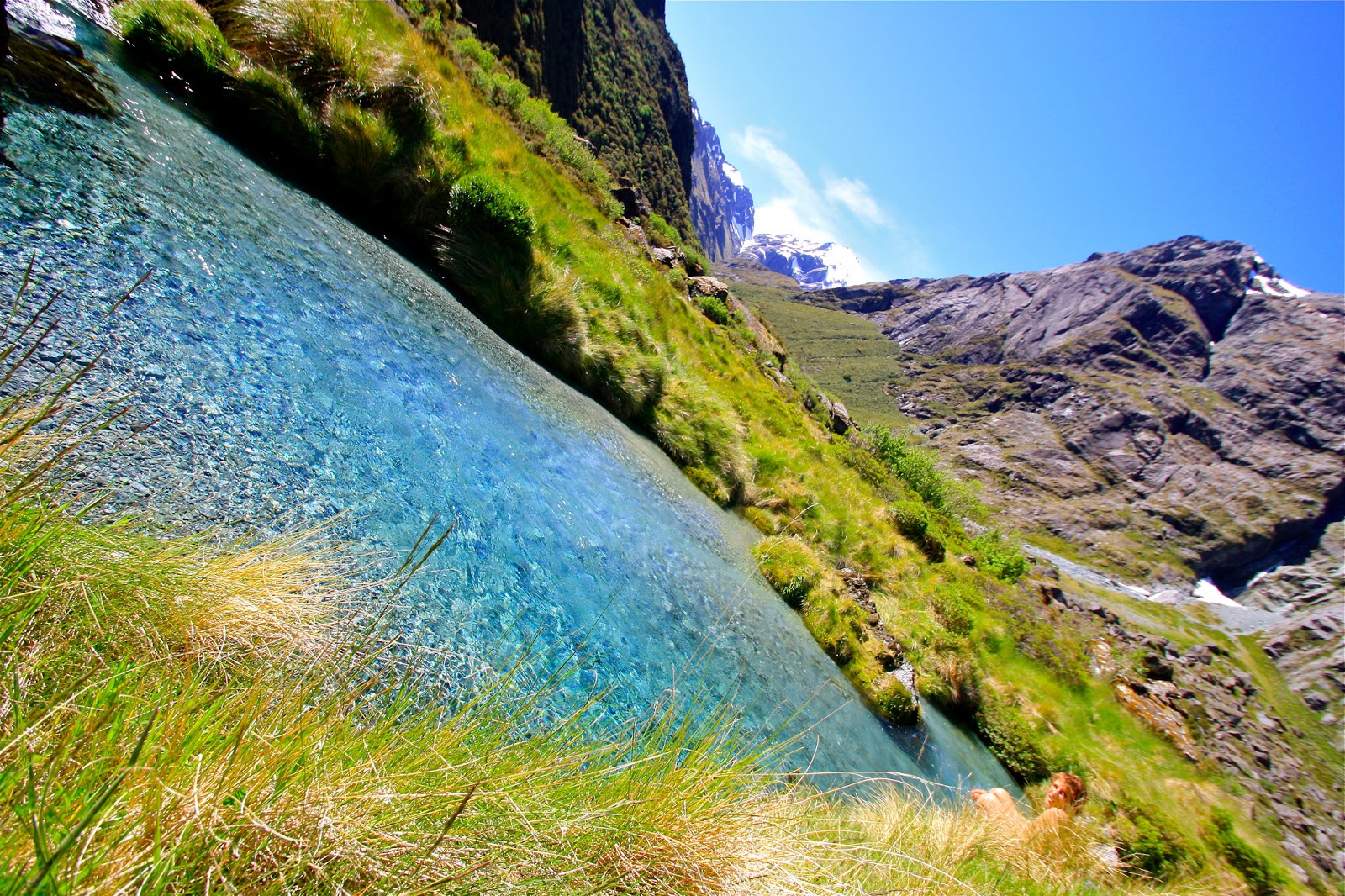
I know I do not. I walk on, sometimes in silent awe, sometimes exclaiming to myself out loud. At the top of a valley where large, scattered boulders and clumps of purplish fern mingle with a sea of golden grasses – where the river deposits itself in pools and cascades before spreading itself wide and braided across the valley below – here we stop for a swim and lie naked in the tussocked grass. There is nothing that could be better than this. The air, the light, the scenery, the solitude – drinking water from the river when we're thirsty, walking barefoot in an alpine valley – we are surely spoiled for life, because nothing else could compare.


13 January 2013

Today I read a passage in Pilgrim at Tinker Creek in which Annie Dillard leaves her cabin on a winter's night to walk in the dark over frozen grasses, and I am suddenly struck with remembrance. Last year at this time, that's exactly what I was doing. I would walk out into the frozen fields of New Hampshire in the moonlight, head bent against the cold, tears dried on my face, until I would realize where I was and stop to look around: tiny stars in an enormous sky glittering above, crystals of frost sparkling on the grass below, my kitchen light glowing yellow in the distance, reminding me which way was home. Which way is home? I still haven't figured it out.

But how much changes in a year. I quit my job and have been living out of a backpack, making hardly any money but nonetheless living richly: traveling in Maine, New Hampshire, Massachusetts, Colorado, Utah, Alaska, Washington, Oregon, California, Costa Rica, Panama and New Zealand. Now, it's 10 p.m. and the sky is still an approximation of blue. A bird still sings. Jesse, tired, sleeps by my elbow; I can see his pulse beneath the skin of his neck. Outside our bedroom door, people are moving around – finishing the dinner dishes, walking to the bathroom to brush their teeth, a quiet laugh. Sounds of life being lived. It doesn't occur to me to be lonely here. But therein lies the paradox – I also do little in the way of reading or writing or being creative. I watch movies, hang out, go places with people. It's all good until weeks pass and my blog is stagnant and my journal blank. Must it be one or the other? Or can I write and create without being lonely and alone?

18 January

I sit in the back of Harlan's car on a gravel road while Jesse and Harlan scout the river. It's windy, and cold for the middle of summer – wind whips the million-hued leaves – all green – and pulls the clouds and sun apart and together, creating bursts of cold sunshine that quickly fade back to gray.

Driving. Flashes of trees punctuated by slivers of light, the open vistas of valleys and rock walls misted with waterfalls, caught in glimpses. My bare feet stretched out in the flickering light. The roof of the Mazda gouged from kayaks and paddles, the floor littered with rocks and pine needles, hats, sleeping bag, atlas.

22 January

Yesterday will be added to my memory as one of those days that define my time in New Zealand: Jesse and I exploring in the wild, free outdoors, scrambling up rocks, following a crystal river to its source in the snows. We crisscross over waterfalls, bend to our knees to drink from a cupped palm, swim naked in a deep pool, walk with the sun on our shoulders. On these days, there is nothing in the world to worry about. Following the Tutoko, the North Routeburn, Bowen and now the Gertrude rivers through valleys and up to their source in the mountains have been among the most carefree days of my life.

This morning, Jesse and I were up at 5 a.m. to go deep sea fishing with Thor. I managed to pull up a shark, two barracudas and a groper before becoming terribly seasick and hurling my breakfast into the Tasman Sea. Back to work tomorrow.

2 February: Catlins coast

This is the kind of ocean I like best: cold, lonely, windswept. We drove all day across the South Island to the Catlins coast, a place where sea lions flop ashore at long sandy beaches, rolling farmland laced with rutted roads abuts the ocean and surf from the Antarctic pounds and swells against cliffs. The kelp forests pulse in the endless rhythm of the sea and penguins walk across pockmarked rocks like flat-footed old men.

The skies are overcast and the evening light is all purple and gray. Jesse and I cook dinner on the grassy bluff where our tent is, and below, along the crescent beach of Porpoise Bay, a handful of lights come on. Four days off here, then back to work, a short road trip, and Jesse goes back to the states. I try not to ask, then what?


6 February

Jesse and I got in a fight last night after downing beers with old men at the one pub in Kaka Point. We turned down an offer from one of the fishermen to stay at his house and pitched our tent on the beach instead, fell into an uneasy sleep. Now, Jesse stays in bed while I make coffee – a peace offering. We are among the first people in the world to see the sun rise today, what little there is of it. Far east, and far south, camping among low dunes with a lighthouse in the distance, the ubiquitous sheep pasture behind us and a sweep of ocean in front, stretching unbroken to Antarctica. I can feel Antarctic winds in the spray of sea salt on my face. This place feels like it's at the end of the world.

27 February

There is less to write about – or so it seems – when I stay in one place. Perhaps that has fed into my apparent aversion to it. New experiences force me to open my senses, to observe – to write. But when life becomes routine, I lose that drive.

Guiding in Milford is dynamic. Every day the wind and weather and light change, but the mountains stay locked in the same positions, towering landmarks that stay constant as the moon and sun and stars travel around them. Surely, there is enough to write about here. Surely, there is much I will forget otherwise. But the days go by quickly, seemingly the same, and the season passes with little to say.


4 March – Haast Pass

Yesterday was Jesse's last day in Milford, and today we left for a whirlwind tour of the South Island. We're camped a few hundred meters off the road by a braided, cobbled river, and summer is on its way out. Days are shorter, nights cooler, and driving today, piles of tiny, golden beech leaves swirled in the wake of cars like glitter sparkling in the autumn sun. Time as flown – I can hardly fathom that I've been here for four months. I'm ready to move on, but at the same time I've grown accustomed to life in Milford, that strange intersection of wilderness and scenic beauty combined with heaps of tourists and the daytime drone of boats and cars and helicopters. New Zealand hasn't quite captivated me the way it has so many others – for all its beauty it often feels packaged, too organized, too tidy and homogenous compared to, say, Alaska. But nonetheless, I'm glad I came.

8 March – Abel Tasman National Park

We drove for three days to get here, and to see the country along the way, since it's so far from home and we may never find ourselves here again. Each night we slept by a body of water, falling asleep when the stars came out and waking up with the sun. We drove for long hours, but slowly, stopping wherever interested us. It sounds romantic, but the reality was long and tedious – the old Corolla we've borrowed won't stay in fifth gear, the front windows won't roll down, and the landscape was certainly nothing worth driving three days for. But at least now we know. And the nights almost made up for the days – finding a quiet spot to camp alone with the waves and stars – until Jesse forgot to put my tent back in the car at Gillespie Beach and no one noticed until we went to set up camp that night in a pine grove overlooking a harbor in California-wine-country-esque Mapua. My tent that I've had for seven years! I loved that tent. So we slept on the ground at the end of a residential street and were woken by retirees on their morning walk and I had a slight breakdown because I'm 28 years old and felt like a homeless person and am sick and tired of always being so broke.

But now we're in Abel Tasman, and it's the first time all week we haven't had to drive anywhere. Yesterday we kayaked to a place called Mosquito Bay, a boat-access only campsite in the national park, and spent the evening drinking good beer and whiskey and playing canasta. Unbelievably – in one of the smallest and most-visited national parks in New Zealand – we have this gorgeous, gold sand beach with a lagoon all to ourselves. Last night we spread our sleeping bags on the beach and while stars swirled overhead, an Australian possum tiptoed around us and the tide slipped out and back in again.


13 March

Back in Milford. The road trip was fairly bland – the scenery uninspiring, the driving long, the towns and cities all seemingly alike. We drove and camped, drove and camped, until Jesse lost my tent and I had a minor breakdown. After that we stayed in hostels and motels for three nights. Once, in our $80 private room at the hostel in Kaikoura, we were woken up by loud drunken backpackers who set off the fire alarm, and we had to stand outside in the street until the firefighters came to shut it off. It's funny how quickly things change – not long ago, I used to think backpacking foreign countries and staying in hostels was just about the coolest thing ever, and now all I want is to camp somewhere quiet and beautiful and unregulated away from the noisy backpacking crowd.

I left Jesse at the airport in Christchurch and drove 11 hours solo through the heart of the South Island to get back to work in Milford. I wanted to stop and record my impressions of this country, but I also wanted to make it home before dark and so I drove on, one landscape blending into another, green pasture to golden hills to craggy mountains, and now I've lost the words, the fleeting impressions. Now I'm back in my own bed, and of all I've seen of this country, I like Fiordland best. It's good to be back. The water is clear and the stars are brilliant and at night I have to go outside to pee, which is something I rather enjoy because it forces me to look at the night sky.

Paul Theroux on ocean paddling: “Sailing the sea was a monotony of doldrums interrupted by windy periods of nightmarish terror. No desert was ever deadlier or more tedious than an ocean.” So true.

3 April

I am a person who thrives on change, and nothing makes me happier than the changing of seasons. Tonight it is fall. The sun sets early and we stay in, those of us left , steaming up the windows while Tex fries up steaks and potatoes. My room is so cold I dive for the blankets, but I won't shut the window yet. Just as the frost arrives, I will walk aboard a plane and fly back into spring in New England, just as I did when I came here in November. I met a girl from Oregon last week who has skipped 11 winters in a row, but it throws me off, settling in for the winter like this and then being yanked away – twice. Tonight, though, I don't care. One by one the guides trickle out of Milford, and those of us who remain grow closer. I have a glass of wine in the evenings, sleep with the windows open and wake up warm and well-rested under a quilt breathing in cold, fresh air. The days are short and brilliant. There is nothing right now that I crave or desire.


For more photos of New Zealand, check out these links:

https://www.facebook.com/media/set/?set=a.743634772895.2127893.10401476&type=1&l=ba47de65af

https://www.facebook.com/media/set/?set=a.772707091735.1073741825.10401476&type=1&l=5103e7dc8a

Wednesday, January 2, 2013

skipping winter.

  -->
I am skipping winter for the third time in my life, and for the third time, it is unsettling. I don't get homesick anymore, not really – not the way I used to. But there is always a part of me that suffers pangs of yearning for the cycle of seasons. Home, more than anything else, is embodied by the feeling of the seasons as they pass.

As I move from place to place, I make trade-offs. No place has it all. I leave the northeastern corner of the U.S. to seek bigger spaces and new horizons, to expand my perspective on things. It's something that I need to do. I cannot stay there – it feels cramped now, too tame for the tastes I've apparently developed. But when I'm away – in particular when I'm far away – and I'm reading a book or watching a film, I am sometimes struck by images of the seasons as I know them. Of northern hardwood forests bare and empty in a monochrome landscape. A sap bucket hanging on a tree. Smoke from a chimney on an old house, evaporating into a frigid galaxy of stars.

It is not only seasons, but history. New England is strong on history, and growing up there it was imbued in my understanding of the place. If I were to take someone to my hometown now, they would would see only the Dunkin Donuts on the corner, gray snow piled against slushy sidewalks; towns bleeding into each other, a vast network of roads drawn willy nilly in the days before urban planners existed.

I see these things too, and yet I see beyond them, into the past. I see my ancestors, who worked outside in all seasons and came to depend on their cyclicality. I see farther north into Vermont and New Hampshire and Maine, where the past is closer at hand and people still live intertwined with the land. My vision is blurred by moments from my own past: a candlelit night in a cabin drinking elderberry wine; a fiddle's notes slicing through a steamy room while dancers shake the 200-year-old floorboards; snowshoeing on winter afternoons filled with silver light and the long shadows of birch trees.

These things are not visible at first glance. They reveal themselves slowly, over a lifetime of exploring, of pulling back the curtain little by little. I brought someone here once, and grew frustrated that he did not love it as I hoped he would. Ultimately, his rejection pf this place became his rejection of me. But you cannot understand this place until you've experienced it in every season – and each week, each month is a season unto itself. They form a rhythm that is vital to my very being. I know there are other places with other seasons. I know that fall in southeast Alaska means not crisp blue days and bright leaves but rather a descending darkness and a steady cold, gray drizzle. This is not any less authentic than the fall I grew up with; nor is Hawaii's warm, rainy winter any less a true representation of winter than one with sleighbells and evergreen boughs hanging on doors. I know this, and yet I cannot believe it to be true: winter is snow, fall is harvest, spring is earth and summer is green. That's simply the way it is, in my mind: all these other places I go to can only approximate the brilliance of seasons in New England. There may be greater wildernesses, more beautiful landscapes, more laidback cultures. But seasons. They mean so much to me. 


 Winter in New Hampshire

Saturday, November 17, 2012

central america journal, part two


Day 10: Panamanian pandemonium at the border. We left Puerto Viejo in the mellowness of the off-season, drove through drooping, stagnant banana towns – fincas owned by Chiquita Co. – and arrived smack in the onslaught of heat, hustlers and traffic that is the Costa Rica/Panama border over the Rio Sixiola. The border itself was out of another era: an old railroad bridge with rough-hewn boards nailed haphazardly over the trestles, workers carrying racks of bananas and old women with children shuffling across. But on the Panamanian side there was chaos, presided over by men intent on hustling groups of heat-dazed backpackers into their elaborate money-making schemes. Jesse and I find ourselves caught in the flow, swept into a room to “pay” for our luggage and squeezed into a packed van without A/C. We careen through a squalid city and over a mountain pass to a dock in the river town of Almirante, where we are transferred onto a boat and motored past stands of mangroves out to sea and, finally, to the islands of Bocas del Toro, where the in-your-face entrepreneurism doesn't stop but at least the beer and food are significantly cheaper than in Costa Rica.


Day 11: We escape to the outer islands of Bocas, and our days are spent reading, snorkeling, boogie boarding and exploring. Time slides by like skin on oiled skin, the hours melting into each other, a swirl of ocean and sun and one jaw-dropping view after another. And then we meet Polo.

To find Polo, fly first to Costa Rica, grow disillusioned, head south to the comparatively lawless Panama, cross the Rio Sixiola, take a boat to Bocas Town, and then find a water taxi to the beautiful, pristine stretch of sand called Red Frog Beach – where camping is allowed, and where the Palmar Tent Lodge will also give you a thatched-roof shower, solar power and delicious communal meals right on the beach. After a day or so of acting like a beach bum, go for a walk. Go past the bar where tourists from Bocas Town come and past a construction zone where million-dollar condos are springing up. Follow the shoreline, cutting into the jungle when it becomes too rocky. When you think you've walked far enough, walk farther. And then, when it seems like you've reached an absolutely empty stretch of white sand beach and turquoise water, you'll find Polo.

Polo is 68 years old and has been living mostly alone on this stretch of beach for 50 years. He speaks three languages – Guari-Guari, the indigenous dialect, Spanish and English – but none are fully intelligible and all are punctuated by a near-constant stream of expletives. “Fock,” he says, slapping you rather hard on the arm, “I've focking been here for 50 years. I'm the roughest focking guy! The roughest focking guy you ever meet!” He holds out his weathered palm as proof, squints into the sun.

Polo lives under a tall thatched roof riddled with gaping holes. His bed is a filthy mattress in the corner. There is a propane stove where he cooks the fish he catches with his spear gun and sells to whomever wanders by. Empty gas jugs and trash litter the sand.

Locals from Bocas come by boat and bring Polo coolers of beer, and take his homemade coconut oil back to town to sell, while Polo sits on a bucket, shouts expletives and tells stories, scaring some people away and entrancing others. While we are there, we meet an Israeli man who met Polo while traveling here 20 years prior and stayed for years, learning to spearfish and live off the land with no electricity, no entertainment and little contact with the outside world. The man returned to Israel, married and had a son, and has now brought his family back to this island to meet Polo. He cooks Jesse and I plates of breadfruit, red snapper fried in coconut oil and heaps of rice, and it is perhaps the best meal I eat in Central America. We pay $5 for all you can eat plus a beer. The food tastes exactly like what I ate when I lived in the Marshall Islands, and is made even better by the fact that I eat it with my hands, in my bikini, feet in the sand, and am told afterward to wash my own plate in the ocean and throw the bones under the palms for the crabs to eat.

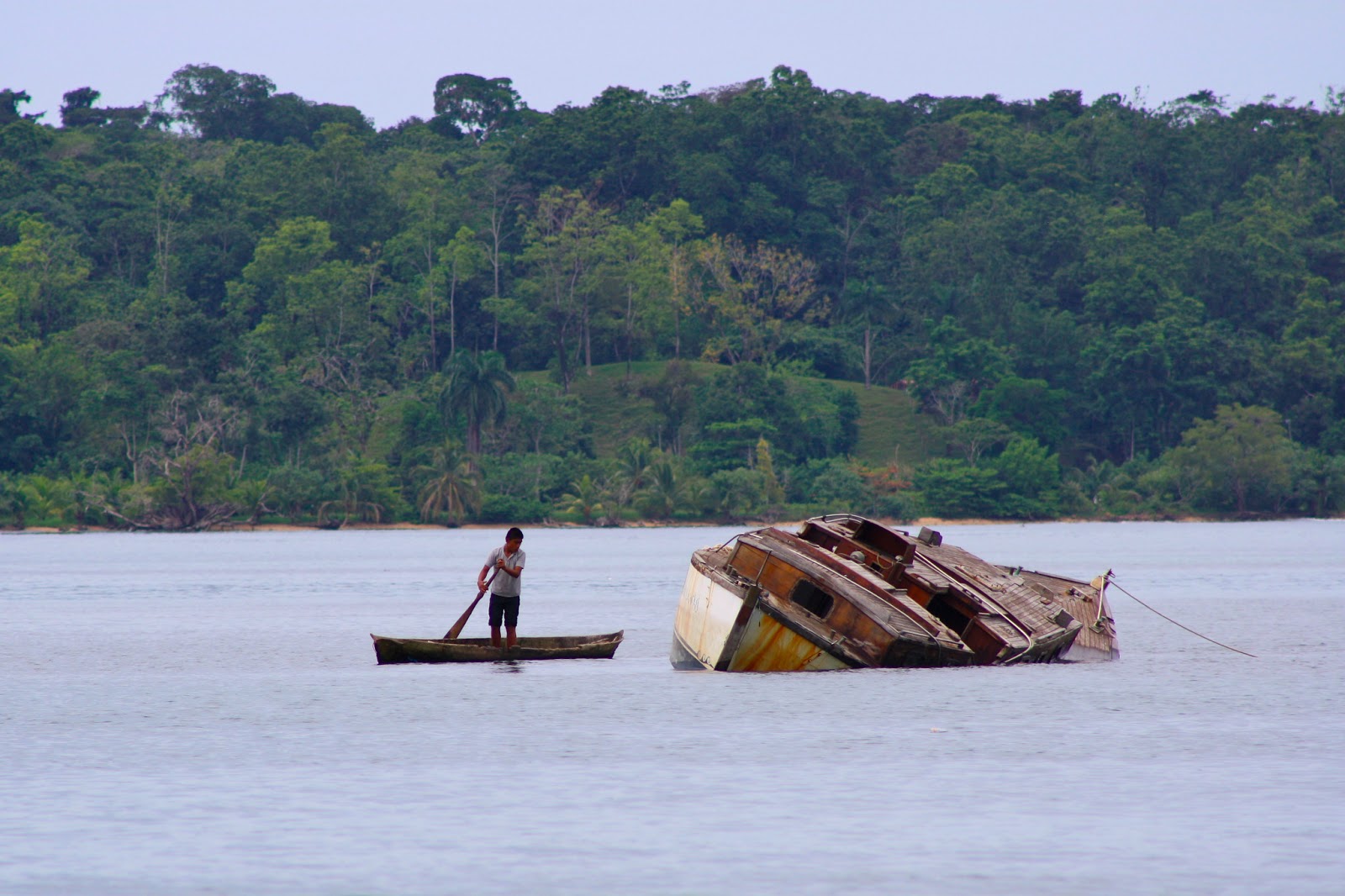
Day 13: Sunday in Panama, feeling Hemingway-esque on the back deck/dock of the Hotel Brisas. Everything is draped with a veil of humidity and the slow, forgotten air of what Pico Ayer calls “tropical classical.” Bocas in the off-season is a town of potted palms and old-fashioned furniture and mahogany bars built with grandiose notions, a place where you feel there should be literary ex-pats smoking cigars and drinking rum. But they aren't here. Instead the décor has become faded, dusty; half-crumbling but clean nonetheless in hope of attracting backpackers and sailors on the prowl for cheap drinks and beds where you can hear the waves lapping at a dock. Here at the back of the Hotel Brisas, a girl in a floral dress sketches at a table, Jesse and I sit reading and writing on a bench piled with pillows and a white-haired man with a paunch and a ponytail sings King of the Road while strumming a guitar. Several sailboats are anchored in our view, with pelicans landing on their masts, and a man in a dugout canoe poles his boat between million-dollar yachts looking for fish.


Day 15: Crossed the border back into Costa Rica and drove to the town of Manzanillo, then hiked 8K through the Gandoca-Manzanillo Wildlife Refuge to Punta Mona, where an 80-hectare experiment in low-impact, off-grid living and permaculture design welcomes guests to sleep under a thatched roof that brings ocean breeze, moonlight and the sounds of the jungle into your bed. It is one of our last nights here, and we are spending it the way we've come to like it: candlelight, mosquitos and the sound of water. 

 
Day 18: In the air en route to Atlanta, Jesse gets up to use the bathroom. Across the aisle sits a Swiss gentleman in a suit with a clean-shaven face and a wedding band and neatly clipped nails typing on a laptop. Then Jesse comes back to his seat, endearing in his one clean shirt, wrinkled khakis and hole-ridden Converse All-Stars, a month's beard sworling on his jawline, blue eyes bright in his tanned face, and I notice that at some point over the last month I have fallen in love with him.


Thursday, November 15, 2012

central america journal, part 1


Jesse and I fly over the turquoise and azure sweep of the Belize coast, heading south for Costa Rica – the “rich coast,” one of the most biodiverse places on earth. Bouncing through the sky, it seems that everyone carries an iPhone, laptop or tablet, and though I feel somewhat lost without the internet at my fingers, it is freeing to travel with no electronics besides my camera. I will be unreachable by phone or email. I will not be blogging or posting or tweeting or texting. I will get lost in the world. The customs form requires us to list the hotel or street address where we'll be staying, but we don't have one – nothing has been booked, no plans made. Just 18 days and some money in the bank and a guidebook in hand. 

We arrive in San Jose and bungle our way through a car rental, realizing that even in a country well-adapted to tourism, our limited Spanish is going to be a stumbling block. Realization number two: navigation skills are useless when roads aren't identified, and of course, being map junkies, we've decided to forego the GPS rental.

“There are two types of people on these roads who don't know what they're doing,” Jesse says, narrowly avoiding yet another accident. “Drunk people, and white people.”


When we finally get our bearings, Jesse drives through a torrential downpour and avoids hitting pedestrians while I marvel at the banana plantations, the clouds rising from thickly forested mountains, the men on the roadsides selling fruit. We stop at our first soda and order rice and beans with gallo pinto from a young woman who watches with wry patience as we figure out currency and menu translations. Then we turn off the highway and, around dusk, find ourselves passing through a town not named on our shoddy map, high in the cloudforest and curving around a single, sinuous road above a green valley. It's Monday evening, following a storm that cleared the day's heat, and everyone in the village seems to be out, gathering in groups on doorsteps and at the ends of driveways, mothers with babies on their hips, men clustered around the counter of the store drinking beers. There is a feeling that this mountainside village could exist nowhere but Central America. We've made it. 

As the sun sets, we pass out of the mountains and into the town of La Fortuna, newly emerging as a tourist gateway to Costa Rica's outdoorsy region, full of ads for rafting, ziplining and canopy tours. We ignore the signs, find a cheap room and fall asleep splayed across the threadbare mattress, a long way from home. Alaska feels like a different world, a different lifetime. 

Day 2. Wake up hot and sticky, with creaky fan overhead doing little. Skip breakfast and gun it out of La Fortuna, quickly turning onto a rocky backroad that we think will take us to an off-grid ranch we want to stay at. The hills are green and rolling, flecked with livestock and horses, and the red-dirt roads intersect broad fields and farms of wind turbines. It is lovely. But soon the roads get sketchier and I get tired of driving. We've been traveling for three days now and I just want to be somewhere. Grouchiness, lostness and incomprehensible conversations in Spanish ensue. Then Jesse spots a paved road in the distance, and finally, after three hours of serious four-wheel driving, we spot a sign for La Carolina lodge, 28k away. It might as well be a sign for heaven. 


Day 3. A different morning entirely. We wake up shrouded in mosquito netting, curled in a soft blanket after sleeping to the sound of rain beating against the metal roof. Breakfast is at 7:30, so I throw on a pair of shorts and wander barefoot to the open-air kitchen, where the cookstove, stone oven and huge wooden table are. I pause to study the surreal tropical botany exploding all around. Then – a tin mug of rich coffee with steamed milk, fried eggs, rice and beans, homemade bread and slabs of homemade cheese, some kind of tangerine-like fruit and a pitcher of fresh squeezed juice magically appear. Later, when Alejandro takes us on a horseback ride around the ranch, we learn that everything served is produced right on this land, from the coffee beans to the butter. 


Because it's the rainy season, we had our choice of cabinas, and chose one so high on a hill it's practically in the trees. From our wraparound porch, we see (and hear) howler monkeys, bats and hummingbirds. The river flows just below, and the sound of rushing water mixes with tree frogs and cicadas to create our evening serenade. At dusk, someone comes around and lights hundreds of slender white candles along the paths and by our bedsides. There is no electricity. It's part jungle lodge, part ranch, part monastery. And it's a short drive from Parque Nacionale Tenorio, home of the Rio Celeste. No words needed. See below. 


Day 5 starts off unpromising. Being travelers with more time than money, our explorations are hit or miss: some fantastic gems, like La Carolina, and some duds, like the Rancho Leona in the tiny town of La Virgen, famed among multiple guidebooks as a hotspot for whitewater kayakers. Waking up in our cockroach-infested room at Rancho Leona, we find it just as dreary and deserted in the daylight as it was when we arrived the night before. Vestiges of its past lie dusty and abandoned in the morning light: a 2009 NRS paddling catalogue, a cobwebbed stack of board games, the dried-out tiles of what was once a hot tub on the banks of one of the premier kayaking rivers in Central America. Driving here late the night before, Jesse and I expected a colonial river town in the middle of a jungle. I went so far as to envision a hybrid of Mark Twain's Mississippi and a remote Amazonian lodge, imagining we'd stumble out of the dark, push open heavy double doors and be greeted by a ragtag group of international kayakers throwing back shots of rum.

Instead – a long drive through what might count as suburban sprawl in this region, except seedier and more rundown – one town melting into the next, streetlights, small stucco houses, girls squeezed into mini skirts walking the roadsides toward a disco. Sodas with bright, fluorescent signs. Nothing quaint or charming about any of it – although, to be fair, it was probably more “authentic” than many of our more idealistic stops, typical of a Costa Rica transitioning from rural to urban. It was interesting to see but also left us wondering, as we pulled into the dark, empty parking lot of Rancho Leona, if we'd be able to find anywhere to sleep in this tourist-free area.

I stayed in the car while Jesse gave a tentative knock on the door. A light came on, and a bored-looking young man tore himself away from his TV and offered us a room for $12. Despite it being the rainy season – a time when the Rio Sarapiqui should have been running high – we were clearly the only visitors. We dropped our bags and went to the soda next door to eat frozen french fries and watch a Latin American game show on mute. Thankfully they had beer.

In the morning, the mighty Sarapiqui River behind the inn (“its prime riverside location allows for easy launches,” raves the latest Lonely Planet about the inn) turns out to be a muddy trickle guarded by a pitbull. The hearty breakfasts and onsite kayak rentals are non-existent.

Later, we meet up with Alex Martinez, a guide and environmental activist who tells us over glasses of freshly-squeezed soursop juice how the 2009 earthquake shifted the path of the Rio Sarapiqui, the owners of Rancho Leona split up and three upriver government-owned dams dealt the final blow to the burgeoning community of kayakers setting up shop in La Virgen. It became a recurring theme on our trip. Though Costa Rica is known as a nature-lovers paradise, its nature is becoming ever more regulated by a government dedicated to ecotourism, which means, ultimately, economic growth.

Thankfully, there are still people like Alex's son Kevin, a strikingly good-looking kid with green eyes and curly hair who is equally well-connected with the outdoor adventure crowd and environmental activist groups in Costa Rica. While he pours us more juice, juggles calls on his iPhone and points out obscure birds, he also makes plans to transport a boa constrictor captured by a farmer to a nearby wildlife refuge and, along the way, introduce us to a friend of his trying to set up a campground on family land.

Camping in most of Costa Rica is rarer than the endangered resplendent quetzal. Throughout our travels, Jesse and I met a number of DIY backpackers who'd come to Costa Rica with a tent, sleeping bag and hiking boots and, like us, planned to dirtbag around the country camping on beaches and in jungles. We didn't want facilities or running water or platforms, just an uninhabited place where we wouldn't get in trouble for pitching a tent. Costa Rica is known for its national parks and wildlife refuges, so surely, backcountry hiking and camping would abound. Right?

Ticos told us that camping was a bad idea due to poisonous snakes and bugs. Foreigners told us it was a bad idea due to crime and theft. Most national parks are so over-visited that they don't allow camping at all, and when they do, you need to hire a local guide to sleep anywhere beyond the ranger station. As we continued to explore by foot and car, we found virtually nowhere that catered to the kind of DIY backpacking we were used to. Even if we'd snuck into a national park with backpacking gear, rangers scoured the trails well before dusk to ensure that all tourists were returning to their vehicles. There were a few “deluxe camping experiences” for $80 a night, where linens and food were provided in a safari-style tent, but we quickly came to realize that the kind of nature lovers catered to in Costa Rica tend to be more take-a-week-off-of-work-and-sign-up-for-a-guided-tour types than sleep-on-the-side-of-the-road-and-eat-canned-beans-for-months types.

Which is why, on Day 5, we were so thrilled to learn that Kevin Martinez and his friends are trying to start a kayaking business, build a riverside campground and protest against government dam building on the last free-flowing rivers in the country. Jesse and I officially became the first guests to camp at an unnamed campsite on an unnamed branch of the Rio Sarapiqui, and the experience stands out as one of our best in the country. We followed Kevin down a dirt road, walked down a path behind his friend's mom's house (no one was home) and set up our tent and hammock in a sandy clearing on the banks of the river. And then, miraculously, we were left alone. No one was trying to sell us a guided nature walk. No one was making us sign a waiver to use the rope swing at our campsite. We had no company except a yellow dog and a little boy fishing from an inner tube. For the entire afternoon, we wandered up-river, through farms and pastureland, over braided cobbles and deep pools, along steep walls of rainforest vegetation. It was marvelous. 


In the evening, we realized how incredible the fledgling campground really was: while it seemed remote and pastoral, it was within a ten-minute drive of Puerto Viejo de Sarapiqui, a seedy banana town on the Nicaraguan border. While our camping gear sat unmolested on the tranquil river, we walked the main drag in town with our mouths slightly agape at the colorful storefronts selling everything from chickens and piles of rambutans to washing machines and high-heels. Couples cleaned up for Saturday night came in from the fields on old motorbikes, families ate fried chicken and drank liters of Pepsi, teenagers giggled into cell phones, men hawked cheap plastic goods and the entire town seemed to pulse with colorful, sweaty, vibrant life. We walked up and down the street taking it in, while unbeknownst to us, our host at the campground had come home from work and was busy lighting the path to our tent with white votive candles. 

Day 6: A several hour drive to the coast takes us to the rough, corrugated metal and shipping barge town of Puerto Limon, hillsides crammed with shacks, drunk men yelling at our car as we pass. Further south, we stop at a sloth sanctuary, where two- and three-toed sloths hit by cars or shocked by power lines are rehabilitated to live in captivity or be released to the wild. There is a canoe ride through lazy sloughs, where we see wild sloths, howler monkeys, bats, lizards and birds. Despite being somewhat wary of tours, I have to admit that it was well worth it. Our guide spotted more wildlife than we ever would have on our own, and I learn a ton about sloths. Such as this: contrary to popular belief, sloths only sleep about eight hours a day. They come down from the treetops once a week to defecate and urinate; they are descendents of giant prehistoric sloths and they have nine cerebral vertebrae, allowing them to practically swivel their heads. Even giraffes only have seven.


Day 7: The Caribbean town of Cahuita is picture perfect, and after a dinner of fresh fish and cocktails with guaro, a local cane liquor, we wander into an open air bar where a group of a dozen or so people sit on chairs and couches watching a so-awful-it's-good 1960s B-movie on a projector. Soon it's evident that the guy who played the sleazy sidekick to the villain is sitting on the couch celebrating his birthday. Long gray hair, board shorts, rum cocktail in hand, he's a typical expat who tried his hand in Hollywood but found this remote surfing outpost more to his liking. Whenever his character makes advances on the female lead, the Tico men roar and cheer and slap his arm. The movie is about a violent motorcycle gang wreaking havoc on a poor bean picker's family in the Florida everglades, and Jesse and I sit and watch it with its co-star in slight disbelief that we've stumbled upon this. 


The next morning, we chase storms and howler monkeys down the trail in Cahuita National Park. The storms never materialize into more than distant lightning and a steady rain, and Jesse and I retreat into the warm, aquamarine water while raindrops pattern the sand. It's lovely, until a couple of rangers come to kick us out of the park because the weather is bad. I grumble again about the over-regulation of the outdoors here, wishing I could be left alone to float on the waves or camp on the beach or even, god forbid, snorkel without a local guide, which signs everywhere forbid. I understand that to maintain an environmentally-friendly economy based on ecotourism, local people need to find work in the industry, and that to keep the rainforest looking pristine, strict regulations are needed to prevent tourists from trashing and over-tramping it, but to be honest, it doesn't feel like there's a waterfall left in the entire country that you don't have to pay an admission to visit. Plus, I hate being told no. I am willing to accept limitations and act responsibly, but a week into this trip, I'm sick to death of the prohibitive signs. No swimming. No jumping. No walking off the path. No snorkeling without local guide. No camping. I'm reminded of an essay I read recently by David Sobel in which he laments the fact that for environmental education to conserve and protect while catering to ever-growing numbers of people, it has become decreasingly hands-on, turning the natural world into a look-don't-touch experience. I want to climb trees, dive under waterfalls, catch frogs. And increasingly, Jesse and I do. Just not when there's a ranger around.


Day 8: Breakfast at our small hotel, a spread of white china while classical violins and tropical birds play off each other in the background. The table is on a breezy veranda shaded by flowering bushes alongside a creek. The owner sits for hours looking at the ocean, smoking, and painting bowls of fruit and Afro-Caribbean women onto canvases that he later hangs on the walls. 

We leave Cahuita and continue south down the coast to the party town of Puerto Viejo de Talamanca, a backpackers paradise with more $3 breakfasts and two-for-one drinks and food specials than you could ever eat, more cheap funky hostels and huts than you could ever sleep in, and enough locals and unpaved roads to make it still feel a bit off the beaten path. For $9 a night, we rent one hammock strung in a row with about 50 others under a metal roof.


Now, I lie belly-down in the sand on the beach, entirely captivated by this place, entertaining notions of staying for a few months, working at a hostel, learning Spanish, surfing every day. By this point, we've realized that our ambitious plan to road trip the entire country is unrealistic, and we decide to focus the rest of our trip here on the Caribbean coast, eventually making our way down to Panama. Memories of the B-movie from two nights ago flavor my perception of this place, making it feel like one giant B-movie set: blurry around the edges, tinged with a nostalgic feeling that you've stumbled upon something that no longer really exists. You hope that dirtbag backpacking destinations like this, cliched though they might be, will hang on despite the ever-growing pressure of a sleek, copyrighted world intent on monetizing and regulating and growing with cancerous efficiency. You hope that there will always be places that rebel against all of that.

The hollow thump of the ocean pounds the sand, ghost crabs scuttle into their holes, and white foam from the waves slips backs to the sea like oil on a piece of glass. I close my eyes and dream.


Nature Blog Network