Labels

Showing posts with label places. Show all posts

Monday, May 19, 2014

slot canyons and sweet desert spring.

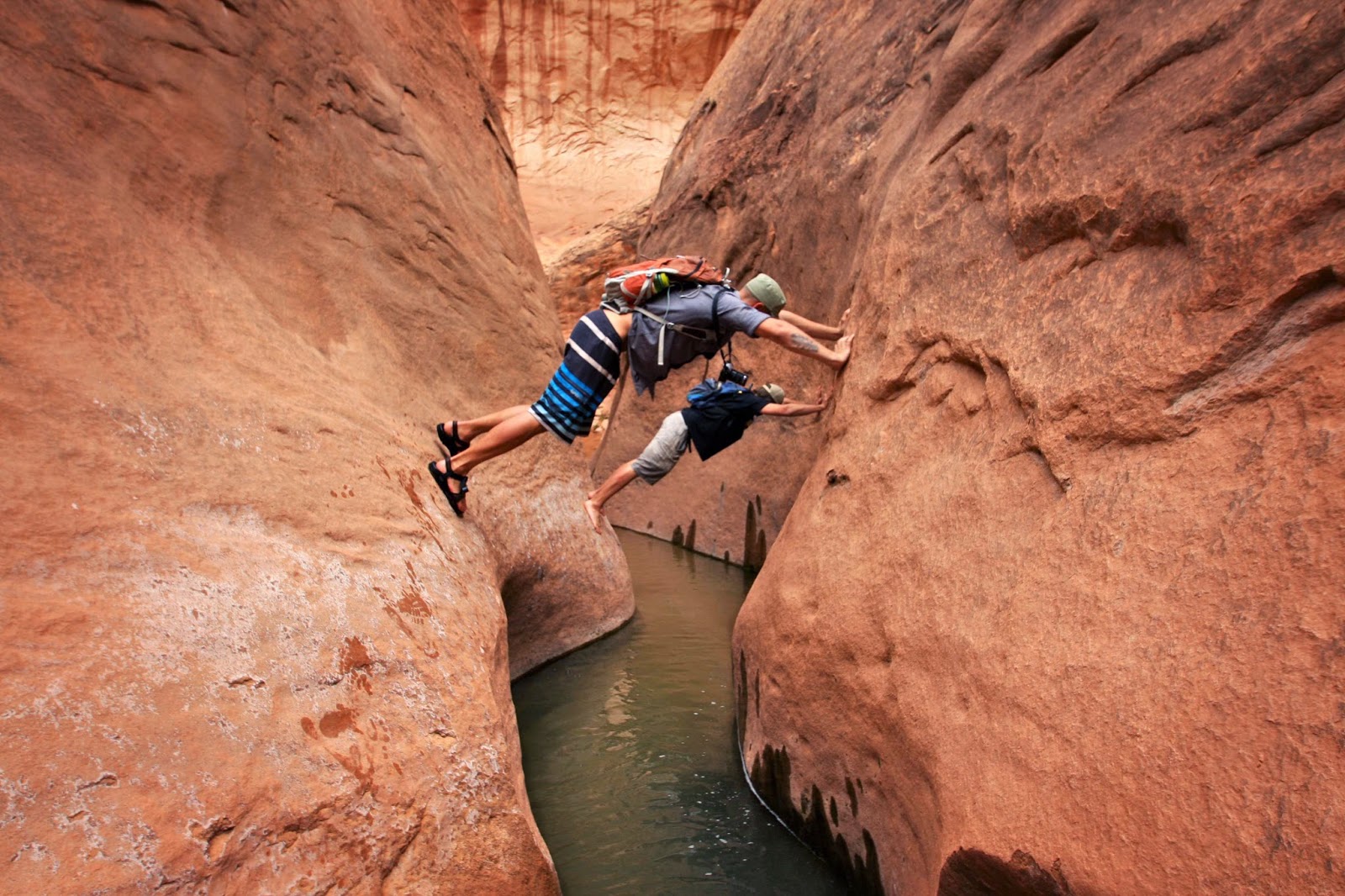
 Some long overdue photos from Easter weekend in Grand Staircase-Escalante National Monument, Utah.


Saturday, March 29, 2014

Scenes from Paonia and nearby


28 Jan. 2014

It occurs to me, lying in bed with the silence of the house pressing around and the moon shining through the curtains, how easily I acclimate to being alone. Jesse is in Peru for six weeks and the solitude comes back as naturally as breathing, which is both reassuring and a little frightening. There are people from other places and other times that I consider good friends, and yet we interact rarely — they're like ships on a sea, summonable if I capsize but mostly just distant lights on my horizon. I go through my days independently, interacting mostly with the people who happen to be here with me in this place, at this time. Our orbits have randomly crossed, and while I'm grateful to walk into the brewery after work and know at least eight people by name, some bitter, cynical part of me can't forget that before long, they'll be gone from this place and so will I. We are all transient and rootless, all following our own paths. Sometimes I have to remind myself that that doesn't make our time here less meaningful.

1 Feb. 2014

Today I drove to Crested Butte, taking the longest of the three possible routes because the other two were blocked by snow. The drive to and from Gunnison was lovely, and the valley up to Crested Butte even more so — worn wooden barns tucked against hillsides, a cloud settling into the muted pink sky, a deepening dusk punctured by the lights of town. I have a drink at the bar where my friend works and talk to an older man, an engineer. Crested Butte is still a little funky and not as gaudy as some Colorado ski towns, but still clearly wealthy, with log beams and pricey boutiques. I am happy that I can drive here for a visit and happier still to come home to a town shaped by people who actually live there. When I'm wakened at night by the whistle of the coal train as it passes through Paonia, I sleepily smile that I live in a place where people still work with their hands in the earth.

8 Feb. 2014

It's been snowing on and off for a week now, a real winter like I haven't had since that one in Vermont — that winter carrying armloads of wood inside, clomping up the stairs in heavy, wet boots, driving up the hill after work and getting out of the car and standing for a moment in the frosted air on the mountaintop, my head tilted to the stars, the night perfectly still. This winter is different — I'm in town, for one thing — but every morning I wake up to a fresh inch or two of snow.

This morning I drink coffee and listen to KVNF as more snow falls outside. There's an old guy named Don doing the Saturday morning children's show, reading a story about going owling in the forest. Don struggles with the broadcasting technology and there's dead air but it's endearing because he's old, and has a sidekick named Wally who keeps saying, 'Yeah, Don. Yeah.' And Pete Seeger died and they play Pete Seeger songs, and then they talk on the phone to an 11-year-old boy and discuss pancakes and sledding and school. The boy gets to shoot .22s for science class. When a baby is born, Don and Wally welcome him or her over the radio and play a song called "You're My Little Potato." Life carries on. The seasons change.

14 February 2014

Walking to Joanna's house on a February night, carrying a jar of wine in my coat pocket, it feels suddenly like spring — a mild weekend coming in. The moon is nearly full and the streets are quiet, houses glowing from behind curtains. Faraway, a dog barks. Melting snow drips off a rooftop. Below the street, fresh snowmelt gushes through a sewer. How can such an ordinary night be so beautiful? Bare branches; grainy snow giving way to bare ground; a smell of wet soil and cold water in the air. Sometimes I love this place too much.

One Sunday in February

I've come to the edge of the San Juan mountains to stay in a friend's cabin for the weekend, and the snow is nearly gone, the landscape brown and soft. This is my dream: To not know or care what the date is; to wake up and sit outside on the steps of a cabin with a book and coffee in a hand-thrown mug; to feel the air on my face and hear, maybe, the rushing of water or of wind; to see the birds and the mountains, or maybe the sea. If this could be my morning at least one day a week, Lord, I will not complain about the other six. I will be happy.

Let this be my Sunday; let this be my church: morning sun, cold air, birds and a cup of strong coffee.

"And I will be to her a wall of fire all around, declares the Lord. And I will be the glory in her midst."
--Zechariah, 2:5


Friday, March 28, 2014

the in-between places.


"How much time does it take for place to seep in, for the here to quell the longing for the there?" -Rebecca Durham

Sometimes I ask how I have come to love this place, this stark, open land, sagebrush stabbed into its sandy soil, cracks and fissures splitting the earth. Coming from the rich and fertile coasts, where everything grows wild and green, where we bend to yank weeds from the ground — how did the people who came here before give that up for a place where every tendril of life must be coaxed from the earth, where the only plants are gnarled and stunted; brittle bits of life that thumb their nose at excess and fertility? Why did they stop moving and say, Here. This is the place.

There is no explaining why places like this get under our skin — not quite desert, not quite mountains, just a wild, lonely in-between. In in a time when the most hospitable places have been flattened under a sea of asphalt or privatized by the wealthy, I wonder whether these expanses appear less like wasteland and more like refuges. If our circumstances cause us to see not desolation but possibility.

I think briefly that must be so, and then I wonder again about the people who came here before. There's more to it. There's something in our soul that yearns for this.


Monday, March 10, 2014

Here in the North Fork Valley, at about 5,600 feet, it feels like spring. There are robins. The sun is still shining when I get home from work. The river is brown and churning and smells like wet earth. 

Today I went for my first good bike ride of the season, feeling every one of my leg muscles on the uphills and grinning wildly on the downs. I passed stiff-legged newborn calves blinking in the bright light and donkeys standing placidly in fields, smiling at the earth. Horses kicking their hooves in sheer joy. I know how they feel. Spring -- even false spring, with more wintry weather likely to come -- stirs a kind of happiness so distinct it should have its own name. Sun on your cheeks. Bare skin. The smell of dirt. One of the reasons I like a good hard winter is so I can really appreciate spring when it comes.

Nothing -- absolutely nothing -- makes me happier than the changing seasons. I thrive on change, and if I can't travel as often as I like or pack my house up every six months, I've decided I must live somewhere with four seasons. Three times in the last decade I've skipped winter (in Hawaii, the Marshall Islands and New Zealand) and now I've sworn to never again live without months of cold and snow; without wood fires and soup-making and early nights. Without winter, there couldn't be fall or spring. Everything would be the same all the time, stagnant and warm and boring, the same foods and the same smells. I won't have it.

It's false spring in the valley, but up in the mountains, at 11,000 feet, winter still holds fast. Last weekend I went to a friend's cabin the day after a storm and backcountry snowboarded through deep, fresh powder for the first time ever, cutting S-shaped tracks through unbroken alpine meadows. Holy god. I'm a convert.

First we skinned and snowshoed up through the clouds:


At the top, the clouds began to lift, and my lungs and legs were burning. I swore I'd only ski down once, because no way in hell was I hiking back up:


Ten minutes later with a shit-eating grin on my face, I gamely turned around for another run. The clouds broke up like ice from a river:


Best. Skiing. Ever.


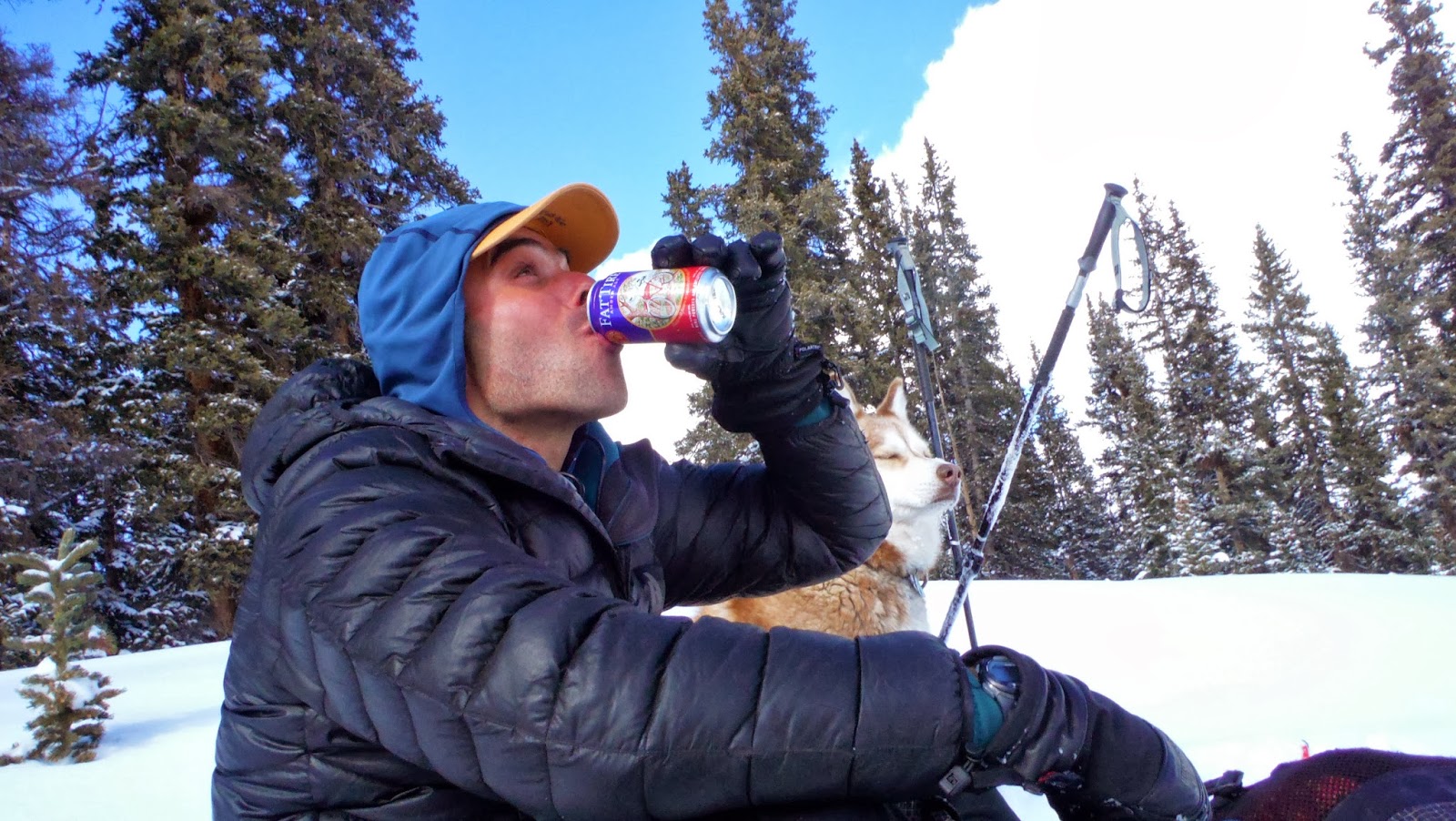
A man, his dog and a beer in the alpine sunshine. I don't think anything could be better.


Life is so beautiful lately I wish I could stop time and prevent anything from marring this perfection. But I know the darkness is inevitable, and I'm not afraid. Spring will always return.

Sunday, November 10, 2013

Smoke and rain: dreaming and adapting on the Western slope

My life is the story of water. My cells, my mitochondria and nuclei and DNA swim in pools of water. It drives me forward, pulls my feet toward its source: a waterfall in the jungle, a crystal pool high in the mountains. I drink it in deeply, let it fall over me, into me, around me, and still I lust for more.
IMG_1449
Perhaps it’s because I grew up in New England, among trees and gardens fed by a generous sky, but for whatever reason I am drawn to the wet places of this world. After college I spent a year in the equatorial Pacific, and in a country of parched white beaches where nothing grows but palm trees, I was assigned to the one island with swampy taro patches and thick creeping jungle. While other islands suffered from drought, the seams of my clothing rotted in the humidity.

Since then, I’ve moved like clockwork. Every six to 12 months I go looking for a new job, a new adventure, and until now, I’ve always gone to places with heavy rainfall — the eastern shore of Hawai’i; the temperate rainforest of Southeast Alaska. Last year I surpassed even my own standards, finding myself in one of the wettest places in the world: Fiordland, New Zealand, which receives an average of 22 feet of rain a year. After  six months there, though, I felt waterlogged and weary, ready for a chance to stay in one place for a while. I’d moved 15 times in nine years.

So when learned I’d gotten a writing job in Paonia, I didn’t hesitate to fly across the world and pack up the car that I’d left at my mom’s house in New England. I headed West to chase my dreams, to find my own Big Rock Candy Mountain, following the tracks of others who’d made this migration before. The morning I left New England, tendrils of fog snaked through valleys and around barns, softening the dawn light. Then the rolling hills of the East gave way to the stubby fields and industrial cities of the plains, and I considered for the first time of how I’d adapt to life in an arid country. I knew almost nothing about Paonia except that one former editor had described it as “very nearly perfect.” But perfection, of course, is a matter of opinion.
IMG_1461The journey West was once a journey of no return, an exchange of the known for the unknown, the tame for the wild, cities for open spaces. But as the West changes, these truths become less and less so until only one remains: moving from East to West means moving from wet to dry. It means leaving a world of abundant water — water so pervasive you can feel it on your skin, see it beaded on every blade of grass — to a place where you cannot legally cache your own rainwater because it’s such a precious commodity. ...

 ... Read the rest of the essay in North Fork Scrapbook, on online record of life in the North Fork valley that began as a response to the proposed leasing of public lands here for oil and gas drilling:

http://www.northforkscrapbook.org/features/smoke-and-rain-dreaming-and-adapting-on-the-western-slope

Wednesday, November 6, 2013

Does reality TV change the reality of Alaska?

Four years ago, when I was 25, I went to Alaska to work as a wilderness guide. I bought my first pair of XtraTuf boots and my first set of head-to-toe rubber rain gear, and between seven-week trips in the backcountry, lived above a Laundromat that smelled perpetually of halibut.

The first spring, my boyfriend and I celebrated the returning light by taking a trip to Juneau to go skiing. Only it rained the whole time, and instead of skiing we sloshed through the alleys and backstreets, lingering in bookshops and stopping at every coffee shop we could find. The last night before catching the ferry home, we stayed at the state’s oldest hotel, The Alaskan. Even on a weeknight, the bar – a former speakeasy – was utterly raucous, and the adjoining hotel was much the same. When it first opened in 1913, the building operated as a thinly-veiled Victorian brothel, and in 2010, if you squinted your eyes just right, you could imagine that it still was, that the man with the stained white beard spinning across the dance floor had just paid his tab with a sack of gold flakes and would soon slip upstairs behind a woman's lace stockings.

The wallpaper was yellowed and peeling, the wood floors scuffed and creaky; the entire place smelled faintly of spilled beer and musty sheets. The walls were thin – in most rooms, you fell asleep (or passed out) to the sound of boot-stomping fiddle music drifting from the bar. If you were in Juneau and wanted a good night's sleep, you went to the Westmark or the Best Western. If you wanted an experience to remember, you went to The Alaskan.

That was before the reality TV craze struck Alaska, turning the Last Frontier into something akin to the “Real Housewives of Orange County.” This year, in addition to “Deadliest Catch” and “Alaska State Troopers” – the old standbys – the 49th state is getting “Alaska Gold Diggers” (five Newport Beach women reviving their grandfather's old mining claim), “Ultimate Survival Alaska,” and an episode of “Hotel Impossible,” a show in which an interior designer and a consultant give hotels the touristic version of an extreme makeover. The show has been to Alaska before, to Yakutat's Glacier Bear Lodge, where celebrity consultant Anthony Melchiorri, an admitted germaphobe, was appalled by the old carpets and fish guts outside the doors. The owners reportedly spent $100,000 on renovations following his suggestions, and occupancy rates increased only 1.5 percent.

... Read the rest of the essay at http://www.hcn.org/blogs/goat/does-reality-tv-change-the-reality-of-alaska
Alaskan 2

Monday, August 12, 2013

The Great Chicken Dump

The joys of small town life, and my favorite HCN blog to date:

The news infiltrated the High Country News mothership like a cute animal video (which editors Sarah Gilman and Betsy Marston are particularly fond of) and spread through the North Fork Valley faster than a stomach flu. Soon, from the barstools of Revolution Brewing to the ratty couches of the HCN intern house, the Great Chicken Dump was all anyone in town could talk about. More than 100 hens had been found clucking and wandering around a dusty mesa above town, and no one knew quite how they had gotten there.

Not since the infamous 2012 confrontation between the billionaire (Bill Koch) and the hairdresser ("Tiananmen Sid") have the North Fork’s collective feathers been so ruffled.

“THESE CHICKENS WERE CLUELESS HOW TO SURVIVE ON THEIR OWN,” wrote one woman (determined to express herself in capital letters) on Paonia’s unofficial Facebook page, where there are over 300 poultry-related comments and counting. “THE FEW THAT KNEW TO GET INTO THE BRUSH AND NOT STAY IN THE OPEN DIDN'T KNOW TO EAT A RIPE SERVICE BERRY IN FRONT OF THEIR NOSES.” And so a herd of Paonians headed up to the mesa to take matters into their own hands, rounding up the hens and searching in the chicken scratch for clues. For breathless hours, the chicken dumper remained at large....

https://www.hcn.org/blogs/goat/paonias-great-chicken-dump-raises-the-question-what-to-do-with-all-those-birds

Monday, July 1, 2013

fires in the west, or, durango-to-paonia journal


Friday, June 28: Durango

I woke up early this morning to the smell of smoke drifting in through the open windows, diffusing the bright morning light that usually wakes me. Drowsily, I thought to myself that if Durango was on fire, at least I was ready to evacuate, my belongings already filling Jesse's truck in preparation for my move to Paonia. Then I fell back asleep, and tossed in and out of strange dreams tinged with the smell of smoke. 

It is slightly surreal to continue sleeping while smoke seeps in your window, but that's what life is like in this part of the country, at this time in history, when southwestern wildfires are burning hotter and brighter than ever before due to a century of forest mismanagement, increased beetle kill and climate change.

When I woke for real, the first thing I did was turn on the radio – every small community should have a local public radio station, a fact which becomes ever more evident in the midst of natural disasters. Luckily, KSUT reported that there were no new fires, just an inverted weather pattern that was sending smoke from the Pagosa Springs fire (to the east) south to New Mexico then back north to Durango. Smoke that smelled dry and acrid, like pine needles underfoot on a hot day, was swirling around the Four Corners – a misnomer itself, for there are no real corners here, only rolling dusky foothills and ponderosa pine valleys and sensuously carved sandstone; mesas and plateaus and mountains, washes and gullies and hoodoo rocks.

Driving north out of Durango with a fully loaded car reminded me of my drive through western Massachusetts and New York state six weeks ago. With the windows up, the hazy, smoky air settling over ranches and fields looked almost like the early morning fog that followed me out of New England on my journey west, a mist that snaked through dewy valleys and around red barns struck by early morning light.

But there was one major difference. One haze was born of moisture, and one of its absence. I left a world of abundant water – water so pervasive you could feel it on your skin, see it beaded on every blade of grass – to a place where you cannot legally cache your own rainwater, because it's such a precious commodity that it belongs not to the landowner, but to the state.

It was 99 degrees at 11 a.m. when I drove through Montrose, and the radio hose called the weather "crispy." It was an apt description. I've never lived anywhere before where the weather could be described as crispy, like a french fry pulled from the oven, but that's what it felt like.

Saturday, June 29: Paonia

Last night a mosquito landed on my arm while I was in bed, and I fell asleep to coyotes howling and the whistle of the train. This morning, it's hard to get out of bed, because the sliver of sky behind my curtains is gray with clouds – a welcome change from the ceaseless blue of Durango skies. I dreamt about rain again last night, again. When I lived in the steamy Marshall Islands, I'd dream that I was swimming in the ocean toward a distant iceberg, blue and irridescent, and I'd swim up to it, treading water at its edge, licking it gratefully. In some versions of the dream, the glacier turned into an ice cream cone.

Here, my dreams are not of respite from heat but from the dryness. Last night I dreamt I walked out of a grocery store into a mundane parking lot made miraculous by rain pouring from the sky, gathering in puddles. I walked slowly with my head tilted up, letting it wash over me.

Paonia is 150 miles north of Durango, but a different environment entirely. This valley is green, full of orchards and vineyards and farms. My new road – Box Elder Lane – is shaded by huge old maples, and stepping barefoot onto the back steps this morning, an unbelievable smell rose to greet me – warm moisture, green growing things, and a few fat raindrops splattering through the leaves. The rain didn't last long enough for me to roll up the windows in my car, but the smell it brought – the wetness of warm streets and gardens and lawns – smelled like home.

Sunday, June 30: Paonia

As I type my journal entries onto the computer, thunder rolls through the valley, and the sky is thick with clouds. It rained today, really rained, hard but brief. People tell me it is the start of monsoon season. Having lived nearly all my life in wet places, I never thought I'd rejoice for rain. But when it comes, I run for the door and stand outside, as if in a dream.

Addendum: Last night, 19 firefighters died fighting a wildfire in Arizona, the deadliest wildfire in the U.S. since 1933. 

Smoke from the fire near Pagosa Springs, Colo.

Monday, June 10, 2013

Sunday at the Bookcase

 
For a town of 13,000 to 18,000 -- depending on the season or who you ask -- Durango, Colorado sure has a lot of book stores. There are at least five, not counting the handful of thrift stores that also sell used books for a quarter each. Equally prolific in this transient, high desert town are interesting characters who could be found in the pages of a book themselves, and the combination of fascinating people hanging around funky bookstores makes it far too easy to lose track of time here, especially on a hot Sunday afternoon.

Last Sunday, sticking to my bike seat in the 90-degree heat, I rode to a tiny storefront called the Bookcase with the intent of asking the owner if I could take her picture. Quick in and out, I thought, then on to dinner with friends. But a tall lemonade, free book and hours of conversation later, the heat of the day had faded into cool evening and I was still there.

I fancy myself something of a bookstore connoisseur, having grown up in a part of Massachusetts that the New York Times once called “the most author-saturated, book-cherishing, literature-celebrating place in the nation.” My favorite bookstore in the world is the Montague Bookmill in Montague, Mass., but in my travels I've come across some other good ones as well. While I don't think much of the highly-touted Powell's City of Books in Portland, Ore.  (a bit overwhelming and lacking in character, if you ask me), the Old Inlet Bookshop in Homer, Alaska is completely my style -- disorganized, cheap, with an compelling and knowledgeable person behind the counter. So is is Observatory Books, a Juneau-based shop that specializes in old maps and Alaskana. Or Lion Heart Book Store in Seattle, or Back of Beyond Books in Moab. Finding these places is one of my favorite things about traveling. Everywhere I've been, from Brooklyn to Burlington to Berkeley, I come across these beloved, ramshackle shops, places with creaky floors and enough dust to cause an allergy attack; places that persevere against .99 cent books from Amazon and quietly retreat to back alleys when rents go up downtown; places that barely scrape by financially but invite you to partake in that modern rarity, browsing leisurely without knowing that you'll find.

Rarely, though, do my traveling companions have the desire to spend hours among yellowing books, so I often only get a taste of what these stores have to offer. Each one leaves me yearning for more -- wondering at its history, wondering what I missed hidden in that back room, wondering what possessed the owner to take up such an enchanting but financially disastrous enterprise. I've daydreamed of owning a bookstore myself someday, but when I talked to Minnesota author and Birchbark Books owner Louise Erdrich about it, she informed me that it's "not a viable business if you want to become a wealthy person at all."

"But when people want to be in a bookstore, they want to really be in a bookstore," she continued. "The thing that ... people really love about small, independent bookstores is you never know what to expect. They're eccentric, and every single one is different."

Here in Durango, Southwest Book Trader has the best selection, seemingly defying the laws of physics by packing an uncountable number of books into an incredibly tight space. But my favorite is The Bookcase, due simply to the charisma and generosity of owner Ann Perkins-Parrott.

On Sunday, when I showed up out of the blue and asked if I could aim my obtrusive camera in her direction, she wasn't fazed. She herself has a degree in "socially responsible journalism," she said, so she gets it. She showed me a stuffed owl her grandfather shot, and a clock topped with a lion's head that she thinks is just about the most interesting thing in her shop, besides the people who come in. She showed me her bookcase of DVDs, full of B-film classics like "Jesse James Meets Frankenstein's Daughter." Prior to receiving her journalism degree and buying the 30-year-old bookstore, she owned two video-rental stores with her now-deceased husband and loves old movies almost as much as she loves books, the weirder and more disturbing the better. "Disturbing's my middle name," she said -- shortly after mentioning that her singing voice could "curdle breast milk still in the teat."

"I'm from Texas," she added. "I can say things like that."

Though business is steady, Ann is at the shop seven days a week, so to stave off boredom she encourages friends and soon-to-be-friends to come hang out. She often takes care of a local disabled man who parks his motorized wheelchair in front of her open door, wiping his weepy eyes with her handkerchief and helping translate his contributions to a running conversation that flows like a river outside her shop. She flirts good-naturedly with a Vietnam vet who sits on the bench outside. She leaves a bowl of water out for dog-walkers who pass by. And lately she's given a key to the bookshop to a friend named Willie, a traveling musician who'd been living under a railroad bridge while trying to find a room for rent in Durango.

"It was loud and cold and dusty as hell with all that coal," he told me of his weeks of homelessness. Now, after Ann leaves for the night, he spreads his sleeping bag on a narrow strip of floor between bookshelves and heats up dinner in the bookshop's microwave. Days, he busks on street corners, playing fiddle and mandolin and guitar. He once sold a song to Willie Nelson. When his two daughters were growing up, he spent most of his time on the road and made enough money playing music to put them both through college, but now when he tries to visit them, he says, they close the door in his face. He's silent for a moment, then tugs on the brim of his worn leather cowboy hat.

"I hope they're happy," he says, looking at the sky. "I am."

Sitting against the sun-warmed bricks in front of the Bookcase, the afternoon slips away, and the talk is of horses and silver-inlaid saddles, Durango locals, the weather. We drink lemonade. A few customers drift in and out of the shop but don't buy anything. Ann takes trades as well as sales, and one young teenage boy seems to treat her sci-fi collection as an obscure rotating library rather than a place to actually make purchases. Ann doesn't seem to mind. The sole online review of her shop says this: "When the owner [Ann] was asked if she took credit cards, this was the answer: 'Plastic, cash, checks. We take everything. If you find something that really needs to be yours and you don't have the money right now, just take it and mail me a check when you get back home.'"

On this particular day, Ann reckons she hasn't made enough money to cover her gas to and from work, so I offer to buy a book just before she closes up for the day. It seems like the least I can do. When I push Aldo Leopold's Sand County Almanac across the counter toward her with six dollars on top, she carefully looks at it, puts the money between the pages of the book, and hands it back to me.

"This is a gift," she says. "Sometime, you come back to Durango and stop back in here and maybe you'll buy something. But I bought this book with my own money and now I'm giving it to you. I'm the owner, so I can do that."


Monday, May 27, 2013

sacred rivers.


San Juan River, Utah
Honaker Camp
May 22

When I'm standing in front of a body of water, I can brush my teeth forever.

The air is perfectly warm against my bare shoulders, alive with the chirping of crickets, the gurgle of river and a rustle of wind. I'm not getting paid much to be here, running a gear raft down the San Juan River with a school group, but the idea that I'm getting paid at all to be on a trip I otherwise would have paid for still astonishes me. It astonishes me that I walked into a pub and got this job; that I've managed to see so much of the world this way. It astonishes me that three weeks ago I was in a New Zealand rainforest. How is it possible to move so quickly from one world to another, from green rainforest to ocher desert just like that? Sometimes science fiction seems more plausible than reality -- Dune, for example, where the desert-world exists on another planet entirely. Here, it's mind-blowing that this is one world, one month in a lifetime of months.

Bats swoop overhead. On a muddy, serpentine river cut through towering sandstone cliffs, the sky becomes small, a misshapen canvas of moonlight outlined by the silhouettes of cliffs. The full moon traverses across this oblong patch of sky, and stars come to life in its wake. As with everywhere else I've been, this world is defined by water -- the lack of it, and the power one ribbon of water has to cut through eons of rock.

May 23
Camp three

Days on the river, long and hot, sun beating between canyon walls, onto the brims of our hats, into water thick and muddy. Our boats are small spots of blue against vertical cliffs of red. The sand blows hot, scouring everything. In the afternoon, when I'm tired from rowing, the sun drops behind a wall and brings shade, cool and beautiful, the colors of dusk painting the canyon walls in the middle of afternoon heat, the burnt red striations in the rock becoming hazy and soft. Fighting off a dehydration headache, drinking as much water as possible, I row the heavy gear boat in the back. I challenge myself, thinking about lines and form and technique. I mess up and get myself out of my messes with no one around to see. I try to learn. I get frustrated, landing on the rocks I want to avoid, and repeat to myself like a mantra: don't look at where you don't want to go. Focus on one line. Nervous before a big rapid, I nail it and surge with confidence, only to get stuck on a teeny submerged rock later on. There's so much time to think, but I think about little except the river.

From Siddhartha: "I am only a ferryman, and it is my task to ferry people across the river. I have transported many, thousands; and to all of them, my river has been nothing but an obstacle on their travels. They travelled to seek money and business, and for weddings, and on pilgrimages, and the river was obstructing their path, and the ferryman's job was to get them quickly across that obstacle. But for some among thousands, a few, four or five, the river has stopped being an obstacle, they have heard its voice, they have listened to it, and the river has become sacred to them, as it has become sacred to me."

Now, at night, the moon rises from within a canyon and illuminates the cliffs like a spotlight.  The moon-shadows of mesas on the cliff look like a city skyline. From deep within the canyon, desert frogs scream like pterodactyls.

May 24
Grand Gulch camp

Another magical day in the desert. The last four miles or so of river today were stupefyingly dull except for getting beached on the occasional sandbar, and I was prepared for a lackluster final camp. But Grand Gulch is grand indeed -- breathtaking, surreal. Spillover pools of clear, still water surrounded by oases of green, climbing in tiers higher and higher up a side canyon, each layer revealing a new world. There's more life and diversity in this desolate landscape than in the moisture-laden city where I grew up. I spend the final evening wandering around snapping photos and learning new flowers and cacti, birds and insects and lizards.


Tuesday, April 16, 2013

New Zealand journal

(Above: Milford Sound, New Zealand)

In one week, I'm leaving New Zealand, flying back to Massachusetts, and driving to Colorado. Shortly after, I'm quite excited to announce that I'll begin work at the High Country News, a magazine covering the environment, land use and culture in the American West.

Instead of posting on this blog in the past month or so, I've been trying to find a wider audience for my writing and have been submitting to various publications – hence the apparent lack of output. Once I begin my new job writing and blogging for HCN, I'll try to post links to my work here as often as possible, but in the meantime, some notes from my journal in New Zealand.

14 November 2012

Leg three of my trip to New Zealand, and time is becoming irrelevant. I nap, I wake, I eat, I drink, I read, I write. My legs feel twitchy, the muscles tight, and so far I've only driven to Boston, spent a mostly sleepless night in a hotel, and flown to Philadelphia. Now we're somewhere over the West, the earth below barren and cracked, looking uninhabited and inhospitable. There's an old Asian woman next to me who has done absolutely nothing but stare at her hands for the past five hours.

Soon, I hope – I am watchless at the moment – we'll land in LA. Then I'll have an eight-hour layover, followed by a 13-hour flight to Auckland, two more hours to Christchurch, an overnight layover, a 9-hour bus ride and, finally, a 2 hour drive to Milford Sound in Fiordland National Park. The world suddenly falls very large indeed.

15/16 November 2012

We've just crossed the international date line over the Kermadec Trench in the Pacific Ocean, southeast of Fiji. Outside the plane window, a strip of blood-orange meets a strip of deep turquoise over a bank of clouds. The last stars are dissolving from the sky, and 10,000 feet below, the islands of the south Pacific are waking up.

Cottonball clouds retreat to the horizon and a neon orange sunrise suddenly shatters the vista like a basketball thrown through a wall of glass. Shards of light and color pierce the sky. Flight attendants come through with coffee as though nothing extraordinary has happened.

The Air New Zealand plane whisking me across the world is brand new, with touchscreens at every seat and a first class section that looks straight out of a spaceship. Information abounds: my screen tells me that the outside temperature is -54 C, our altitude is 10,972 meters and our ground speed is 761 kilometers per hour. We've traveled 9,891 kilometers so far, with 624 to go.

17 November 2012

New Zealand, so far, is much like my memories of Australia – clean, modern and full of charming people with charming accents. Steve, the bus driver on my trip from Christchurch to Te Anau, talks over a PA system about the Canterbury plains through which we're passing. They stretch 200 kilometers north and south of Christchurch, he says, and 80 kilometers to the east and west. For the past couple centuries they've been mixed-use farmland, mostly crops and sheep, but within the past few decades forests have been cut and many farms converted to dairy, which is more profitable. Steve is regretful that sheep farmers are losing out to the dairy industry, and while I suspect he's driven by nostalgia, he's also armed with plenty of reasons why sheep farming is culturally and environmentally superior.

Half a world away, in Vermont, sheep farming was replaced by dairy well over a century ago, and while no one alive today laments the loss of sheep farms, nearly everyone mourns the demise of small scale dairy farms as factory farming in the midwest runs them out of business. A hundred years from now, I wonder, will Kiwis be mourning the loss of dairy farms as well, as yet another change rolls in? Is it simply that we humans resist change, while simultaneously finding it inevitable? I'm no different, I suppose, seeking out change and adventure while quietly longing for comfort and familiarity.


There are yellow bushes blooming everywhere, huge clumps of them lining flat green fields that stretch on to distant craggy mountains. The bushes look like forsythia, and the landscape like Idaho. It is all disconcertingly familiar. I have a bad habit of trying to wrap my head around new places by comparing them to places I've already been, but here, flying across the international dateline and into another hemisphere, I half expected the plants to all be as if from another planet – wild, Dr. Seuss-shaped leaves, surreal flowers, Jurassic Park-like sizes. But it's all rather mundane. We pass by rows of yellow flowers, small neat houses, a river braided with gray cobbles spilling from the mountains.

A group of teenagers boards the previously-quiet bus, wearing sweatshirts that say Santa Cruz and Waikiki – places they haven't been but that are synonymous with sun and surf. Girls in Costa Rica and New Zealand wear the same sweatshirts, look at their cell phones with the same practiced indifference. Teenagers are teenagers the world over.

In another small town now – Timaru is it? They all look the same, safe and clean and modern with lots of green space, very pleasant – and yet there's something stubborn in me that rebels, wants a bit of dirt, some rough edges, grit. Something old or crumbling or neglected. As we continue south, the sky turns to a low gray and rain streaks the windows of the bus, making things look dreary, a bit Irish. Good. That's better.

It's green here, green as shit, with fat white sheep everywhere standing in the rain like dirty woolen cherubs. I have never in my life seen or thought about seeing so many sheep. There are 4 million people in New Zealand, and 64 million sheep. It rains and rains and rains, and I'm glad to be on a bus.

20 November 2012

Milford Sound first impressions: there's been a high pressure front sitting overhead since I arrived three days ago, and the weather has been stellar, all blue skies, 65 degrees and an afternoon breeze. No one wears shoes, ever – there's nothing dangerous, no spiders or snakes or even thorny plants. The scenery is spectacular, and the living conditions good – Jesse & I get our own room with double bed and views, and the rest of the house is stocked with every piece of kitchen gear, household good, outdoor gear and electronic device you could desire. It's luxurious by guide standards.


26 November 2012

It's a rare quiet morning, with a gray rain dripping outside and a few tuis and bellbirds singing from a tangle of wet branches. Doors open and close – this place has a million doors, it seems – as my housemates get ready and go off to work. As soon as they're gone I sneak out of my room, a quick barefoot hop across wet rocks to the kitchen for a cup of coffee, then back to bed with a book. It's my first morning off in New Zealand.

Most mornings, I pull myself out of bed at 6 a.m. and carry kayaks to the water in the early morning stillness. Then the customers come, 20 or 30 at a time, mostly international travelers speaking in all sorts of different accents. My body readjusts to padding 20+ kilometers a day, and I learn about the fiord, its geography and wildlife, absorbing yet another new place into my skin and bones.

The weather had been ideal until yesterday, when the afternoon forecast was northerly 30 knots and heavy rain. I led my first solo trip in the morning, got soaked, and was settling in for a cozy afternoon of movies when Horey comes in and tells me to get ready to paddle. There are three strapping young German lads keen to go out despite the storm blowing in, and while we'd normally just call it off, Horey wants to show me what the outer fjord is capable of.

The boat ride out to sea is stomach-lurching, and as the Sea-ka slams into yet another trough beneath a curtain of water, I think, really? I'm kayaking in this?

Horey assigns me the lone single kayak while he and the Germans get into doubles. And then it's full-on. The wind is gusting 50-plus knots, I am surfing waves, bracing, surfing, bracing, being blown down a channel that feels more like a whitewater river than an ocean. By miracle and luck, I manage to stay upright. I can't keep up with the boys in their doubles and fall behind, which is even more nerve-wracking, but after a while what began as terrifying becomes normal, and I'm able to look up and see that the sheer granite walls are streaming with more waterfalls than I ever imagined possible.

At one point, I catch up with Horey, and he shouts to me over the wind, spitting rainwater out between words: “If you ever. (gasp) Come out. (gasp) And it looks like this. (gasp) You know you've made. (gasp) A bad decision!”


10 December: Tutoko valley

It never gets old: hiking on a shitty trail as evening descends and rain drizzles through the trees, nothing to see but green – green moss, green ferns, green trees. Smaller ferns growing on larger ones, six or seven different species of ferns in a square foot of forest. The trail is wet and muddy. I'm glad to be wearing Chacos and not boots until I over-confidently step into a mud puddle and sink to my thigh in the only pair of pants I've brought.

We walk on and on, not tiring so much as growing tired of the repetitiveness, the constantly stepping over roots and rocks and puddle and streams, seeing nothing but rainforest. But here, the temperate rainforest abuts alpine splendor, and suddenly we break out of it and the clouds are just lifting, the forecast right for once, and as we walk over a meadow toward a river we begin to see snowy mountaintops and waterfalls emerging through the clouds.

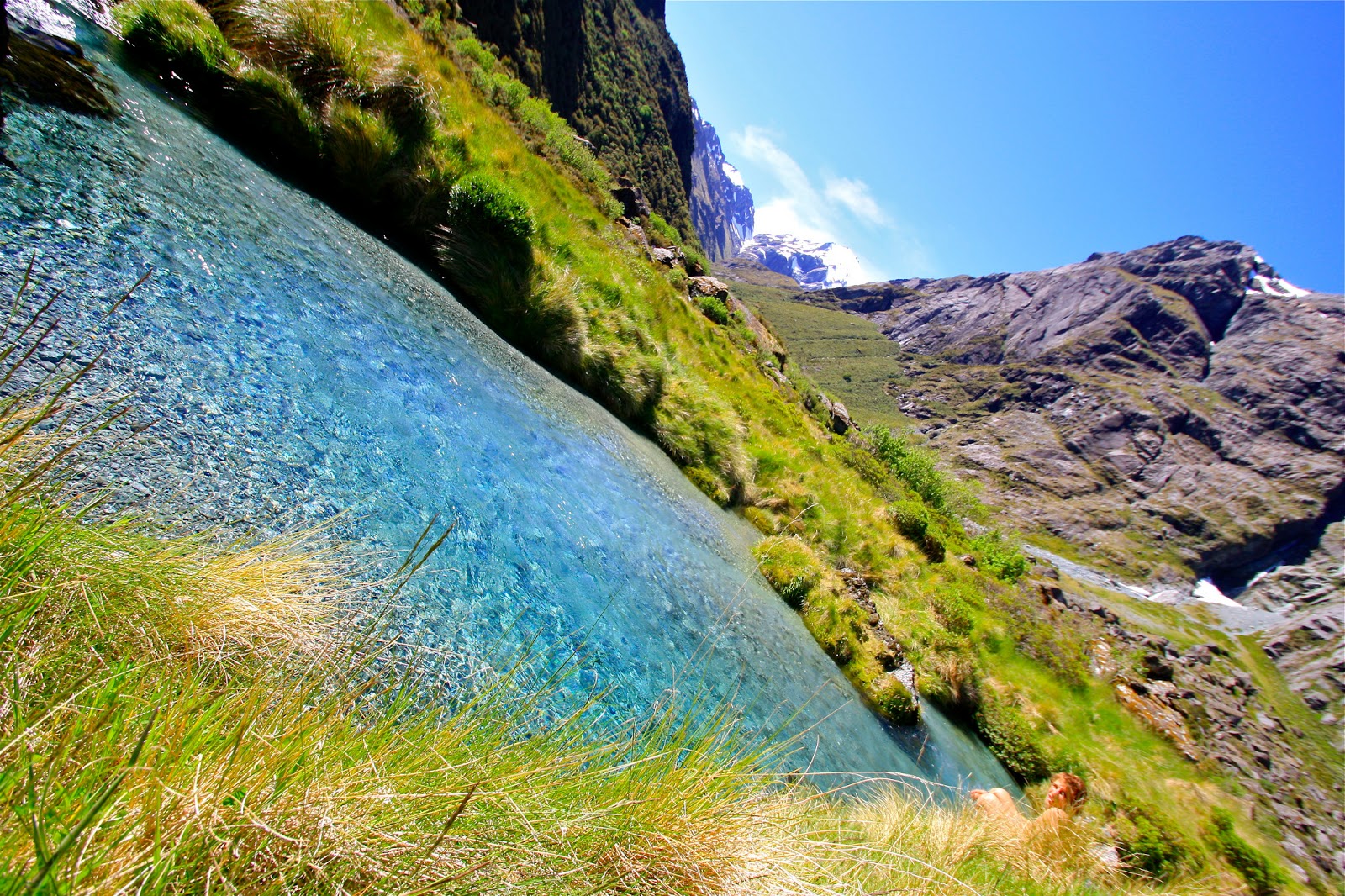
At 11 p.m. it's still not dark but we go to sleep anyway, and in the morning we bury our heads from the brightening sky. The sun takes its time reaching this valley – it has 5,000-foot peaks to climb up first – and we don't rise until it reaches our tent at 9 a.m. Then we sit up and are blown away. Our tent is surrounded by mountains and glaciers and snow – there is a luminous turquoise river flowing outside the tent, waterfalls dripping from cliffs, the sky a brilliant blue. We spend the day following the river upstream to the glacier that's created it.


15 December

At what point does the sacred become mundane, and what do we lose in the change?

The first time it rained here – really rained – I was enthralled, raptured, awed. You've been told that thousands of waterfalls will appear in a heavy rain, but how do you prepare yourself for that? You've seen a waterfall, and you can conceptualize thousands as a number, an amount – but try as you may it is impossible to imagine the dry cliffs you've come to know covered in literally thousands of waterfalls. It is majestic. It makes you want to run outside in the rain, hands in the air, letting water pool in your palms and trickle down your arms.

And then... several feet of rain later... days later, when you realize you can never count on the clear skies to last, that you've chosen to live in one of the wettest inhabited places on earth and that this rain is costing you your livelihood, when you run out of things to do on rainy days and you start to feel old, run down – then what? Someone always puts on the TV and it's all downhill from there. There is no sacred when the TV is on. Not even when you look out the window across the river and see water cascading into the sea.

So it was with the monkeys. I was beside myself with excitement the first time we spotted howler monkeys in Costa Rica earlier this year. It was like a scene from a movie – Jesse and I on the wraparound porch of our jungle cabin, monkeys and bats and lizards in the trees – but after a few days of hiking, we glanced up, saw monkeys on the trail and kept going, feeling slightly superior to the tourists who stopped in their tracks with cameras pointed at the canopy. Is this how it is, then? Must nature present itself in ever new and exciting ways to hold our attention? The natural world as a whole still entices me and drives me and amazes me, powerfully or subtly, but the individual phenomena are becoming like items checked off a list. Thousands of waterfalls? Check. Manta rays? Check. Now how about some whale sharks...?

24 December 2012: Routeburn track

I do not stop and write as I'm walking, because the sensations are too multitudinous to describe. They come and go quickly, each turn of the trail bringing a slight change in the feeling of the place. As the sun travels across the sky, we travel up a valley, through mature southern beech forest, alongside a turquoise river dropping into pools, into open meadows flanked by alpine peaks. With each bend, the light changes and brings a different kind of magic. Who has the words to describe this?

I know I do not. I walk on, sometimes in silent awe, sometimes exclaiming to myself out loud. At the top of a valley where large, scattered boulders and clumps of purplish fern mingle with a sea of golden grasses – where the river deposits itself in pools and cascades before spreading itself wide and braided across the valley below – here we stop for a swim and lie naked in the tussocked grass. There is nothing that could be better than this. The air, the light, the scenery, the solitude – drinking water from the river when we're thirsty, walking barefoot in an alpine valley – we are surely spoiled for life, because nothing else could compare.


13 January 2013

Today I read a passage in Pilgrim at Tinker Creek in which Annie Dillard leaves her cabin on a winter's night to walk in the dark over frozen grasses, and I am suddenly struck with remembrance. Last year at this time, that's exactly what I was doing. I would walk out into the frozen fields of New Hampshire in the moonlight, head bent against the cold, tears dried on my face, until I would realize where I was and stop to look around: tiny stars in an enormous sky glittering above, crystals of frost sparkling on the grass below, my kitchen light glowing yellow in the distance, reminding me which way was home. Which way is home? I still haven't figured it out.

But how much changes in a year. I quit my job and have been living out of a backpack, making hardly any money but nonetheless living richly: traveling in Maine, New Hampshire, Massachusetts, Colorado, Utah, Alaska, Washington, Oregon, California, Costa Rica, Panama and New Zealand. Now, it's 10 p.m. and the sky is still an approximation of blue. A bird still sings. Jesse, tired, sleeps by my elbow; I can see his pulse beneath the skin of his neck. Outside our bedroom door, people are moving around – finishing the dinner dishes, walking to the bathroom to brush their teeth, a quiet laugh. Sounds of life being lived. It doesn't occur to me to be lonely here. But therein lies the paradox – I also do little in the way of reading or writing or being creative. I watch movies, hang out, go places with people. It's all good until weeks pass and my blog is stagnant and my journal blank. Must it be one or the other? Or can I write and create without being lonely and alone?

18 January

I sit in the back of Harlan's car on a gravel road while Jesse and Harlan scout the river. It's windy, and cold for the middle of summer – wind whips the million-hued leaves – all green – and pulls the clouds and sun apart and together, creating bursts of cold sunshine that quickly fade back to gray.

Driving. Flashes of trees punctuated by slivers of light, the open vistas of valleys and rock walls misted with waterfalls, caught in glimpses. My bare feet stretched out in the flickering light. The roof of the Mazda gouged from kayaks and paddles, the floor littered with rocks and pine needles, hats, sleeping bag, atlas.

22 January

Yesterday will be added to my memory as one of those days that define my time in New Zealand: Jesse and I exploring in the wild, free outdoors, scrambling up rocks, following a crystal river to its source in the snows. We crisscross over waterfalls, bend to our knees to drink from a cupped palm, swim naked in a deep pool, walk with the sun on our shoulders. On these days, there is nothing in the world to worry about. Following the Tutoko, the North Routeburn, Bowen and now the Gertrude rivers through valleys and up to their source in the mountains have been among the most carefree days of my life.

This morning, Jesse and I were up at 5 a.m. to go deep sea fishing with Thor. I managed to pull up a shark, two barracudas and a groper before becoming terribly seasick and hurling my breakfast into the Tasman Sea. Back to work tomorrow.

2 February: Catlins coast

This is the kind of ocean I like best: cold, lonely, windswept. We drove all day across the South Island to the Catlins coast, a place where sea lions flop ashore at long sandy beaches, rolling farmland laced with rutted roads abuts the ocean and surf from the Antarctic pounds and swells against cliffs. The kelp forests pulse in the endless rhythm of the sea and penguins walk across pockmarked rocks like flat-footed old men.

The skies are overcast and the evening light is all purple and gray. Jesse and I cook dinner on the grassy bluff where our tent is, and below, along the crescent beach of Porpoise Bay, a handful of lights come on. Four days off here, then back to work, a short road trip, and Jesse goes back to the states. I try not to ask, then what?


6 February

Jesse and I got in a fight last night after downing beers with old men at the one pub in Kaka Point. We turned down an offer from one of the fishermen to stay at his house and pitched our tent on the beach instead, fell into an uneasy sleep. Now, Jesse stays in bed while I make coffee – a peace offering. We are among the first people in the world to see the sun rise today, what little there is of it. Far east, and far south, camping among low dunes with a lighthouse in the distance, the ubiquitous sheep pasture behind us and a sweep of ocean in front, stretching unbroken to Antarctica. I can feel Antarctic winds in the spray of sea salt on my face. This place feels like it's at the end of the world.

27 February

There is less to write about – or so it seems – when I stay in one place. Perhaps that has fed into my apparent aversion to it. New experiences force me to open my senses, to observe – to write. But when life becomes routine, I lose that drive.

Guiding in Milford is dynamic. Every day the wind and weather and light change, but the mountains stay locked in the same positions, towering landmarks that stay constant as the moon and sun and stars travel around them. Surely, there is enough to write about here. Surely, there is much I will forget otherwise. But the days go by quickly, seemingly the same, and the season passes with little to say.


4 March – Haast Pass

Yesterday was Jesse's last day in Milford, and today we left for a whirlwind tour of the South Island. We're camped a few hundred meters off the road by a braided, cobbled river, and summer is on its way out. Days are shorter, nights cooler, and driving today, piles of tiny, golden beech leaves swirled in the wake of cars like glitter sparkling in the autumn sun. Time as flown – I can hardly fathom that I've been here for four months. I'm ready to move on, but at the same time I've grown accustomed to life in Milford, that strange intersection of wilderness and scenic beauty combined with heaps of tourists and the daytime drone of boats and cars and helicopters. New Zealand hasn't quite captivated me the way it has so many others – for all its beauty it often feels packaged, too organized, too tidy and homogenous compared to, say, Alaska. But nonetheless, I'm glad I came.

8 March – Abel Tasman National Park

We drove for three days to get here, and to see the country along the way, since it's so far from home and we may never find ourselves here again. Each night we slept by a body of water, falling asleep when the stars came out and waking up with the sun. We drove for long hours, but slowly, stopping wherever interested us. It sounds romantic, but the reality was long and tedious – the old Corolla we've borrowed won't stay in fifth gear, the front windows won't roll down, and the landscape was certainly nothing worth driving three days for. But at least now we know. And the nights almost made up for the days – finding a quiet spot to camp alone with the waves and stars – until Jesse forgot to put my tent back in the car at Gillespie Beach and no one noticed until we went to set up camp that night in a pine grove overlooking a harbor in California-wine-country-esque Mapua. My tent that I've had for seven years! I loved that tent. So we slept on the ground at the end of a residential street and were woken by retirees on their morning walk and I had a slight breakdown because I'm 28 years old and felt like a homeless person and am sick and tired of always being so broke.

But now we're in Abel Tasman, and it's the first time all week we haven't had to drive anywhere. Yesterday we kayaked to a place called Mosquito Bay, a boat-access only campsite in the national park, and spent the evening drinking good beer and whiskey and playing canasta. Unbelievably – in one of the smallest and most-visited national parks in New Zealand – we have this gorgeous, gold sand beach with a lagoon all to ourselves. Last night we spread our sleeping bags on the beach and while stars swirled overhead, an Australian possum tiptoed around us and the tide slipped out and back in again.


13 March

Back in Milford. The road trip was fairly bland – the scenery uninspiring, the driving long, the towns and cities all seemingly alike. We drove and camped, drove and camped, until Jesse lost my tent and I had a minor breakdown. After that we stayed in hostels and motels for three nights. Once, in our $80 private room at the hostel in Kaikoura, we were woken up by loud drunken backpackers who set off the fire alarm, and we had to stand outside in the street until the firefighters came to shut it off. It's funny how quickly things change – not long ago, I used to think backpacking foreign countries and staying in hostels was just about the coolest thing ever, and now all I want is to camp somewhere quiet and beautiful and unregulated away from the noisy backpacking crowd.

I left Jesse at the airport in Christchurch and drove 11 hours solo through the heart of the South Island to get back to work in Milford. I wanted to stop and record my impressions of this country, but I also wanted to make it home before dark and so I drove on, one landscape blending into another, green pasture to golden hills to craggy mountains, and now I've lost the words, the fleeting impressions. Now I'm back in my own bed, and of all I've seen of this country, I like Fiordland best. It's good to be back. The water is clear and the stars are brilliant and at night I have to go outside to pee, which is something I rather enjoy because it forces me to look at the night sky.

Paul Theroux on ocean paddling: “Sailing the sea was a monotony of doldrums interrupted by windy periods of nightmarish terror. No desert was ever deadlier or more tedious than an ocean.” So true.

3 April

I am a person who thrives on change, and nothing makes me happier than the changing of seasons. Tonight it is fall. The sun sets early and we stay in, those of us left , steaming up the windows while Tex fries up steaks and potatoes. My room is so cold I dive for the blankets, but I won't shut the window yet. Just as the frost arrives, I will walk aboard a plane and fly back into spring in New England, just as I did when I came here in November. I met a girl from Oregon last week who has skipped 11 winters in a row, but it throws me off, settling in for the winter like this and then being yanked away – twice. Tonight, though, I don't care. One by one the guides trickle out of Milford, and those of us who remain grow closer. I have a glass of wine in the evenings, sleep with the windows open and wake up warm and well-rested under a quilt breathing in cold, fresh air. The days are short and brilliant. There is nothing right now that I crave or desire.


For more photos of New Zealand, check out these links:

https://www.facebook.com/media/set/?set=a.743634772895.2127893.10401476&type=1&l=ba47de65af

https://www.facebook.com/media/set/?set=a.772707091735.1073741825.10401476&type=1&l=5103e7dc8a
Nature Blog Network