Labels

Showing posts with label reflections. Show all posts

Thursday, April 10, 2014

suffering and beauty.

 
One night, driving along the dark ribbon of Highway 550, I see movement. The movement becomes a shape; the shape a deer. A doe, struggling to stand and move out of the road. She rises halfway and her back legs crumple to the ground. She is broken. I'm at a dead stop now; don't know what to do, can't find the switch to put my hazards on, fumbling clumsily with one eye on the deer and the other on the headlights swiftly approaching in my rearview mirror. I drive forward, hoping that someone behind me has a gun to put her out of her misery. Suffering is the one thing I cannot bear to contemplate too deeply. When I arrive at the hot springs, I decide, I'll tell someone, ask what they would've done, ask to use the phone. Who should I call? The sheriff? There are so many deer around here.

There is no blood in the road. None.

At the desk of the hot springs, the woman who takes my $10 is beautiful and disinterested. She's talking to a co-worker; neither of them look at my face. For the second time this night, I am uncertain. It's light in here, and warm. The cold dark road is so distant it feels like it may not have been real.

I wish I carried a rifle.

I step outside again, naked, prancing across the cold ground like a deer myself, then ease into the steaming pool. There are two old men sitting at its ledge. A couple embracing. A woman talking to no one who says she's from a city and marvels aloud at the stars, which are indeed magnificent. So many bright pinpricks of light. I wonder who I could approach about the deer, but weighing my options, each seems too awkward and so I float on my back instead, submerging my ears into the silence of the pool.

I think, likely, that she will drag herself off the road and be killed by coyotes. That's not such a bad end. Then I think of all the other cars speeding down that dark road at 60 miles an hour and realize she will probably be hit again; that she will die slowly, her blood seeping onto the roadside, watching without comprehension as loud, bright machines roar past with no regard for her pain.

I think about the time I moved to Vermont and saw a dead doe and her fawn, 20 feet apart on the side of the highway. It seemed a bad omen for starting over in a new place. I cried for miles, wondering which died first and which, struck by grief, wandered nearby until it too was killed.

I think about my dog, who was struck by a car one night while I was out partying. I wasn't there, but I've relived the scene in my mind over and over again. He didn't die right away. He waited on the cold table of the vet's office until they could reach me at a bar across the state and get my permission for strangers to put him down.

Roadkill made me cry even before that.

There in the water, surrounded by lovers and strangers, thinking of suffering and death and whatever implicit roles I've played in both, I stare through the steaming breath of the earth to the mountains and stars beyond and for a moment, the veil lifts. For the space of a breath, I understand that we are small and insignificant. And yet at the same time, it doesn't feel that way. How can this be just another night, one among billions and billions on this spinning planet?


Saturday, March 29, 2014

Scenes from Paonia and nearby


28 Jan. 2014

It occurs to me, lying in bed with the silence of the house pressing around and the moon shining through the curtains, how easily I acclimate to being alone. Jesse is in Peru for six weeks and the solitude comes back as naturally as breathing, which is both reassuring and a little frightening. There are people from other places and other times that I consider good friends, and yet we interact rarely — they're like ships on a sea, summonable if I capsize but mostly just distant lights on my horizon. I go through my days independently, interacting mostly with the people who happen to be here with me in this place, at this time. Our orbits have randomly crossed, and while I'm grateful to walk into the brewery after work and know at least eight people by name, some bitter, cynical part of me can't forget that before long, they'll be gone from this place and so will I. We are all transient and rootless, all following our own paths. Sometimes I have to remind myself that that doesn't make our time here less meaningful.

1 Feb. 2014

Today I drove to Crested Butte, taking the longest of the three possible routes because the other two were blocked by snow. The drive to and from Gunnison was lovely, and the valley up to Crested Butte even more so — worn wooden barns tucked against hillsides, a cloud settling into the muted pink sky, a deepening dusk punctured by the lights of town. I have a drink at the bar where my friend works and talk to an older man, an engineer. Crested Butte is still a little funky and not as gaudy as some Colorado ski towns, but still clearly wealthy, with log beams and pricey boutiques. I am happy that I can drive here for a visit and happier still to come home to a town shaped by people who actually live there. When I'm wakened at night by the whistle of the coal train as it passes through Paonia, I sleepily smile that I live in a place where people still work with their hands in the earth.

8 Feb. 2014

It's been snowing on and off for a week now, a real winter like I haven't had since that one in Vermont — that winter carrying armloads of wood inside, clomping up the stairs in heavy, wet boots, driving up the hill after work and getting out of the car and standing for a moment in the frosted air on the mountaintop, my head tilted to the stars, the night perfectly still. This winter is different — I'm in town, for one thing — but every morning I wake up to a fresh inch or two of snow.

This morning I drink coffee and listen to KVNF as more snow falls outside. There's an old guy named Don doing the Saturday morning children's show, reading a story about going owling in the forest. Don struggles with the broadcasting technology and there's dead air but it's endearing because he's old, and has a sidekick named Wally who keeps saying, 'Yeah, Don. Yeah.' And Pete Seeger died and they play Pete Seeger songs, and then they talk on the phone to an 11-year-old boy and discuss pancakes and sledding and school. The boy gets to shoot .22s for science class. When a baby is born, Don and Wally welcome him or her over the radio and play a song called "You're My Little Potato." Life carries on. The seasons change.

14 February 2014

Walking to Joanna's house on a February night, carrying a jar of wine in my coat pocket, it feels suddenly like spring — a mild weekend coming in. The moon is nearly full and the streets are quiet, houses glowing from behind curtains. Faraway, a dog barks. Melting snow drips off a rooftop. Below the street, fresh snowmelt gushes through a sewer. How can such an ordinary night be so beautiful? Bare branches; grainy snow giving way to bare ground; a smell of wet soil and cold water in the air. Sometimes I love this place too much.

One Sunday in February

I've come to the edge of the San Juan mountains to stay in a friend's cabin for the weekend, and the snow is nearly gone, the landscape brown and soft. This is my dream: To not know or care what the date is; to wake up and sit outside on the steps of a cabin with a book and coffee in a hand-thrown mug; to feel the air on my face and hear, maybe, the rushing of water or of wind; to see the birds and the mountains, or maybe the sea. If this could be my morning at least one day a week, Lord, I will not complain about the other six. I will be happy.

Let this be my Sunday; let this be my church: morning sun, cold air, birds and a cup of strong coffee.

"And I will be to her a wall of fire all around, declares the Lord. And I will be the glory in her midst."
--Zechariah, 2:5


Friday, March 28, 2014

the in-between places.


"How much time does it take for place to seep in, for the here to quell the longing for the there?" -Rebecca Durham

Sometimes I ask how I have come to love this place, this stark, open land, sagebrush stabbed into its sandy soil, cracks and fissures splitting the earth. Coming from the rich and fertile coasts, where everything grows wild and green, where we bend to yank weeds from the ground — how did the people who came here before give that up for a place where every tendril of life must be coaxed from the earth, where the only plants are gnarled and stunted; brittle bits of life that thumb their nose at excess and fertility? Why did they stop moving and say, Here. This is the place.

There is no explaining why places like this get under our skin — not quite desert, not quite mountains, just a wild, lonely in-between. In in a time when the most hospitable places have been flattened under a sea of asphalt or privatized by the wealthy, I wonder whether these expanses appear less like wasteland and more like refuges. If our circumstances cause us to see not desolation but possibility.

I think briefly that must be so, and then I wonder again about the people who came here before. There's more to it. There's something in our soul that yearns for this.


Monday, March 10, 2014

Here in the North Fork Valley, at about 5,600 feet, it feels like spring. There are robins. The sun is still shining when I get home from work. The river is brown and churning and smells like wet earth. 

Today I went for my first good bike ride of the season, feeling every one of my leg muscles on the uphills and grinning wildly on the downs. I passed stiff-legged newborn calves blinking in the bright light and donkeys standing placidly in fields, smiling at the earth. Horses kicking their hooves in sheer joy. I know how they feel. Spring -- even false spring, with more wintry weather likely to come -- stirs a kind of happiness so distinct it should have its own name. Sun on your cheeks. Bare skin. The smell of dirt. One of the reasons I like a good hard winter is so I can really appreciate spring when it comes.

Nothing -- absolutely nothing -- makes me happier than the changing seasons. I thrive on change, and if I can't travel as often as I like or pack my house up every six months, I've decided I must live somewhere with four seasons. Three times in the last decade I've skipped winter (in Hawaii, the Marshall Islands and New Zealand) and now I've sworn to never again live without months of cold and snow; without wood fires and soup-making and early nights. Without winter, there couldn't be fall or spring. Everything would be the same all the time, stagnant and warm and boring, the same foods and the same smells. I won't have it.

It's false spring in the valley, but up in the mountains, at 11,000 feet, winter still holds fast. Last weekend I went to a friend's cabin the day after a storm and backcountry snowboarded through deep, fresh powder for the first time ever, cutting S-shaped tracks through unbroken alpine meadows. Holy god. I'm a convert.

First we skinned and snowshoed up through the clouds:


At the top, the clouds began to lift, and my lungs and legs were burning. I swore I'd only ski down once, because no way in hell was I hiking back up:


Ten minutes later with a shit-eating grin on my face, I gamely turned around for another run. The clouds broke up like ice from a river:


Best. Skiing. Ever.


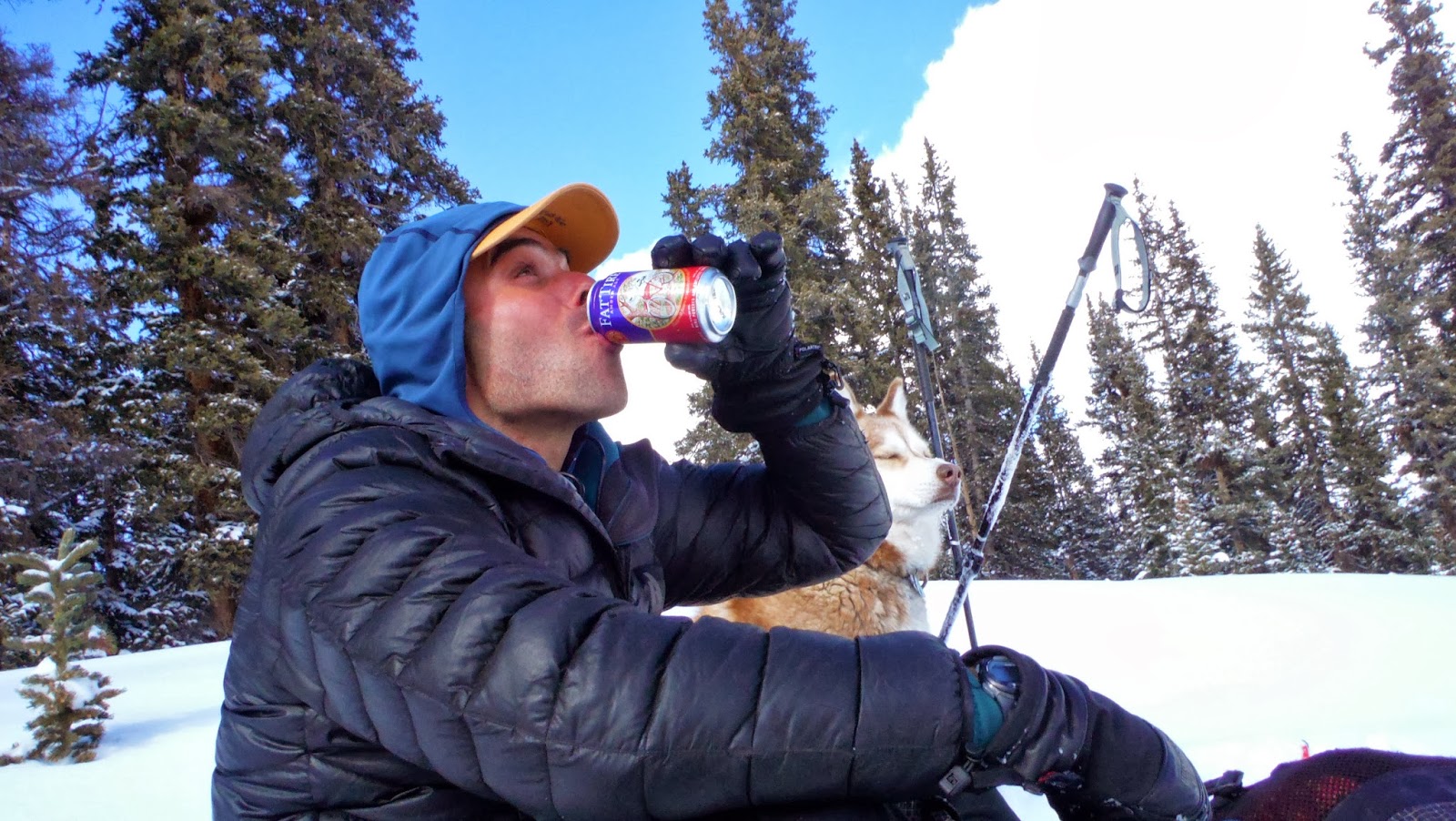
A man, his dog and a beer in the alpine sunshine. I don't think anything could be better.


Life is so beautiful lately I wish I could stop time and prevent anything from marring this perfection. But I know the darkness is inevitable, and I'm not afraid. Spring will always return.

Thursday, March 6, 2014

Living with less.

Let me start right off by saying that I failed. Miserably. Last summer I moved to western Colorado after spending most of my 29 years in exceptionally rainy places, and amid discussions of water rights and fights and rivers drying up and unraveling, I decided it would be a good idea to limit my own water footprint. For one week, I’d live on just five gallons of water a day. Then I’d write about it.
I could envision two possible endings:

Scenario One: While standing naked in the bathtub, smugly dribbling water over my head from a cup dipped in a bucket, I conclude that I must be in the 99th percentile of environmentally conscious Americans because living on five gallons a day requires little sacrifice. My houseplants thrive, I remain clean and good-natured, and the brilliant essay I planned to write suffers because it was too easy.

Scenario Two: One week into my experiment, I am ragged and filthy. My plants have withered and I've been shunned at work for peeing in a chamber pot under my desk. I am desperate for a hot shower, and when I finally turn on the faucet and step into the tub, I experience deep revelations that lead to a brilliant essay about limiting my water supply.

Scenario Three never made an appearance in my daydreams, but this is what really happened: It's Monday night – a mere three days after my resolution to live for a week on limited water ­– and I am sitting in bed freshly showered. I did not shower with a bucket. In other words, I didn't even make it to the end of the week.

***
For me, five gallons a day was a quirky experiment. For the 17 California communities on a list released last month by state health officials, it may become reality: As drought tightens its grip on the state, each community is at risk of running out of drinking water within 100 days. Officials are discussing trucking in water as a possible solution.

In one such place, a town of 1,200 called Lompico, water comes from underground aquifers replenished by rainwater. The problem is, there hasn’t been much rain lately: California received an average of just 7 inches in 2013, compared to their usual 22, and the Sierra Nevada snowpack that feeds many reservoirs is at 12 percent of normal. Lompico residents have been asked to cut their water usage by 30 percent, but as Water District Board president Lois Henry pointed out to the San Francisco Chronicle, “We live in the Santa Cruz Mountains. People don't have lawns. They don't have gardens. How are they going to conserve 30 percent?"

California isn’t the only state to face water shortages; residents of Magdalena, N.M., might be able to offer a few water-conserving suggestions. Last June, Magdalena’s sole well ran dry, and for several weeks Socorro County officials had to truck in water from the county seat, 30 miles away. For a while, families received two plastic water bottles and a five-gallon tank per day. The medical clinic shut its doors. Restaurants switched to disposable plates. Tourism effectively ceased, and some people living in rental properties packed their bags and moved on. It was like a glimpse into a drought-wracked dystopian future ­– or a not-so-distant future, if predictions that the California drought will persist for several months or longer prove accurate.

Dara Machotka-Hafey and her husband, Jonathan, wanted to stay in Magdalena. The year before, they’d bought the only Laundromat in a 60-mile radius, added a mercantile where locals could buy fresh produce, and were renovating an Airstream trailer to live in with their 4-year-old daughter, Nia.
The Laundromat drew customers from as far away as the Navajo reservation and the town of Datil, 40 miles west. The Machotka-Hafeys were still living paycheck-to-paycheck, but they had hope. “We were struggling,” Dara says, “but it was getting better, you know?”

... Read the rest of my essay here:  http://www.hcn.org/blogs/goat/living-with-less-water-lessons-for-californians-and-the-rest-of-us-from-a-new-mexico-village

Sunday, January 26, 2014

I went to the desert.


I went to the desert because it had been too long since I'd slept in the cold air, under the stars. I went because I had nowhere else to go. I went because for the first time in a long while, I was alone.

Jesse left for Peru the day before, to be gone for six weeks. I don't mind these long absences, I tell myself. They sweeten the time we spend together, and give me the space I crave – the space to sit in my pajamas long into a Sunday morning, writing and puttering, or to walk outdoors at my own pace, learning the stories of the land.

And so I sit on a sun-warmed slab of sandstone on the far western edge of Colorado, where Utah's red rock canyons have seeped across the border. North, the Grand Valley is a tabletop wound through by the Colorado River; south, the mesas and cracked canyons of this country spread out like an intricate taproot, a living network of veins and capillaries. I sit at the nexus of five canyons, at the center of a wobbly star pressed into the earth. The sun slips lower and my pack remains where I dropped it; the thought of spending 13 hours of darkness out here is unnerving, and I hold out the possibility that maybe I'll hike back to my car.

At 4:30 p.m. on this mid-winter day, the circle of sun drops behind the canyon wall, and I put on another layer of clothing. I think of the people who wander the desert alone. I think of Jesse, who hikes under the moon until midnight. I tell myself that there's nothing to be afraid of, and yet the prospect of my thoughts stretching out across 13 hours of fireless night fills me with trepidation.

Every so often a plane passes overhead, and as I watch their tails of exhaust cross my lone slice of sky, I think of Jesse in one of them looking down on the earth and my heart nearly breaks.

The last stripe of light hugging the rim of canyon disappears. The croaking raven has flown away. The winter sunset is not a real sunset at all, just a gradual deepening of light from washed out blue to indigo to purple to black. In the darkness I read and wait for the moon to rise. The canyons are frosted and still. It's probably about 20 degrees.

***

In the morning, the sun turns the red rock wall behind me a burnished orange, then creeps down slowly, lighting the juniper branches and dead grasses until it's warmth finally reaches my camp. The glint of it off my cooking pot is a beautiful thing, and I am inexpressibly happy to be alive and in this place.

Last night, the moon lit up the entire canyon, and a great horned owl called again and again.


Monday, December 23, 2013

Two months' of journal snippets.


Fall in the mountains: Woke with melting frost dripping on my head, dead leaves sifting through a tangle of willows, blue sky snapped tight like a sheet out to dry. The morning sun makes everything look more golden than it already is -- burnt, burnished, waiting for snow. The coffee in my tin cup gets cold before my fingers can warm up. ...


Tonight after work I went out to the small grocery store just as it was closing; the kids who work there having a last cigarette in the parking lot, pushing the carts in a train toward the door. The four-way stop in town was empty of traffic, moon rising over the hill, my bicycle creaking, rolling home through silent, dreaming streets...


I dreamt last night that I took Jesse to Vermont, that we went to a ski mountain and the drive in was beautiful, the mountains taller than they really are, hazy on the horizon, and Jesse exclaimed how beautiful it was, and lift tickets were only $4. Places that do not exist except in other dreams, places I do not know but that are real in the dreamworld I have built slowly, one night at a time, a few pebbles each night (except, sometimes, with a flash of lightning, one that brings a whole city into being in less than an hour) -- those places were there -- a house up a windy road on a hill, a restaurant, a collection of cabins under thick pines. Dirt roads, a friend's house. Jesse liked it all, and I was happy.


All day, I write, and yet time passes unmarked; the days slide by as stealthily as fog. Thanksgiving is past, autumn is past - winter blew in overnight, eight inches of sparkling snow, a fine sift of powder falling all day. In the evening, after a good day at work, I eat thin slices of elk, then go for a glittering starlight snowshoe above town, looking down at the houses with Christmas lights and up at the gathering stars, the dissipating clouds. Headlamp off, tramping over the blanket of snow, making tracks intersected only by those of deer, and perhaps the mountain lions that we know are here somewhere, out of sight... The trees and shrubs are strange, twisted lumps under the snow ... lungs burning, nose cold, heart full ... a burst of laughter, then home to a soft blanket, hot cocoa, and the last 20 pages of a book.

The days slide by like fog over the river, but sometimes the fog burns off and a day stands out, shining, clear.


Sunday, November 10, 2013

Smoke and rain: dreaming and adapting on the Western slope

My life is the story of water. My cells, my mitochondria and nuclei and DNA swim in pools of water. It drives me forward, pulls my feet toward its source: a waterfall in the jungle, a crystal pool high in the mountains. I drink it in deeply, let it fall over me, into me, around me, and still I lust for more.
IMG_1449
Perhaps it’s because I grew up in New England, among trees and gardens fed by a generous sky, but for whatever reason I am drawn to the wet places of this world. After college I spent a year in the equatorial Pacific, and in a country of parched white beaches where nothing grows but palm trees, I was assigned to the one island with swampy taro patches and thick creeping jungle. While other islands suffered from drought, the seams of my clothing rotted in the humidity.

Since then, I’ve moved like clockwork. Every six to 12 months I go looking for a new job, a new adventure, and until now, I’ve always gone to places with heavy rainfall — the eastern shore of Hawai’i; the temperate rainforest of Southeast Alaska. Last year I surpassed even my own standards, finding myself in one of the wettest places in the world: Fiordland, New Zealand, which receives an average of 22 feet of rain a year. After  six months there, though, I felt waterlogged and weary, ready for a chance to stay in one place for a while. I’d moved 15 times in nine years.

So when learned I’d gotten a writing job in Paonia, I didn’t hesitate to fly across the world and pack up the car that I’d left at my mom’s house in New England. I headed West to chase my dreams, to find my own Big Rock Candy Mountain, following the tracks of others who’d made this migration before. The morning I left New England, tendrils of fog snaked through valleys and around barns, softening the dawn light. Then the rolling hills of the East gave way to the stubby fields and industrial cities of the plains, and I considered for the first time of how I’d adapt to life in an arid country. I knew almost nothing about Paonia except that one former editor had described it as “very nearly perfect.” But perfection, of course, is a matter of opinion.
IMG_1461The journey West was once a journey of no return, an exchange of the known for the unknown, the tame for the wild, cities for open spaces. But as the West changes, these truths become less and less so until only one remains: moving from East to West means moving from wet to dry. It means leaving a world of abundant water — water so pervasive you can feel it on your skin, see it beaded on every blade of grass — to a place where you cannot legally cache your own rainwater because it’s such a precious commodity. ...

 ... Read the rest of the essay in North Fork Scrapbook, on online record of life in the North Fork valley that began as a response to the proposed leasing of public lands here for oil and gas drilling:

http://www.northforkscrapbook.org/features/smoke-and-rain-dreaming-and-adapting-on-the-western-slope

Wednesday, November 6, 2013

Does reality TV change the reality of Alaska?

Four years ago, when I was 25, I went to Alaska to work as a wilderness guide. I bought my first pair of XtraTuf boots and my first set of head-to-toe rubber rain gear, and between seven-week trips in the backcountry, lived above a Laundromat that smelled perpetually of halibut.

The first spring, my boyfriend and I celebrated the returning light by taking a trip to Juneau to go skiing. Only it rained the whole time, and instead of skiing we sloshed through the alleys and backstreets, lingering in bookshops and stopping at every coffee shop we could find. The last night before catching the ferry home, we stayed at the state’s oldest hotel, The Alaskan. Even on a weeknight, the bar – a former speakeasy – was utterly raucous, and the adjoining hotel was much the same. When it first opened in 1913, the building operated as a thinly-veiled Victorian brothel, and in 2010, if you squinted your eyes just right, you could imagine that it still was, that the man with the stained white beard spinning across the dance floor had just paid his tab with a sack of gold flakes and would soon slip upstairs behind a woman's lace stockings.

The wallpaper was yellowed and peeling, the wood floors scuffed and creaky; the entire place smelled faintly of spilled beer and musty sheets. The walls were thin – in most rooms, you fell asleep (or passed out) to the sound of boot-stomping fiddle music drifting from the bar. If you were in Juneau and wanted a good night's sleep, you went to the Westmark or the Best Western. If you wanted an experience to remember, you went to The Alaskan.

That was before the reality TV craze struck Alaska, turning the Last Frontier into something akin to the “Real Housewives of Orange County.” This year, in addition to “Deadliest Catch” and “Alaska State Troopers” – the old standbys – the 49th state is getting “Alaska Gold Diggers” (five Newport Beach women reviving their grandfather's old mining claim), “Ultimate Survival Alaska,” and an episode of “Hotel Impossible,” a show in which an interior designer and a consultant give hotels the touristic version of an extreme makeover. The show has been to Alaska before, to Yakutat's Glacier Bear Lodge, where celebrity consultant Anthony Melchiorri, an admitted germaphobe, was appalled by the old carpets and fish guts outside the doors. The owners reportedly spent $100,000 on renovations following his suggestions, and occupancy rates increased only 1.5 percent.

... Read the rest of the essay at http://www.hcn.org/blogs/goat/does-reality-tv-change-the-reality-of-alaska
Alaskan 2

Tuesday, November 5, 2013

Throwing stones.

Today, I'm thinking about rocks. Specifically, boulders, and even more specifically, the practice of rolling them downhill. Out of the many hours I've spent outdoors -- hiking, biking, reading, reflecting, being generally quite responsible and picking up other people's trash -- one of the best was spent hucking big rocks down a rocky bowl in New Zealand.

It started with a small rock, about the size of a basketball. One of the Kiwis I was hiking with nudged it with his toe down toward the lake below. It bounced once -- rock crashing against rock with an loud, echoing crack -- before landing in the water with an equally satisfying thump. We all stopped in our tracks, smiles tugging at the corners of our mouths. Then someone else picked up a rock, then another, and soon, the quiet mountain was alive with a resonant, joyous cacophony. It wasn't the noise so much as it was the giddiness of making big splashes and playing outside.

I think of another time -- the summer I spent doing trail work in Idaho, when one of the tasks was to create gravel where there was none to protect a trail. The work involved taking a large rock from nearby, placing it on a flattish rock, like a log about to be split, then swinging a sledgehammer ('doublejack,' in trail-crew speak) over your head and smashing the rock to smithereens. The work was backbreaking but utterly satisfying, and the chalky smell of powdered rock still brings me back to those days in the mountains.
These experiences, I understand, are different from the recent episode caught on video of two Boy Scout leaders toppling an ancient rock formation in Utah in front of their students. That was a poor example of leadership and not exactly how to teach kids respect for the outdoors. The backlash over the video also brought new attention to a 2011 essay by the inimitable Micheal Branch, a professor in Nevada's Great Basin who writes for High Country News. In his essay, What Would Edward Abbey Do?, Branch recreates a scene of he and three other grown men mischievously dislodging a giant, precariously perched boulder and "trundling" it into a canyon. His writing reminds me that there are certain impulses that transcend time and age, and that indulging in a bit of unadulterated fun in the natural world is often what forges a connection to it.

Some readers with a sense of humor seemed to agree, but Branch's essay also prompted a backlash of its own from readers who called his act "selfish," "bad karma," immature vandalism and worse. One particularly insightful reader, however, noted to the detractors that "your privileged North American consumer lifestyle does more harm to the so-called environment than an army of 'trundlers' could ever do." I imagine that gets at the reason why humble Kiwis not responsible for quite as much global environmental destruction were more unabashed about their rock trundling than we Americans are.

The online vitriol surrounding rock trundling in all forms brings up another issue described in David Sobel's 2012 Orion essay, Look, Don't Touch. In it, Sobel laments the direction that natural education has taken: A hands-off approach that sees nature as too delicate and easily disrupted to be explored in a meaningful way. Trying to make kids (and big kids) feel guilty about picking up frogs, taking home feathers and chucking rocks off cliffs only deepens our alienation from the natural world.

So, should you topple an ancient, beloved rock in front of children and gloat about it online? Probably not. Should you compare that action to the innocent pleasure of throwing rocks downhill, or villainize people who partake in such indulgences? Again, I think not.

People in glass houses shouldn't throw stones. But if people outside want to responsibly throw stones down a hill and laugh hysterically at themselves afterward, I fully support it.


Trundle fail.


Monday, September 9, 2013

wolves and wild horses


DeWitt Daggett is not a cowboy. He's a short man with curly black hair on his arms who was a geologist and an audio book publisher before he decided to move to Western Colorado and dedicate his life to horses. He's not quite a veterinarian either, but he shoes horses and de-worms them and doles out advice that's easy for horse owners to accept, because DeWitt himself is easy to accept — the kind of man that never makes you feel dumb or awkward but teaches you in a such a subtle manner that you feel as if you knew it all along. He grew up in Texas but didn't encounter horses until later in life, and yet he's got a way that makes both people and horses trust him.

The weekend that DeWitt takes me riding, I'm dog-sitting at a ranch in Crawford, Colorado, a place with 336 people and about 100,000 sage bushes. I dress for the occasion in cowboy boots and a cowboy hat, then follow DeWitt's pickup through a cloud of dust to another ranch eight miles outside town. We saddle up two Palominos and ride out onto an expanse of BLM land, nothing but rolling sagebrush and hidden canyons as far as the eye can see. The sun is harsh and the ground cracked, but thunderclouds are already building up around the Elk Mountains, suggesting the promise of respite.

After talking about a lot of things -- how to "bridge" Western-style reins, the cost of college education, the Christchurch, NZ earthquake, New England vs. the West, the West vs. Alaska -- we ride silently for a while through the sea of sage. Then I tentatively bring up wild horses. In polite company, it's said, you don't talk politics or religion at the dinner table. In religious areas, it's wise not to discuss abortion. Here in the rural West, the two topics sure to create contention are wild horses and wolves.

But I'm feeling bold, and I want to know DeWitt's opinion of a Roswell, New Mexico slaughterhouse that's been fighting to become the first in the country to legally butcher horses since 2007. I don't come right out and say that, though. I ask what he thinks of wild horses.

After a pause, he clears his throat and says, "Well. Like many things associated with humans, there's too many of 'em."

After another pause that lasts at least a few hoofbeats, he adds, "And their management is political, not practical. Some people would rather see horses starve or get shipped off to Mexico than admit we need a slaughterhouse. People don't have the cohones to do what's right."

I was glad to hear this smart, respectable, horse-lovin' man defend the need for an equine slaughterhouse. A few weeks before, I'd talked to Erny Zah, a spokesman for Navajo Nation, who told me that while horses are sacred to Navajo culture, wild horses have become so problematic on the Navajo reservation that the tribe has publicly come out supporting the Roswell slaughterhouse. Since then, both Navajo Nation and the slaughterhouse have been harassed by animal rights activists.

The owner of the proposed slaughterhouse is Rick De Los Santos, shown in photographs as a lanky man with a serious handlebar mustache. De Los Santos has not responded to my phone calls, but his voice on the answering machine matches his appearance: slow and drawling, borne from the Southwest.

De Los Santos has a lot of experience running cattle slaughterhouses, and after Congress re-authorized horse slaughter in 2011, he realized he was in a position to provide a service for which there was great demand. He jumped through all the necessary hoops, and his slaughterhouse was scheduled to open in July. But then his family began receiving threatening phone calls, the building was set on fire, and a lawsuit by the Humane Society of the United States and other animal-rights' groups further delayed the opening. A proposed equine slaughterhouse in Iowa has faced similar challenges, and recently announced that they're giving up the fight. But De Los Santos won't back down.

I grew up riding horses, and I love them. Yet horse culture in the East is fundamentally different from horse culture in the West, and after researching the state of wild horses here, I can't help but agree that this country needs an equine slaughterhouse. The BLM spends more on "managing" feral horses than on saving endangered species. There are more wild mustangs in captivity than in the wild, and even so, more wild horses than many ecosystems and human communities can support. And that's not counting the domestic horses, the ones neglected in sun-baked backyard corrals. During the recession and accompanying drought, people tried to get rid of horses they couldn't afford to keep by releasing them into the wild, where their fate was hardly better. Navajo Nation freely admits that they're forced to round up wild horses and sell them to Mexico, where they're likely slaughtered in facilities far less regulated than those in the U.S. would be. Meanwhile, many "civilized" countries in the world eat horsemeat. And by way of comparison, pigs have a higher IQ than horses.

Unfortunately, the same groups that vehemently, even violently, oppose horse slaughter for emotional reasons are lumped in the same category as the people who fight for wolf protection. And yet wolf protection is something I can get behind. For centuries, humans have relentlessly and ruthlessly exterminated wolves, and in the process wrecked the natural balance. Yet because some of the people advocating for wolf protection also want to prohibit the slaughter of wild horses, they've sacrificed their credibility with many rural Westerners, who regard them all as out-of-touch city dwellers. Their rational argument for wolves is diminished by their irrationality regarding horses.

Hearing DeWitt cautiously defend the slaughterhouse, I feel relieved. DeWitt supports slaughterhouses because he loves horses -- it's the most humane solution to a human-created problem. I tell DeWitt that I fear wolf crusaders are sacrificing their credibility and influence by refusing to accept horse slaughter, and from behind, I see his bone-colored cowboy hat nod once up and down. Then he rides on, swallowed up by junipers. 

Evening in Crawford, Colorado

Tuesday, August 13, 2013

In praise of inefficiency.

Tonight I lay in bed reading The Monkey Wrench Gang, wanting just to escape into a story, to forget for a moment about the craft of writing and editing and pitching stories that consumes my days. But once you've entered that world it's impossible to close the door and leave it behind.

I remember hating my high school English teacher for forcing me to think about structure and dialogue and other writers' tools that until then I'd taken for granted. But once I began to notice those things, they were impossible to ignore. No longer could I open the covers of a book and simply lose myself. Rather than diminish the pleasures of reading, though, my reluctant literary education made me appreciate a well-written story even more, in the same way that a well-educated oenophile better appreciates a quality bottle of wine.

So here I am, three beers into forgetting a day rife with sentences and structure, thinking I could snuggle into some pajamas, slide under the covers and enjoy some Edward Abbey. I got two pages in when when I read a passage: "Hayduke reflected. That was true. There was truth in that statement," and the subconscious editor in me flared up. Or rather, the writer who lives in fear of the subconscious editor. Most editors I've worked with wouldn't think twice about cutting the second sentence. Superfluous! Repetitive! The sirens go off. The words slashed. Good writing is all about efficiency. Clarity and brevity are the name of the game.

The books I read say that writers who break the rules are allowed do so only after they've mastered them. Maybe by the time Edward Abbey wrote The Monkey Wrench Gang he'd already reached that point. Maybe Dave Eggers and Hunter S. Thompson had to spend years proving their adroit efficiency before they were able to get a single rambling train-of-consciousness sentence published. But you know what I say? I say fuck that.

Everywhere I turn, I'm encouraged to be efficient. My car is very fuel efficient. There are only 24 hours in the day, so I must be efficient with my time. Most annoyingly, I'm encouraged to be efficient when I head into the backcountry. Nature has no room for superfluity – even the most extravagant flower is born of function – so perhaps it makes sense that we are stripped to the bare necessities when we venture outside. But really? Ultralight backpackers who cut the tags off their clothing to save weight and measure their freezedried food by the ounce seem only to further distance themselves from the natural world, more in tune with the machinery of urban life than the meandering nature of the trail. When I used to work on trail crew, the attitude was that the more weight you carried, the tougher you were. Leave sparseness to the monks. I find beauty in the excess weight, the unnecessary sentences, the pleasure in lugging a bottle of beer or a book of poetry 12 miles into the backcountry. I don't want my life — or my writing — stripped to the bare minimum. I want to spill over the edges, explode with extravagance, resist the pressure to reduce word count and fit only into the space allotted. Ramble on. 

Saturday, June 29, 2013

without a trace.

 
Colorado's Weminuche Wilderness

Recently I voted in a one-question online survey for a chance to win a pair of sunglasses. The question was: Do You Leave No Trace?

I really wanted to win the sunglasses, so I checked the box marked "Yes, mostly." I mean, I consider that a fairly accurate response, but I also thought that if I was more truthful and checked ones of the boxes marked "Um, I take a rock every now and then," or "Don't camp within 200 feet of water? Really?", I might jeopardize my chances of winning the sunglasses. And did I mention the sunglasses were really sweet?

The author of the survey, who comes across as a strong Leave No Trace proponent, wrote that "LNT has done a fantastic job of getting the message out, and, incredibly, without coming across like a nag. Too many wilderness proponents are shrill, annoying, and self-righteous... but Leave No Trace principles are clearly grounded in our own best self-interest. And they aren’t so difficult to follow.

"But," he concluded, as if with one eyebrow raised, staring right at me, "Do you?"

LNT as a concept is easy enough, but the seven LNT principles (memorized by anyone who wants a wilderness job) are pretty rigid. I clearly remember my first night camping on the Middle Fork of the Salmon River (a Wild and Scenic River as revered as the holy grail) and asking my group innocently if I should toss the stubby carrot-ends from our dinner into the churning, silty river.

My friend Chris looked at me aghast. "Do you know," he asked, his voice dripping with italics, "where we ARE?"

Fair enough. But fair, too, that the sediment in the river would likely have ground those three carrot stubs into shreds that soon would have joined the bits of leaves and other biomass in that turbulent, dynamic ecosystem.

There are diehard LNT proponents (like my friend Chris) who will never build a fire in the backcountry, who eat their apple cores, wipe their ass with pinecones, and practice the endearing habit known as self-sumping: wherein, after cooking and eating a meal, one sloshes an inch of precious water into the pot, uses one's grubby fingers to scrub off all remaining grease, bits of food, burned tidbits, etc., then drinks the resulting dirty dishwater to avoid leaving any bits of food behind. Though self-sumping was born in environments where water is precious or food smells might attract grizzlies, it's now practiced nonchalantly even in environments where it's completely unnecessary. Some people actually claim to enjoy the taste of dirty dishwater.

The alternative to self-sumping is to dig a hole far from where you'll be sleeping, place a piece of mesh or a hash of twigs over it, pour the dishwater into the hole, fling the bits of food caught in your sieve into a trash bag, then cover the hole. Is this a pain in the ass? Maybe. If you're not in bear country, can you simply fling the water into the bushes? I say, why not?

In parts of Alaska, Leave No Trace is almost laughable. There are places so rarely visited by humans, where the land is so fecund and so resilient that it erodes, eats up, grows over, and washes away any prints left by a lonely camper within a matter of days. There are places where the rivers are so enormous and silty and filled with hungry organisms that they immediately devour last night's leftover spaghetti. Should campers in such places be ashamed into not carrying out a rock as a memento when miners a few hundred miles away are blasting into watersheds with TNT?

I believe that Leave No Trace is a worthy principle to teach anyone new to backcountry travel, or anyone who believes that burying toilet paper or tossing orange peels off the trail are acceptable practices. But after a while, you (hopefully) learn that LNT is just that: a principle, not a set of unbendable rules. Obviously, respecting fire bans and leaving cultural artifacts are important, but there's a lot to be said for having a campfire: not only when it's necessary for warmth or to dry out, but to help ensure that kids or even wilderness newbies have a positive experience in a place that can otherwise be cold and scary. There's a lot to be said for being hands-on: for picking flowers and edible plants, for catching frogs, for being the kind of kid who has a rock collection. There's a lot to be said for leaving the hard-packed trail behind and venturing into the unknown.

There are places to rejoice in these small vagrancies, and places not to. It's more important to practice LNT on highly used lands that receive a lot of impact, or in sensitive environments like alpine or desert areas. And while I often walk off trail, choose a waterfront camp or take home a porcupine quill, I always pick up others' trash and carry out my own. It's all a matter of judgement.

For information's sake, the seven Leave No Trace principles:

Plan ahead and prepare
Travel and camp on durable surfaces
Dispose of waste properly
Leave what you find
Minimize campfire impacts
Respect wildlife
Be considerate of other visitors
 
Waterfront camping on the Stikine River, British Columbia

Thursday, June 6, 2013

adapting to the desert.

I've been living in southwest Colorado for three weeks now and haven't felt so much as a drop of rain against my face. Every morning, a cloudless blue sky flutters behind the thin curtains and sunshine streams in through my bedroom windows. I've stopped carrying raingear "just in case" -- last week I went on a three-day trip down the Rio Chama and against all my training and better judgement, brought neither a rainjacket nor a tent. I'm growing used to sleeping under the stars.

Farmers and ranchers are praying for rain, and the local newspapers are full of stories about drought. But it doesn't feel like a drought. The hillsides are verdant, the trees are topped with bursts of spring green, our garden is flourishing. But whereas summer in New England is a nonstop explosion of green and growing things, the color will only last so long here in the West. Even in good years, anything not artificially irrigated will wither and turn brown by the end of July. I have to tell myself that my idea of beauty -- the one ingrained by my cultural and environmental upbringing in the Northeast -- is not the only one. My friend Montana thinks there is nothing more beautiful than an undulating sea of gold and brown or a jumble of bare rock. Just as concepts of human beauty differ between cultures, so do ideas of environmental beauty.

In the midst of the dry air and endless sunshine, it amazes me that some of the most beautiful rivers in the world still flow, and that life here feels rich rather than scarce. I've spent as much time on and in the water here on the edge of the desert than I did in the middle of the rainforest, and given the lack of precipitation, the gift of water feels even more miraculous.


Tuesday, May 14, 2013

Eulogy for the Northeast

 
In an early morning fog on May 10, I set off down the street with my little Honda packed to the gills. The familiar houses disappeared in my rearview mirror, and the familiar road turned into a familiar highway. All this familiarity was made new by the feeling in my chest that I was not going to stop driving until 2,300 miles had passed under my tires. I would stop for sleep and gas and food of course, but I would be in the dreamstate of traveling for thousands of miles, and when I awoke, I would be somewhere entirely different. The soft green light and rolling hills and warm fog of New England would be replaced by red sandstone desert and rabbitbrush and towering mountains, and I would have another pin to place on the map of my life, another place to call home. I'm ready to stay somewhere for a while this time, I tell myself, and the western slope of Colorado sounds as ideal as anywhere. But as I drove through New York state, struck by its quiet, early morning beauty, I found myself again holding up the mirror of the place I'm choosing to go against the place where I'm from and trying, again, to reconcile my love for two disparate places. The West and the East.

Among the super-fit outdoorsy types who tend to settle in the mountain West, it's common to disparage the relatively tame, settled East. The rivers are bigger in the West, the wildlife is grander and the landscapes are more dramatic, but more importantly there's the issue of accessibility. More than anything else, it's what sets the east and west apart. As much as 80 percent of western states are publicly owned by the Forest Service, the Bureau of Land Management and the National Park Service, leading to large stretches of unbroken land open to outdoor pursuits like climbing, camping and paddling. In New England, the majority of land is privately held. As little as 20 percent belongs to the public.

It's difficult in the Northeast to pull over by the side of the road and simply walk into the woods. As Robert Frost asked, Whose woods are these? The culture of the outdoors is also more genteel (think New Hampshire's stately AMC lodges compared to California dirtbag climbing camps), and we have more people crammed into a smaller space. If you haven't been here – or if you've only been to Boston and New York – you might easily be mistaken in thinking that everything north of D.C. and east of Chicago is one big over-populated sprawl.

But though I don't know if I see myself settling in New England, I'm quick – too quick – to defend my homeland. I bristle when anyone says anything negative about the East. True, New England lacks the large-scale wilderness and outdoor opportunities of the West, but I think it's unfairly maligned. For example: while more than 80 percent of old-growth forest in the Pacific Northwest has been razed by loggers – and that which remains is checkerboarded and left to a few protected reserves – New England is recovering from past abuses and is now 80 percent forested. Looking at a map of forest cover in the U.S., the region I call home is more lushly covered in green than anywhere else in the country. Some of this can be attributed to climate and an influx of people to urban centers, but it's also due to a sense of environmentalism and the actions of private landowners who care about their land. In the Northwest, the Forest Service needs to make money and does so by handing large parcels of public land over to private logging companies who are driven by profit. (Elsewhere in the West, it's private mining or oil companies.) While the straggly second- and third-growth forests of New England don't begin to compare with the majestic old-growth of the Pacific Northwest, it is more consistent, abutting people's homes and yards, stretching along roadsides, spreading through valleys and over mountains. It isn't relegated to a few protected strongholds. It's part of the places where people actually live.

And therein lies another of New England's strengths: the population is more evenly distributed. Many cities in the West were planned around water sources and habitable land, and populations are centered in big cities that radiate outward in ever-widening concentric rings. In the East, where the land is more forgiving, towns and roads sprung up in random disorder, a meandering, bleeding network that doesn't revolve around one large city but rather dissipates itself across the land. On one hand, this means fewer unbroken tracts of wilderness, but on the other, it means that people live more closely with the land. What we lack in raw wildness we make up for in intimacy, in having mountains and hollows and backroads that are ours to care for and explore. Just because land is privately owned doesn't mean it's off-limits – but you often have to be a local to know about it. New England isn't a place that's particularly welcoming for those who are just passing through; it wasn't built on mobility or transience, but on staying and spreading roots.

Soon, I'll be writing for a publication founded on the unique identity of the American West. I'm excited to explore new places and build a community and learn more about magazine journalism. But I'm also worried that working on stories emphasizing the singularity of the West will cause my instinctive defensiveness of my homeland to kick in more strongly and the line between East and West to become more defined, and I will have to live with part of my heart in one place and part in another. 


 The big flat

Tuesday, May 7, 2013

the beauty of simplicity.

 
Aldo Leopold: "Experience... is actually a progressive dilution of the essentials by the trivialities of living."

Life is more beautiful when reduced to the essentials. It seems at times like we are surrounded by superfluousness since birth, at least here in America. The accumulation begins when we're still in the womb, at a baby shower – so many things in so many boxes, and really, is the convenience of a new gadget offset by the inconvenience of organizing a house full of stuff?

Some stuff is unnecessary but beautiful – pottery, I think, and books and glass and art – and therefore necessary for its beauty. We need beauty. But so much of what fills our lives is just throwaway clutter. We think of ourselves as consumers, but really, it's our habits that consume us. There are people I love dearly who are convinced of the necessity of changing one's curtains twice a year, ironing the doilies, and keeping the exterior of their cars impeccably clean. They become stressed when they lack the time for these perceived necessities.

These, of course, are not earth-shattering observations. In an increasingly complex world, we are urged at every turn to simplify. But instead of actually doing it, we buy a magazine about simplifying our lives and add it to the stack of Things To Read, after which it's relegated to Things To Organize and Dust, and later, Things To Recycle. Rarely does anyone truly downsize: when we decide to get rid of something, we eventually buy something else to take its place.

Spartanism is an ugly alternative, though, and I certainly don't want it. There are few things I love more than going to a flea market and spending a morning pawing through other people's junk, marveling at the discarded bits of life that are sold and sold again, cycled through generations and across borders. I walked away from one last weekend with a cast iron pan – something I hope will last a lifetime, but I don't delude myself. Tastes change. Even while espousing against it, I add more clutter to my life with great enthusiasm.

And yet caught in the cycle, I pause. Past a certain point, more stuff unequivocally equals less time. Today I scoffed at my mother when she said she'd be happy living in a one-room cabin, but my grandmother – who is one of the people convinced she needs to do housework that I find completely unnecessary – defended the statement, reminiscing about the times she lived on the road for months in a small RV after she and my grandfather retired. She loved the simplicity of having everything its place in her tiny home on wheels; it was like being on a ship, where everything has a function and nothing is extraneous.

I've experienced this myself: traveling, to an extent, is an exercise in simplicity, living off only what you can carry on your person. I did it for years. But the truest example of this kind of beauty has come from my time with Alaska Crossings, when, for seven weeks at a stretch you live fully in the present day. Every morning you wake up and think only about the essential needs of the group: getting from point A to point B safely, finding water, gathering wood and making a fire, cooking food, setting up shelter, and sleeping. You move no faster than your own arms or legs can carry you. You live by the weather and the tides. You find water from the earth, and sleep under the trees. There are no bills to pay, no errands to run; no distractions from the important work of building relationships and living unobtrusively in the wilderness -- and somehow, the outside world carries on without you and you find you can still be happy.

In nature, as on a tidy ship, there is nothing without purpose. It's only during these times living in the bush that I've come to understand what's truly important and what can fall away as easily as a leaf from a tree, and even as I pack my car full of stuff to take with me to Colorado, I'm grateful to have had the opportunity. 


Thursday, February 14, 2013

dreams.

 
My dreams howl into the core of my being, following me like a wolf on the tracks of its prey. They often seem far-fetched and unrealistic, these dreams, and I put them aside for more pressing, attainable goals: paying back student loans, pursuing a career, being a good daughter. But always my dreams linger on the periphery, the wolf at the edge of the firelight, moving through a landscape of swirling mist, changing shape, calling to me.

Sometimes my dreams make sense, coalescing into something I can reach for – an achievable goal, a certain place on the map. But more often they are simply images I've carried with me since childhood, vague and uncertain. When I was in fifth grade and had to choose anyone in the world to impersonate, I chose Dian Fossey, the gorilla researcher who gave her life fighting for conservation in Rwanda. That was the kind of life I wanted. I'd pore over photos of SCUBA divers swimming with manta rays and National Geographic explorers in Papua New Guinea. My make-believe games consisted of creeping stealthily along creekbeds or pretending the side of my house was El Capitan. But were there any children growing up in post-industrial America that didn't dream of being an explorers or rock climbers or SCUBA divers?

At some point, I shifted my focus north. I devoured books about Alaska, homesteaders striking it out in the last frontier, dog sleds and moose carcasses and detailed descriptions of sewing mukluks and chinking cabins. My greatest dream became to be self-sufficient somewhere in those distant reaches, to live a life worth writing about.

And then I went to college, became saddled with debt and had to find a steady paycheck to cover the bills. The same old story. It happens to everyone; fantasies inevitably become squelched beneath the realities of life. Stubborn or immature or both, though, I've had a hard time letting go. I travel and live in rugged places as best I can; I dabble in adventure sports. But always dreams of a different life elude me, remaining just out of grasp. My housemates go out to the pub and I stay home staring at photographs in a new book I was given about a polar expedition. I peer into the eyes of one of the explorers and they squint back from within the fur ruff of a parka, revealing nothing. How did you get there? Who will invite me on an Arctic expedition? And more importantly, how will I pay the bills? Surviving seems simple these days compared to the question of how people can afford to be professional explorers.

These are the questions that plague my dreams – like most people, I suppose. I don't delude myself into thinking that I am unique. I don't feel sorry for myself. But I wonder what I can do to get invited on some epic expedition, how I get to be one of the people who squint into the camera lens with a face hardened with jungle mud, Arctic ice, sea salt. It hardly matters where. All that matters is that these dreams continue to chase me like a hungry wolf. They keep me restless, roaming, searching, awake while everyone else drinks a beer and goes to bed. I stay awake writing, because writing seems to be the answer.

Wednesday, January 2, 2013

skipping winter.

  -->
I am skipping winter for the third time in my life, and for the third time, it is unsettling. I don't get homesick anymore, not really – not the way I used to. But there is always a part of me that suffers pangs of yearning for the cycle of seasons. Home, more than anything else, is embodied by the feeling of the seasons as they pass.

As I move from place to place, I make trade-offs. No place has it all. I leave the northeastern corner of the U.S. to seek bigger spaces and new horizons, to expand my perspective on things. It's something that I need to do. I cannot stay there – it feels cramped now, too tame for the tastes I've apparently developed. But when I'm away – in particular when I'm far away – and I'm reading a book or watching a film, I am sometimes struck by images of the seasons as I know them. Of northern hardwood forests bare and empty in a monochrome landscape. A sap bucket hanging on a tree. Smoke from a chimney on an old house, evaporating into a frigid galaxy of stars.

It is not only seasons, but history. New England is strong on history, and growing up there it was imbued in my understanding of the place. If I were to take someone to my hometown now, they would would see only the Dunkin Donuts on the corner, gray snow piled against slushy sidewalks; towns bleeding into each other, a vast network of roads drawn willy nilly in the days before urban planners existed.

I see these things too, and yet I see beyond them, into the past. I see my ancestors, who worked outside in all seasons and came to depend on their cyclicality. I see farther north into Vermont and New Hampshire and Maine, where the past is closer at hand and people still live intertwined with the land. My vision is blurred by moments from my own past: a candlelit night in a cabin drinking elderberry wine; a fiddle's notes slicing through a steamy room while dancers shake the 200-year-old floorboards; snowshoeing on winter afternoons filled with silver light and the long shadows of birch trees.

These things are not visible at first glance. They reveal themselves slowly, over a lifetime of exploring, of pulling back the curtain little by little. I brought someone here once, and grew frustrated that he did not love it as I hoped he would. Ultimately, his rejection pf this place became his rejection of me. But you cannot understand this place until you've experienced it in every season – and each week, each month is a season unto itself. They form a rhythm that is vital to my very being. I know there are other places with other seasons. I know that fall in southeast Alaska means not crisp blue days and bright leaves but rather a descending darkness and a steady cold, gray drizzle. This is not any less authentic than the fall I grew up with; nor is Hawaii's warm, rainy winter any less a true representation of winter than one with sleighbells and evergreen boughs hanging on doors. I know this, and yet I cannot believe it to be true: winter is snow, fall is harvest, spring is earth and summer is green. That's simply the way it is, in my mind: all these other places I go to can only approximate the brilliance of seasons in New England. There may be greater wildernesses, more beautiful landscapes, more laidback cultures. But seasons. They mean so much to me. 


 Winter in New Hampshire

Tuesday, December 11, 2012

imagination.

(Above: The world's only alpine parrot, a native Kea peers down into New Zealand's Fiordland region from nearly 5,000 meters above sea level.)

Living here requires imagination. I steer my kayak into a slough of the Arthur River, a narrow channel of water where ferns of every size and shape gather along the banks and moss-covered trees intertwine their arms overhead. In the luminous, chlorophyll-filled sunlight filtering through the forest, birds' melodies fall like raindrops. It is like paddling through Jurassic Park.

Imagine, for a moment, that it is not the year 2012, that you do not live in a Jetsons-like world of sleek electronics and tiny computers, a world where cities encroach ever further into wild places. Imagine you live in the year 1200 a.d., when the Maori first reached the shores of New Zealand and discovered an evolutionary wonderland devoid of mammals and overrun with birds. In the absence of predators, the islands' birds lost their defense mechanisms and grew to outrageous proportions. There were enormous moas that no longer needed to fly to escape from hungry jaws; flightless parrots that roamed the forest floor beneath brilliant green and turquoise plumage; penguins that nested among evergreens. There were eagles capable of plucking a fully grown man into the sky. The only native mammal was a small bat. People took a long time to arrive.

In the morning, the birdsong was deafeningly loud, bouncing off steep valley walls. Early European explorers wrote that they couldn't hold a conversation while enjoying their morning tea because of the competing choruses of songbirds. But by the time they arrived in the 1800s, the Maori had already decimated many of the defenseless giant birds, hunting them one by one for meat until 26 species were eliminated. The Europeans inadvertently finished the job, bringing rats and cats and opossums that further wiped out New Zealand's native bird populations by preying on their eggs. Today, the flightless kakapo parrot lives on only in isolated, controlled islands off the coasts. The emblematic kiwi is critically endangered. And in the still mornings, only a handful of bellbirds fill the air with their clear, beautiful melody. Some environmentalists argue that the government-led effort to control invasive mammals is further poisoning the forest, ushering in a third wave of extinctions even as it tries to restore an ecological balance.

But forget about that. It is relevant, and yet it is not. On mornings like this, the past is still present, still very much alive. Squint your eyes until you are gliding through a web of green jewels. Dip your kayak blade into the water. Forget that you live in a time when species are disappearing in rapid succession, when animals and plants must adapt to an anthropogenic world or be relegated to a few protected strongholds. As John Haines writes, it is foolish to believe that we erase life by killing it off. Vanquished in one place, life springs back in another. Echoes remain. Use your imagination. 


 (Above: Endangered Whio, or blue ducks, live exclusively in New Zealand's clear, swift-moving streams and rivers, often playing in whitewater rapids.)
Nature Blog Network