Labels

Tuesday, April 16, 2013

New Zealand journal

(Above: Milford Sound, New Zealand)

In one week, I'm leaving New Zealand, flying back to Massachusetts, and driving to Colorado. Shortly after, I'm quite excited to announce that I'll begin work at the High Country News, a magazine covering the environment, land use and culture in the American West.

Instead of posting on this blog in the past month or so, I've been trying to find a wider audience for my writing and have been submitting to various publications – hence the apparent lack of output. Once I begin my new job writing and blogging for HCN, I'll try to post links to my work here as often as possible, but in the meantime, some notes from my journal in New Zealand.

14 November 2012

Leg three of my trip to New Zealand, and time is becoming irrelevant. I nap, I wake, I eat, I drink, I read, I write. My legs feel twitchy, the muscles tight, and so far I've only driven to Boston, spent a mostly sleepless night in a hotel, and flown to Philadelphia. Now we're somewhere over the West, the earth below barren and cracked, looking uninhabited and inhospitable. There's an old Asian woman next to me who has done absolutely nothing but stare at her hands for the past five hours.

Soon, I hope – I am watchless at the moment – we'll land in LA. Then I'll have an eight-hour layover, followed by a 13-hour flight to Auckland, two more hours to Christchurch, an overnight layover, a 9-hour bus ride and, finally, a 2 hour drive to Milford Sound in Fiordland National Park. The world suddenly falls very large indeed.

15/16 November 2012

We've just crossed the international date line over the Kermadec Trench in the Pacific Ocean, southeast of Fiji. Outside the plane window, a strip of blood-orange meets a strip of deep turquoise over a bank of clouds. The last stars are dissolving from the sky, and 10,000 feet below, the islands of the south Pacific are waking up.

Cottonball clouds retreat to the horizon and a neon orange sunrise suddenly shatters the vista like a basketball thrown through a wall of glass. Shards of light and color pierce the sky. Flight attendants come through with coffee as though nothing extraordinary has happened.

The Air New Zealand plane whisking me across the world is brand new, with touchscreens at every seat and a first class section that looks straight out of a spaceship. Information abounds: my screen tells me that the outside temperature is -54 C, our altitude is 10,972 meters and our ground speed is 761 kilometers per hour. We've traveled 9,891 kilometers so far, with 624 to go.

17 November 2012

New Zealand, so far, is much like my memories of Australia – clean, modern and full of charming people with charming accents. Steve, the bus driver on my trip from Christchurch to Te Anau, talks over a PA system about the Canterbury plains through which we're passing. They stretch 200 kilometers north and south of Christchurch, he says, and 80 kilometers to the east and west. For the past couple centuries they've been mixed-use farmland, mostly crops and sheep, but within the past few decades forests have been cut and many farms converted to dairy, which is more profitable. Steve is regretful that sheep farmers are losing out to the dairy industry, and while I suspect he's driven by nostalgia, he's also armed with plenty of reasons why sheep farming is culturally and environmentally superior.

Half a world away, in Vermont, sheep farming was replaced by dairy well over a century ago, and while no one alive today laments the loss of sheep farms, nearly everyone mourns the demise of small scale dairy farms as factory farming in the midwest runs them out of business. A hundred years from now, I wonder, will Kiwis be mourning the loss of dairy farms as well, as yet another change rolls in? Is it simply that we humans resist change, while simultaneously finding it inevitable? I'm no different, I suppose, seeking out change and adventure while quietly longing for comfort and familiarity.


There are yellow bushes blooming everywhere, huge clumps of them lining flat green fields that stretch on to distant craggy mountains. The bushes look like forsythia, and the landscape like Idaho. It is all disconcertingly familiar. I have a bad habit of trying to wrap my head around new places by comparing them to places I've already been, but here, flying across the international dateline and into another hemisphere, I half expected the plants to all be as if from another planet – wild, Dr. Seuss-shaped leaves, surreal flowers, Jurassic Park-like sizes. But it's all rather mundane. We pass by rows of yellow flowers, small neat houses, a river braided with gray cobbles spilling from the mountains.

A group of teenagers boards the previously-quiet bus, wearing sweatshirts that say Santa Cruz and Waikiki – places they haven't been but that are synonymous with sun and surf. Girls in Costa Rica and New Zealand wear the same sweatshirts, look at their cell phones with the same practiced indifference. Teenagers are teenagers the world over.

In another small town now – Timaru is it? They all look the same, safe and clean and modern with lots of green space, very pleasant – and yet there's something stubborn in me that rebels, wants a bit of dirt, some rough edges, grit. Something old or crumbling or neglected. As we continue south, the sky turns to a low gray and rain streaks the windows of the bus, making things look dreary, a bit Irish. Good. That's better.

It's green here, green as shit, with fat white sheep everywhere standing in the rain like dirty woolen cherubs. I have never in my life seen or thought about seeing so many sheep. There are 4 million people in New Zealand, and 64 million sheep. It rains and rains and rains, and I'm glad to be on a bus.

20 November 2012

Milford Sound first impressions: there's been a high pressure front sitting overhead since I arrived three days ago, and the weather has been stellar, all blue skies, 65 degrees and an afternoon breeze. No one wears shoes, ever – there's nothing dangerous, no spiders or snakes or even thorny plants. The scenery is spectacular, and the living conditions good – Jesse & I get our own room with double bed and views, and the rest of the house is stocked with every piece of kitchen gear, household good, outdoor gear and electronic device you could desire. It's luxurious by guide standards.


26 November 2012

It's a rare quiet morning, with a gray rain dripping outside and a few tuis and bellbirds singing from a tangle of wet branches. Doors open and close – this place has a million doors, it seems – as my housemates get ready and go off to work. As soon as they're gone I sneak out of my room, a quick barefoot hop across wet rocks to the kitchen for a cup of coffee, then back to bed with a book. It's my first morning off in New Zealand.

Most mornings, I pull myself out of bed at 6 a.m. and carry kayaks to the water in the early morning stillness. Then the customers come, 20 or 30 at a time, mostly international travelers speaking in all sorts of different accents. My body readjusts to padding 20+ kilometers a day, and I learn about the fiord, its geography and wildlife, absorbing yet another new place into my skin and bones.

The weather had been ideal until yesterday, when the afternoon forecast was northerly 30 knots and heavy rain. I led my first solo trip in the morning, got soaked, and was settling in for a cozy afternoon of movies when Horey comes in and tells me to get ready to paddle. There are three strapping young German lads keen to go out despite the storm blowing in, and while we'd normally just call it off, Horey wants to show me what the outer fjord is capable of.

The boat ride out to sea is stomach-lurching, and as the Sea-ka slams into yet another trough beneath a curtain of water, I think, really? I'm kayaking in this?

Horey assigns me the lone single kayak while he and the Germans get into doubles. And then it's full-on. The wind is gusting 50-plus knots, I am surfing waves, bracing, surfing, bracing, being blown down a channel that feels more like a whitewater river than an ocean. By miracle and luck, I manage to stay upright. I can't keep up with the boys in their doubles and fall behind, which is even more nerve-wracking, but after a while what began as terrifying becomes normal, and I'm able to look up and see that the sheer granite walls are streaming with more waterfalls than I ever imagined possible.

At one point, I catch up with Horey, and he shouts to me over the wind, spitting rainwater out between words: “If you ever. (gasp) Come out. (gasp) And it looks like this. (gasp) You know you've made. (gasp) A bad decision!”


10 December: Tutoko valley

It never gets old: hiking on a shitty trail as evening descends and rain drizzles through the trees, nothing to see but green – green moss, green ferns, green trees. Smaller ferns growing on larger ones, six or seven different species of ferns in a square foot of forest. The trail is wet and muddy. I'm glad to be wearing Chacos and not boots until I over-confidently step into a mud puddle and sink to my thigh in the only pair of pants I've brought.

We walk on and on, not tiring so much as growing tired of the repetitiveness, the constantly stepping over roots and rocks and puddle and streams, seeing nothing but rainforest. But here, the temperate rainforest abuts alpine splendor, and suddenly we break out of it and the clouds are just lifting, the forecast right for once, and as we walk over a meadow toward a river we begin to see snowy mountaintops and waterfalls emerging through the clouds.

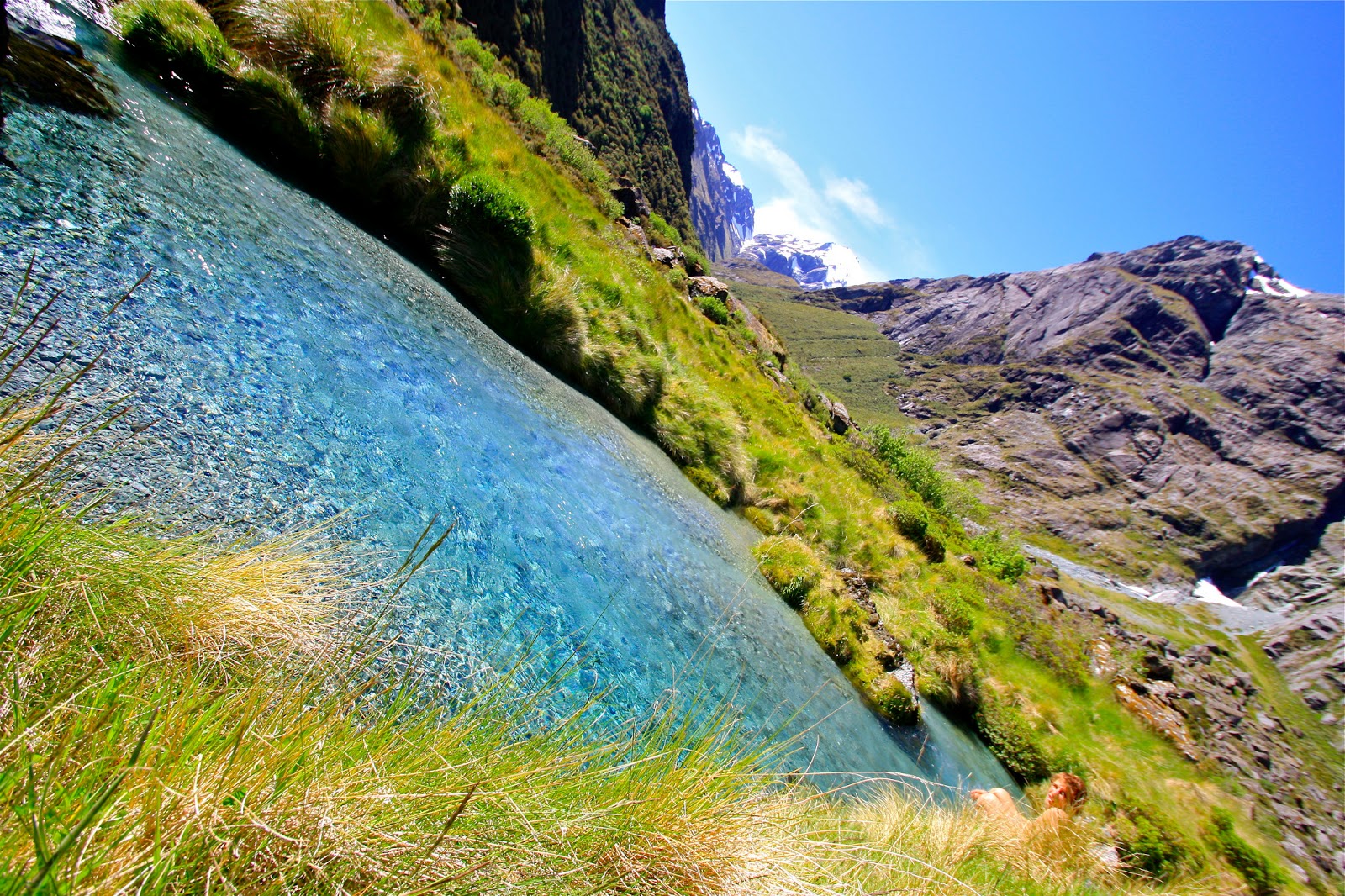
At 11 p.m. it's still not dark but we go to sleep anyway, and in the morning we bury our heads from the brightening sky. The sun takes its time reaching this valley – it has 5,000-foot peaks to climb up first – and we don't rise until it reaches our tent at 9 a.m. Then we sit up and are blown away. Our tent is surrounded by mountains and glaciers and snow – there is a luminous turquoise river flowing outside the tent, waterfalls dripping from cliffs, the sky a brilliant blue. We spend the day following the river upstream to the glacier that's created it.


15 December

At what point does the sacred become mundane, and what do we lose in the change?

The first time it rained here – really rained – I was enthralled, raptured, awed. You've been told that thousands of waterfalls will appear in a heavy rain, but how do you prepare yourself for that? You've seen a waterfall, and you can conceptualize thousands as a number, an amount – but try as you may it is impossible to imagine the dry cliffs you've come to know covered in literally thousands of waterfalls. It is majestic. It makes you want to run outside in the rain, hands in the air, letting water pool in your palms and trickle down your arms.

And then... several feet of rain later... days later, when you realize you can never count on the clear skies to last, that you've chosen to live in one of the wettest inhabited places on earth and that this rain is costing you your livelihood, when you run out of things to do on rainy days and you start to feel old, run down – then what? Someone always puts on the TV and it's all downhill from there. There is no sacred when the TV is on. Not even when you look out the window across the river and see water cascading into the sea.

So it was with the monkeys. I was beside myself with excitement the first time we spotted howler monkeys in Costa Rica earlier this year. It was like a scene from a movie – Jesse and I on the wraparound porch of our jungle cabin, monkeys and bats and lizards in the trees – but after a few days of hiking, we glanced up, saw monkeys on the trail and kept going, feeling slightly superior to the tourists who stopped in their tracks with cameras pointed at the canopy. Is this how it is, then? Must nature present itself in ever new and exciting ways to hold our attention? The natural world as a whole still entices me and drives me and amazes me, powerfully or subtly, but the individual phenomena are becoming like items checked off a list. Thousands of waterfalls? Check. Manta rays? Check. Now how about some whale sharks...?

24 December 2012: Routeburn track

I do not stop and write as I'm walking, because the sensations are too multitudinous to describe. They come and go quickly, each turn of the trail bringing a slight change in the feeling of the place. As the sun travels across the sky, we travel up a valley, through mature southern beech forest, alongside a turquoise river dropping into pools, into open meadows flanked by alpine peaks. With each bend, the light changes and brings a different kind of magic. Who has the words to describe this?

I know I do not. I walk on, sometimes in silent awe, sometimes exclaiming to myself out loud. At the top of a valley where large, scattered boulders and clumps of purplish fern mingle with a sea of golden grasses – where the river deposits itself in pools and cascades before spreading itself wide and braided across the valley below – here we stop for a swim and lie naked in the tussocked grass. There is nothing that could be better than this. The air, the light, the scenery, the solitude – drinking water from the river when we're thirsty, walking barefoot in an alpine valley – we are surely spoiled for life, because nothing else could compare.


13 January 2013

Today I read a passage in Pilgrim at Tinker Creek in which Annie Dillard leaves her cabin on a winter's night to walk in the dark over frozen grasses, and I am suddenly struck with remembrance. Last year at this time, that's exactly what I was doing. I would walk out into the frozen fields of New Hampshire in the moonlight, head bent against the cold, tears dried on my face, until I would realize where I was and stop to look around: tiny stars in an enormous sky glittering above, crystals of frost sparkling on the grass below, my kitchen light glowing yellow in the distance, reminding me which way was home. Which way is home? I still haven't figured it out.

But how much changes in a year. I quit my job and have been living out of a backpack, making hardly any money but nonetheless living richly: traveling in Maine, New Hampshire, Massachusetts, Colorado, Utah, Alaska, Washington, Oregon, California, Costa Rica, Panama and New Zealand. Now, it's 10 p.m. and the sky is still an approximation of blue. A bird still sings. Jesse, tired, sleeps by my elbow; I can see his pulse beneath the skin of his neck. Outside our bedroom door, people are moving around – finishing the dinner dishes, walking to the bathroom to brush their teeth, a quiet laugh. Sounds of life being lived. It doesn't occur to me to be lonely here. But therein lies the paradox – I also do little in the way of reading or writing or being creative. I watch movies, hang out, go places with people. It's all good until weeks pass and my blog is stagnant and my journal blank. Must it be one or the other? Or can I write and create without being lonely and alone?

18 January

I sit in the back of Harlan's car on a gravel road while Jesse and Harlan scout the river. It's windy, and cold for the middle of summer – wind whips the million-hued leaves – all green – and pulls the clouds and sun apart and together, creating bursts of cold sunshine that quickly fade back to gray.

Driving. Flashes of trees punctuated by slivers of light, the open vistas of valleys and rock walls misted with waterfalls, caught in glimpses. My bare feet stretched out in the flickering light. The roof of the Mazda gouged from kayaks and paddles, the floor littered with rocks and pine needles, hats, sleeping bag, atlas.

22 January

Yesterday will be added to my memory as one of those days that define my time in New Zealand: Jesse and I exploring in the wild, free outdoors, scrambling up rocks, following a crystal river to its source in the snows. We crisscross over waterfalls, bend to our knees to drink from a cupped palm, swim naked in a deep pool, walk with the sun on our shoulders. On these days, there is nothing in the world to worry about. Following the Tutoko, the North Routeburn, Bowen and now the Gertrude rivers through valleys and up to their source in the mountains have been among the most carefree days of my life.

This morning, Jesse and I were up at 5 a.m. to go deep sea fishing with Thor. I managed to pull up a shark, two barracudas and a groper before becoming terribly seasick and hurling my breakfast into the Tasman Sea. Back to work tomorrow.

2 February: Catlins coast

This is the kind of ocean I like best: cold, lonely, windswept. We drove all day across the South Island to the Catlins coast, a place where sea lions flop ashore at long sandy beaches, rolling farmland laced with rutted roads abuts the ocean and surf from the Antarctic pounds and swells against cliffs. The kelp forests pulse in the endless rhythm of the sea and penguins walk across pockmarked rocks like flat-footed old men.

The skies are overcast and the evening light is all purple and gray. Jesse and I cook dinner on the grassy bluff where our tent is, and below, along the crescent beach of Porpoise Bay, a handful of lights come on. Four days off here, then back to work, a short road trip, and Jesse goes back to the states. I try not to ask, then what?


6 February

Jesse and I got in a fight last night after downing beers with old men at the one pub in Kaka Point. We turned down an offer from one of the fishermen to stay at his house and pitched our tent on the beach instead, fell into an uneasy sleep. Now, Jesse stays in bed while I make coffee – a peace offering. We are among the first people in the world to see the sun rise today, what little there is of it. Far east, and far south, camping among low dunes with a lighthouse in the distance, the ubiquitous sheep pasture behind us and a sweep of ocean in front, stretching unbroken to Antarctica. I can feel Antarctic winds in the spray of sea salt on my face. This place feels like it's at the end of the world.

27 February

There is less to write about – or so it seems – when I stay in one place. Perhaps that has fed into my apparent aversion to it. New experiences force me to open my senses, to observe – to write. But when life becomes routine, I lose that drive.

Guiding in Milford is dynamic. Every day the wind and weather and light change, but the mountains stay locked in the same positions, towering landmarks that stay constant as the moon and sun and stars travel around them. Surely, there is enough to write about here. Surely, there is much I will forget otherwise. But the days go by quickly, seemingly the same, and the season passes with little to say.


4 March – Haast Pass

Yesterday was Jesse's last day in Milford, and today we left for a whirlwind tour of the South Island. We're camped a few hundred meters off the road by a braided, cobbled river, and summer is on its way out. Days are shorter, nights cooler, and driving today, piles of tiny, golden beech leaves swirled in the wake of cars like glitter sparkling in the autumn sun. Time as flown – I can hardly fathom that I've been here for four months. I'm ready to move on, but at the same time I've grown accustomed to life in Milford, that strange intersection of wilderness and scenic beauty combined with heaps of tourists and the daytime drone of boats and cars and helicopters. New Zealand hasn't quite captivated me the way it has so many others – for all its beauty it often feels packaged, too organized, too tidy and homogenous compared to, say, Alaska. But nonetheless, I'm glad I came.

8 March – Abel Tasman National Park

We drove for three days to get here, and to see the country along the way, since it's so far from home and we may never find ourselves here again. Each night we slept by a body of water, falling asleep when the stars came out and waking up with the sun. We drove for long hours, but slowly, stopping wherever interested us. It sounds romantic, but the reality was long and tedious – the old Corolla we've borrowed won't stay in fifth gear, the front windows won't roll down, and the landscape was certainly nothing worth driving three days for. But at least now we know. And the nights almost made up for the days – finding a quiet spot to camp alone with the waves and stars – until Jesse forgot to put my tent back in the car at Gillespie Beach and no one noticed until we went to set up camp that night in a pine grove overlooking a harbor in California-wine-country-esque Mapua. My tent that I've had for seven years! I loved that tent. So we slept on the ground at the end of a residential street and were woken by retirees on their morning walk and I had a slight breakdown because I'm 28 years old and felt like a homeless person and am sick and tired of always being so broke.

But now we're in Abel Tasman, and it's the first time all week we haven't had to drive anywhere. Yesterday we kayaked to a place called Mosquito Bay, a boat-access only campsite in the national park, and spent the evening drinking good beer and whiskey and playing canasta. Unbelievably – in one of the smallest and most-visited national parks in New Zealand – we have this gorgeous, gold sand beach with a lagoon all to ourselves. Last night we spread our sleeping bags on the beach and while stars swirled overhead, an Australian possum tiptoed around us and the tide slipped out and back in again.


13 March

Back in Milford. The road trip was fairly bland – the scenery uninspiring, the driving long, the towns and cities all seemingly alike. We drove and camped, drove and camped, until Jesse lost my tent and I had a minor breakdown. After that we stayed in hostels and motels for three nights. Once, in our $80 private room at the hostel in Kaikoura, we were woken up by loud drunken backpackers who set off the fire alarm, and we had to stand outside in the street until the firefighters came to shut it off. It's funny how quickly things change – not long ago, I used to think backpacking foreign countries and staying in hostels was just about the coolest thing ever, and now all I want is to camp somewhere quiet and beautiful and unregulated away from the noisy backpacking crowd.

I left Jesse at the airport in Christchurch and drove 11 hours solo through the heart of the South Island to get back to work in Milford. I wanted to stop and record my impressions of this country, but I also wanted to make it home before dark and so I drove on, one landscape blending into another, green pasture to golden hills to craggy mountains, and now I've lost the words, the fleeting impressions. Now I'm back in my own bed, and of all I've seen of this country, I like Fiordland best. It's good to be back. The water is clear and the stars are brilliant and at night I have to go outside to pee, which is something I rather enjoy because it forces me to look at the night sky.

Paul Theroux on ocean paddling: “Sailing the sea was a monotony of doldrums interrupted by windy periods of nightmarish terror. No desert was ever deadlier or more tedious than an ocean.” So true.

3 April

I am a person who thrives on change, and nothing makes me happier than the changing of seasons. Tonight it is fall. The sun sets early and we stay in, those of us left , steaming up the windows while Tex fries up steaks and potatoes. My room is so cold I dive for the blankets, but I won't shut the window yet. Just as the frost arrives, I will walk aboard a plane and fly back into spring in New England, just as I did when I came here in November. I met a girl from Oregon last week who has skipped 11 winters in a row, but it throws me off, settling in for the winter like this and then being yanked away – twice. Tonight, though, I don't care. One by one the guides trickle out of Milford, and those of us who remain grow closer. I have a glass of wine in the evenings, sleep with the windows open and wake up warm and well-rested under a quilt breathing in cold, fresh air. The days are short and brilliant. There is nothing right now that I crave or desire.


For more photos of New Zealand, check out these links:

https://www.facebook.com/media/set/?set=a.743634772895.2127893.10401476&type=1&l=ba47de65af

https://www.facebook.com/media/set/?set=a.772707091735.1073741825.10401476&type=1&l=5103e7dc8a

Thursday, February 14, 2013

dreams.

 
My dreams howl into the core of my being, following me like a wolf on the tracks of its prey. They often seem far-fetched and unrealistic, these dreams, and I put them aside for more pressing, attainable goals: paying back student loans, pursuing a career, being a good daughter. But always my dreams linger on the periphery, the wolf at the edge of the firelight, moving through a landscape of swirling mist, changing shape, calling to me.

Sometimes my dreams make sense, coalescing into something I can reach for – an achievable goal, a certain place on the map. But more often they are simply images I've carried with me since childhood, vague and uncertain. When I was in fifth grade and had to choose anyone in the world to impersonate, I chose Dian Fossey, the gorilla researcher who gave her life fighting for conservation in Rwanda. That was the kind of life I wanted. I'd pore over photos of SCUBA divers swimming with manta rays and National Geographic explorers in Papua New Guinea. My make-believe games consisted of creeping stealthily along creekbeds or pretending the side of my house was El Capitan. But were there any children growing up in post-industrial America that didn't dream of being an explorers or rock climbers or SCUBA divers?

At some point, I shifted my focus north. I devoured books about Alaska, homesteaders striking it out in the last frontier, dog sleds and moose carcasses and detailed descriptions of sewing mukluks and chinking cabins. My greatest dream became to be self-sufficient somewhere in those distant reaches, to live a life worth writing about.

And then I went to college, became saddled with debt and had to find a steady paycheck to cover the bills. The same old story. It happens to everyone; fantasies inevitably become squelched beneath the realities of life. Stubborn or immature or both, though, I've had a hard time letting go. I travel and live in rugged places as best I can; I dabble in adventure sports. But always dreams of a different life elude me, remaining just out of grasp. My housemates go out to the pub and I stay home staring at photographs in a new book I was given about a polar expedition. I peer into the eyes of one of the explorers and they squint back from within the fur ruff of a parka, revealing nothing. How did you get there? Who will invite me on an Arctic expedition? And more importantly, how will I pay the bills? Surviving seems simple these days compared to the question of how people can afford to be professional explorers.

These are the questions that plague my dreams – like most people, I suppose. I don't delude myself into thinking that I am unique. I don't feel sorry for myself. But I wonder what I can do to get invited on some epic expedition, how I get to be one of the people who squint into the camera lens with a face hardened with jungle mud, Arctic ice, sea salt. It hardly matters where. All that matters is that these dreams continue to chase me like a hungry wolf. They keep me restless, roaming, searching, awake while everyone else drinks a beer and goes to bed. I stay awake writing, because writing seems to be the answer.

Saturday, January 26, 2013

deep roots

A version of an assignment I worked on last fall when I was staying at my friend Theo's cabin:

---


Euclid Farnham's wife is trying to shove a head of cabbage into the refrigerator.

“This is not working,” she calls from the kitchen, her head buried in the depths of the appliance.

“This is not working,” Euclid repeats to himself, rising from the rocking chair by the woodstove 
where he's been discussing, among other things, how history and conservation are two sides of the same coin. He shuffles into the narrow kitchen. Seventy-nine years old, he's lived in this house his entire life. His family inherited it “down to the kettle” in the throes of the Great Depression.

“And the squash is getting gooey,” Priscilla Farnham mutters from within the fridge.

“The squash is getting gooey,” Euclid repeats. “What do you need me to do?”

“Take this.” Priscilla shoves an armload of fall produce at her husband. “There's no room in the crisper. We should never have bought those grapes.”

“Our problem is we have the world's smallest refrigerator,” Euclid explains en route to the pantry. “Look around this room. We have seven doors and two windows. Where do you put anything?”

“Oh, hell,” Priscilla says from the kitchen. There's a loud thump. Just then the phone rings – an old-fashioned, actual-bell ringer. It's a library group asking to book a visit from Mr. and Mrs. Claus at their Christmas party, roles that Euclid and Priscilla have been playing for decades despite the fact the Euclid – lean, with a gray mustache and thinning hair – needs a good deal of padding to fit the part. He takes the call and makes a note on the calender.

“It's a real ordeal, getting involved in all this stuff,” he says wryly, sitting back down. Not only is he the only Santa anyone can remember, he's also served as town moderator and president of the Tunbridge Historical Society for more than 30 years, and recently retired as cemetery commissioner and president of the Tunbridge World's Fair, an annual agricultural event. He's been a justice of the peace, the town lister, the trustee of public funds, a dairy farmer, a maple syrup producer, a soldier, a Republican, a Democrat and an author. The one thing he has not been is a father.

“I'm the end of the Farnham line,” he says. “That concerns me, it really does.”

Farnhams have been in Tunbridge, Vermont for eight generations – since before statehood in 1791. Euclid's ancestors walked north from Connecticut alongside Ethan Allen's family after the Revolutionary War, hauling their belongings on horseback through the forest until they reached the present site of Tunbridge. They've survived a Mohawk raid, fought against a dam that would have flooded the town, and lived through natural disasters that nearly did flood it. Euclid describes events from the early 1800s as though talking about yesterday's Red Sox game.

“My family's been here so long, I grew up with all this history,” he says. “If I don't write this down, a lot of it's going to be lost. It's the roots of the community.”

***
In Where the Bluebird Sings to the Lemonade Springs, the western writer Wallace Stegner writes about the “deficiency of community” and lack of “deeply lived-in places” that can result from the transient, mobile culture of the American West. Coming from a nation built by pilgrims and pioneers, Americans have long searched for identity and opportunity by taking to the roads, trails and highways. Leaving is in our blood.

Staying is less romantic. Staying means grappling with sustainability. It means preserving resources. But when you stay, your history sinks like taproots beneath the land until you become part of a place. You remember, for instance, what the forest looked like before the American chestnuts and elms all died. You know there used to be salmon and eels in the First Branch of the White River, because your mother told you how she sat on the banks and fished for them. When you know these things and you care about a place, you have the power to protect it.
 
For decades, though, the Farnhams were the exception, not the rule, even in blue-blooded New England. Throughout the 20th century, droves of families and young people left Vermont in search of richer soil and better opportunities, and the population of Tunbridge dwindled from 2,000 to less than 790 by the 1960s.

Even Euclid's grandfather left for a while. In 1880, Grandfather Farnham was swept up with the great migration west, joining millions of others who left their homelands and sought new opportunities and better futures by pushing ever further into the new frontier. Grandfather Farnham found himself drawn to the the fertile, boulder-less expanses of Kansas, but his own father, a Civil War veteran, wouldn't let his son out of Vermont so easily. 
 
“In a last desperate attempt, he took a train as far west as he could go to convince him to come back,” Euclid recounts, his gray eyes flashing. “He was successful, thank heaven. I've been in Kansas, and it's long and flat and boring. I'm glad I'm not in Kansas.”

Euclid is glad he's not anywhere else but on Whitney Hill Road in Tunbridge, Vermont. In the 1950s, he spent three years in the army traveling through Europe, and in the early 1980s he spent a month exploring National Parks west of the Mississippi. 
 
“It's great out there,” he says. “But I just – I just missed the hills of Vermont. I missed the hardwoods. It's a silly thing, but growing up with the maples and the beeches, when I got east to Minnesota I felt like I was home again.”

***
Today, the hardwood forests that Euclid loves are changing, along with nearly everything else. The state has turned from staunchly Republican to staunchly Democrat (a move Euclid applauds), many of the old family farms have been hacked into smaller and smaller plots, and much of the old pastureland has reverted to forest. 

“It seems like everything is happening to our forests,” he says, ticking off the diseases that have swept New England trees in his lifetime. “We lost our chestnuts. The elm trees are gone. The butternut trees are well on their way. The beech trees – well, the reason I'm burning beech this winter is I'm told to burn them for wood or they'll die anyway. It seems like one species after another is going.”

Seasons have changed drastically since he was growing up. Winters are warmer and natural disasters are more common. Sugar bushes and apple orchards are suffering. There are fewer fish in the rivers and the rivers themselves are less stable due to decades of human intervention. 

But today, a second wave of back-to-the-land revivalists buying land in Vermont, and they're doing it with the radical intent of staying. The local stigma against “flatlanders” is lifting, and demographics are slowly shifting. Euclid's neighbors on Whitney Hill Road now include a young law student who put his career on hold to build a cabin, a Jamaican farmer (the only black man in town) and his artist wife, and a publishing agent who's no longer chained to New York City thanks to broadband internet. None of them have roots in Tunbridge. But they all want to stay. 
 
***
The recorded history of Tunbridge, Vermont currently resides in its entirety in a cramped office in Euclid Farnham's house, but within the year a new fireproof room will be completed at the local library and the collection will be moved. Euclid and Priscilla are deciding what to do with their house – a piece of living history itself – when the time comes. Meanwhile, Euclid is working on his third book about Tunbridge history, preparing to leave eight generations' worth of research, observations and anecdotal knowledge to his new neighbors. He hopes it's enough.

“If we lose our roots,” he says, “then future generations have lost a lot.”

Thursday, January 24, 2013

where the wild things are

 
Why does it matter that we preserve wilderness in the United States?

Some people argue that we need to preserve wilderness for its own sake; others that wild places heal and replenish the human soul, and are necessary to our very being. There is a current wave of “neo-environmentalists” who argue wild places have economic and social value and should be preserved for those reasons. The point can also be made that wild plants and animals may hold medical secrets that could benefit humans, and there are countless other reasons stretching across time and literature and academia. But none have held up against our ongoing march toward progress.

Last week, U.S. District Judge Ralph Beistline from Alaska ruled against afederal Fish and Wildlife proposal to protect a 187,000 square mile chunk of the Arctic – an area larger than California – from oil and gas exploration to preserve rapidly shrinking polar bear habitat. Judge Beistline's ruling was applauded by nearly every public figure in Alaska: Governor Sean Parnell called the ruling a victory against “the latest in a long string of examples of the federal government encroaching on our state's rights.”

I have never been inside the Arctic Circle, and I have never seen a wild polar bear. I do not have personal experience of the financial and physical struggles of families living on Alaska's North Slope. But I like to think that I have a degree of empathy, and I've worked closely with Alaskan teenagers who have come from such families. I've spent many weeks in the wilderness with them and many hours paddling canoes and talking with them and I think that in the process I've gotten a glimpse into life in villages of the far north. It doesn't sound easy. But a line has to be drawn somewhere.


Though I haven't met with a polar bear in the wild, I have watched one at the Chicago Zoo – a massive creature with a range of hundreds of miles in the wild, forced to swim in circles in an artificially blue pool in 90 degree heat in the middle of Chicago. I've also encountered a good number of wild Alaskan brown bears, and their smaller black cousins. I've paddled a canoe next to a swimming brown bear, watched them snatch salmon from a river and spied on them through binoculars as they lumber over brown tundra. And I have seen enough other large animals – sharks, manta rays, whales, wolves, moose and buffalo in the wild – to know the contradictions that exist in such creatures: violence and grace side by side, power on one side of the coin and fragility on the other.

In response to Judge Beistline's ruling, Gov. Parnell issued a statement that he is “pleased the State of Alaska was able to fight off this concerted effort to kill jobs and economic development.” Meanwhile, environmentalists elsewhere in the U.S. have raised their collective megaphones to express outrage over the decision, protesting on behalf of the bears. All well and good, but their voices aren't heard in the one place where it matters most: Alaska, which, as a state, sued the federal government for trying to intervene in local affairs. Alaskans know that a bunch of liberals in Washington D.C. don't know shit about what goes down in northern Alaska. It's a different country up there, a different culture. And when students are dropping out of school to hunt walrus to support their family, it's hard to turn down development that brings jobs and hope to a region still struggling to define itself in the modern world.

In New Zealand, where I am spending six months, there are no large native mammals. The only native land species of any substance were the moa – large emu-like birds that were hunted to extinction by the Maori – and the Haast eagle, which died along with their main food source, the moa. True there are dolphins and whales in New Zealand's waters, but it is utterly strange to tramp through thick forest, beneath towering peaks and glistening glaciers, in deep valleys that seem as wild and remote as you can get – and not have the slightest fear of running into something that can kill you. Edward Abbey said that it ain't wilderness unless there's something big out there that can kill you, but perhaps he had never been to New Zealand. It's plenty wild down here on the South Island, but you can cook dinner right in your tent without fear of a bear attack and walk barefoot up the trails without worrying about a snakebite.

In a way, it's freeing: a hiker's paradise, free of danger as long as you bring the right clothing and don't get lost. It offers a relaxed sort of wilderness experience, and that's a nice change after spending months camping in bear country. But imagine a world where all the wild places were like that? It would get boring pretty fast. Part of the allure of spending time in the wilderness is not knowing what you'll see, what you might run into around the next bend. There's a sense of trepidation and excitement. There's the knowledge that you're not the biggest, baddest thing out there.

So why preserve wilderness? Because it's of value to use as a species, because we need it as much as it needs us, economically and spiritually and ecologically. Preserve wilderness for its own sake, in the spirit of altruism. And preserve wilderness because I personally do not want to live in a world where buffalo are nothing but a roadside attraction on the outskirts of Yellowstone and polar bears swim in hopeless circles in Chicago and people can walk in the wild places without any chance of encountering something that bigger than they are, something very much alive and breathing.

Tuesday, January 15, 2013

Alaska journal, part 2

Dug this out of my journal from the summer, back when I was in Alaska.
 
4 August

Another month, another program. I forget what it was like, to not be fully absorbed in your job, to not live, eat and breathe it. In a way, it is too consuming: I have little time or inclination to write or be creative. That part of me falls away as easily as a label peeled off a bottle, and I wonder whether I have the self discipline to conjure it back up when I leave. Do I need the structure of a writing job to live the life of a writer, or can it be like flipping a switch: wilderness guide one week, writer the next? How are these two parts of me conjoined, and where do they diverge? Most importantly, how can I connect them?

On the other hand, it is a blessing to be fully present in each moment. I am absorbed by the girls in this program, the guide team, the group, the expeditions, the daily tasks and routines – every piece of it requires my undivided attention until the extraneous thoughts drift away into the cobwebbed corners of my mind. Today I was doing paperwork and looked at the date – 8.4.12 – and had to pause to consider how unreal is seems. Has it really been nine months since my heart was stomped on like a burning cigarette on a cold night? Now, days pass and I hardly think of him except with a twinge of regret that it wasn't what I'd hoped it would be. But I am glad to be here and doing this again, and glad to have the freedom afterward to go anywhere, do anything.

14 August

Time, as usual, flies, and I have little of it to spare for writing. Two guides and five kids is a demanding ratio, and in the evenings I like to sit and talk with Jesse. But there is so much I wish I could write down, because I know that without writing, it will become lost. It is not the words that count, looking back at it years later, but the act of writing itself, as if sitting and making yourself aware of where you are and what it smells and tastes and feels like is more important than the words themselves. I remember being about 9 years old and sitting behind a dresser, writing in my diary while cookies baked in the kitchen. I wrote about school that day, but what I remember most is the moment I put pen to paper: the smells of Christmastime, the grey slush outside the window, the toys on the floor. We cut and paste together our lives in this way, words and old photographs coalescing until we develop stories, memories, explanations, selves. 

Last week, we attempted to hike 3,700-foot Mount Etolin and made it to approximately 1,300 feet, or roughly one mile in four days of hiking. Since there was no chance of summiting, we were able to come down a day early and dry out at the floathouse: we were soggy to the core, filthy and stinky. All the girls got their periods at once and I didn't pack nearly enough tampons, and everyone was drenched to their socks and underwear within the first hour of hiking. How to possibly describe such rank wetness, with no dry place to escape to? We slogged through mud, slept in wet sleeping bags, hung wet clothes from our bodies. It was one big fat bucket of suck, and yet, there were moments: bending over with a 70-lb pack on to lean on my trekking pole and noticing how alive the forest floor is, how much life thrives in the wetness that drives humans away. Hair-like worms waving, centipedes skittering under leaf litter, tiny spiders and beetles and nameless insects crawling and dangling and jumping. Everything fetid, fecund, alive; growing, rotting, struggling to carry on.

And let us not forget the black flies. The hoards of no-see-ums that erupted fro the muskeg pools upon our arrival, enlivened by the first human prey they'd likely seen in their brief, miserable lives. They dropped into our food by the hundreds, flung themselves into our eyes, noses and ears; invaded our tents and brains and sanity. Let us not forget them.

Then today, for the first time in 20 days, we awoke to sunshine. Beautiful beach, fire, dry everything. We are on the move agin, circumnavigating Etolin Island. I move my home every night, carrying what I need from the canoe to the woods, setting up my tarp and sleeping bag again and again under different trees, in different forests – all different and all, somehow, the same.

17 August

I'm sitting on the long flat-rock beach of South Etolin Island, watching the tide creep closer to my feet. We are staying here for three days for reflection time, and it is nice to rest from the rigors of expedition. The embers of the morning cook fire crackle and the occasional salmon throws itself out of the water and lands on its side with a smack. Ravens fan the air with their heavy wingbeat and, as in a Grateful Dead song, the eagles fill the sky – four adults and two juveniles swooping back and forth, dropping feathers along the beach. The woods are like a park here – flat and mossy ground under a canopy of widely spaced cedars and ancient spruces. The sun is shining and the sky is blue for the fourth unbelievable day in a row, and I'm living in shorts and a tank top. Life is grand. I do not doubt for a second that returning here was the right decision, that ending a two-year relationship and quitting the lodge were all right in some roundabout way and that this is the track my life is going to take: wandering, loopy and beautifully unpredictable.

The water is a flat powder blue with ripples of electric teal wavering toward the rim of sky. The sky itself is wide and blue and the horizon is a haze of blue mountaintops and blue islands. It is a whole landscape painted in shades of blue, a blue that is alive, flecked with silver and light, always changing.

Later – Walking back from across the long beach at twilight, Jesse's figure as he stoops by the water to wash the dinner pot is striking – a lone silhouette against an enormous backdrop of sky and ocean. It is sometimes easy to forget, being part of a group all the time, that we are essentially the only people on these distant, scattered beaches; that we alone make these untouched islands our home. I am more comfortable walking barefoot across this beach with a drom of water collected from the creek than I am on any city street. Stumps and trees and rocks become my landmarks. It is not a life I want to live forever, but I will always miss the simplicity of gathering water from a stream, cooking over a fire and sleeping under a tree.

There are no unsacred places – only sacred places, and desecrated places.” – Wendell Berry 


Wednesday, January 2, 2013

skipping winter.

  -->
I am skipping winter for the third time in my life, and for the third time, it is unsettling. I don't get homesick anymore, not really – not the way I used to. But there is always a part of me that suffers pangs of yearning for the cycle of seasons. Home, more than anything else, is embodied by the feeling of the seasons as they pass.

As I move from place to place, I make trade-offs. No place has it all. I leave the northeastern corner of the U.S. to seek bigger spaces and new horizons, to expand my perspective on things. It's something that I need to do. I cannot stay there – it feels cramped now, too tame for the tastes I've apparently developed. But when I'm away – in particular when I'm far away – and I'm reading a book or watching a film, I am sometimes struck by images of the seasons as I know them. Of northern hardwood forests bare and empty in a monochrome landscape. A sap bucket hanging on a tree. Smoke from a chimney on an old house, evaporating into a frigid galaxy of stars.

It is not only seasons, but history. New England is strong on history, and growing up there it was imbued in my understanding of the place. If I were to take someone to my hometown now, they would would see only the Dunkin Donuts on the corner, gray snow piled against slushy sidewalks; towns bleeding into each other, a vast network of roads drawn willy nilly in the days before urban planners existed.

I see these things too, and yet I see beyond them, into the past. I see my ancestors, who worked outside in all seasons and came to depend on their cyclicality. I see farther north into Vermont and New Hampshire and Maine, where the past is closer at hand and people still live intertwined with the land. My vision is blurred by moments from my own past: a candlelit night in a cabin drinking elderberry wine; a fiddle's notes slicing through a steamy room while dancers shake the 200-year-old floorboards; snowshoeing on winter afternoons filled with silver light and the long shadows of birch trees.

These things are not visible at first glance. They reveal themselves slowly, over a lifetime of exploring, of pulling back the curtain little by little. I brought someone here once, and grew frustrated that he did not love it as I hoped he would. Ultimately, his rejection pf this place became his rejection of me. But you cannot understand this place until you've experienced it in every season – and each week, each month is a season unto itself. They form a rhythm that is vital to my very being. I know there are other places with other seasons. I know that fall in southeast Alaska means not crisp blue days and bright leaves but rather a descending darkness and a steady cold, gray drizzle. This is not any less authentic than the fall I grew up with; nor is Hawaii's warm, rainy winter any less a true representation of winter than one with sleighbells and evergreen boughs hanging on doors. I know this, and yet I cannot believe it to be true: winter is snow, fall is harvest, spring is earth and summer is green. That's simply the way it is, in my mind: all these other places I go to can only approximate the brilliance of seasons in New England. There may be greater wildernesses, more beautiful landscapes, more laidback cultures. But seasons. They mean so much to me. 


 Winter in New Hampshire

Tuesday, January 1, 2013

water power


There used to be a boardwalk. Now it is closed off, rotting, ridden with holes and plastered in slippery leaves. It has been raining for three days now, really raining, the kind of rain that can only occur in a place that receives upwards of seven meters of rain a year. Three days ago the sky opened up and water began pouring out of it in the way it might during a tropical afternoon storm or a monsoon – a kind of rain that comes quickly and leaves a short while later. But this rain doesn't leave. It continues unabated for days.

On Monday, having played board games, baked, done yoga, ate and watched moves for far too long, we gear up. Everyone digs out the most protective, waterproof combination they can find. I wear my dry suit, neoprene booties, neoprene gloves, a neoprene balaclava and my diving mask. Then we pile into the back of the van and drive to Bowen Falls.

At 160 meters tall, Lady Bowen Falls is three times higher than Niagra Falls. It's fed by a glacier, but the sheer mountains surrounding it lack soil and thus do not absorb rainwater, so when it rains hard like this, Bowen floods quickly. The mountains funnel rainwater into an ever-swelling river that churns through an alpine valley, then shoots like a firecracker into the sky before dropping over a ledge the height of a 50-story building.

Bowen Falls is not only a magnificent example of hydrology, it also supplies the community of Milford Sound with drinking water and electricity. About 150 people live in Milford Sound, and every time one of us flushes a toilet, drinks a glass of water or takes a shower, we are using pure, untreated glacier melt-off that has been locked up in ice for 30,000 years. Humans arrived in New Zealand 800 years ago, so the water coming off Bowen Falls has never before touched another human being. This astounds me. In London, they say, the water coming from the tap has already been cycled through eight people.

We're lucky here. Not only because we can turn on the tap and drink glacier water (as well as brew beer from it), but because when it rains hard and there is no work and the one road into this place is closed off due to rock slides, we venture into the most raw, wild display of nature I have ever imagined. We can go under Bowen Falls while it is flooding.

I've known this for weeks. I think I'm ready. I've been warned to cover every possible piece of skin. I'm expecting it to be intense.

But nothing can prepare me for the reality of it. We pile out of the van – seven of us, five kayak guides and two friends – and walk along a narrow, crumbling piece of asphalt, the start of the old trail. On one side is the loamy, pulsing ocean; on the other, a cliff dripping with ferns, sphagnum moss and rivulets of water. We reach a solid metal gate and climb over it, like teenagers sneaking onto the football field at night. The boardwalk on the other side curves against the ocean for a while, then disappears into the forest. As we follow it deeper toward the falls, water becomes the only sound. Rain pelts the leaves and splatters into a forest that has become swampland practically overnight.

The wind picks up as we approach. Bowen Falls creates its own winds, gusting over 100 kilometers per hour at its base. Trees become gnarled bonsais, their branches and trunks swept away from the falls and frozen in fantastic shapes as if reaching their arms toward the sea in a plea for help, a desperate attempt to get away from this reckless display of power.

Then there is nothing. Even with a diving mask, I cannot see anything but driving water against a backdrop of gray. I can hardly breathe; I must constantly spit out mouthfuls of water. There is no sound but the roar of the falls. I concentrate only on putting one foot in front of the other, battling against the force of the wind, leaning into it with all my weight, trying not to lose sight of Ricki's orange jacket somewhere ahead. At some point, the boardwalk ends, and we struggle on. Often the wind knocks us over and we sit, clutching tussocks of grass, helping each other crawl forward. We cannot talk or see each other's faces, aware only of the vague blurs of color and groping hands that we know belong to fellow human beings.

The force of the wind and water is overwhelming, breathtaking, astonishingly powerful. It is like intense heat or cold: impossible to describe until you've felt it for yourself. I feel like there should be a TV camera on me, like I am a foolish meteorologist risking life and limb to deliver a report from the middle of a hurricane. But there are no cameras. There isn't even the sensation of wetness anymore. Everything else drops away until there is only the rush of adrenaline coursing through our veins and the understanding that for all our bravo, mother nature is able to knock us and anything we build swiftly and surely on its ass. 

 (Above: Bowen Falls when it's decidedly NOT in flood.)


 (Above: Paddling under 150-meter Stirling Falls as it empties into the ocean.)
Nature Blog Network