Labels

Tuesday, December 11, 2012

water, part 2.


My life is the story of water. My cells, my mitochondria and riboplasm and DNA swim in pools of water. I pour it into my body and still I want more; I lust for it. It drives me forward, pulls my feet toward its source. I swim under waterfalls and break the surface of a crystal pool high in the mountains. I drink it deeply, let it fall over me, into me, around me, and still I want more.

Though I have moved often, I have lived most of my life in wet places. Unintentionally, I am drawn to them, perhaps because I grew up in New England's green summers, among plants and gardens fed by a generous sky. In college I studied in Ireland, wrote papers while lying on dew-covered fields beneath banks of clouds. Later, gone to the Marshall Islands to teach, I happened upon the wettest and most fertile island among thousands of parched white-sand beaches. The seams of my clothing rotted in the humidity. Everything stank. Later still, I went to live in southeast Alaska, to a place that receives 160 inches of rain a year. I moved up and down the misty, echoing passages of the Tongass Forest one canoe stroke at a time, vainly trying to stay dry in a world carved by water.

Thinking I needed to dry out, I left Alaska and went to Hawaii, but inadvertently chose to live on the eastern shore, the one deluged with rain and dripping with waterfalls while black lava bakes in the sun on the west coast. And now I have surpassed even my own standards, finding myself in one of the wettest places in the world, a place that makes the Amazon basin seem arid, a place that receives an average of 22 feet of rainfall each year.

Outside, the rain is falling incessantly and has closed the Homer tunnel, which provides the only road access to this remote corner of New Zealand. We are stuck here in Milford Sound, rained in. New waterfalls appear every time we look outside at the sheer cliff faces surrounding us. They multiply by the hour, trickles of rain turning to ribbons of mist, ribbons turning to cascades and cascades becoming spouts of whitewater that run violently into the sea, creating temporary microclimates at their bases.

Though these sea cliffs are covered in green, there is virtually no soil holding the plant life together, nothing to absorb this water that pours from the sky. Lacking soil, the mountains shed rain like water off a duck. Thousands of waterfalls appear, more than you ever imagined, more than seem realistically feasible. They stream into the sea, gathering tannins from plants on their way down. The brown, tannin-rich freshwater floats atop the saltwater in a visible layer that can be several feet deep and filters out sunlight, creating a unique phenomena called deep water emergence, in which extreme deep-water species are tricked into living in depths of just 30 feet.

Last year was the driest summer on record in Milford Sound. The rivers ran low and the layer of freshwater floating atop the saltwater shrank and the peaks of the sea cliffs stood starkly gray against an unwavering blue sky. Today, that world seems far away. The sky has cleaved open and rain is pouring out of it and our kayaks lie upsidedown on the gravel, waiting for the rivers to rise. Without water, the granite walls of Milford Sound would resemble Yosemite's blank rock faces, but thanks to massive rainfall they are blanketed in vegetation. One in ten trees manages to bury its roots in a crack in the granite. The others simply entwine their roots together, spreading them over the thin layer of moss and ferns that clings to the sheer cliffs. When it rains hard there are tree avalanches, massive swaths of plant life ripped from its tenuous foothold and sent crashing down into the sea. The mountainsides are streaked with the scars of these avalanches, dark green where the oldest ones have struck, lighter green for avalanches from 20 or so years ago, where moss and ferns have started to grow back, and gray for the most recent, where only bare rock has been left behind. It takes 80 to 150 years for the forest to re-establish itself.

This is a place defined by water. My life is defined by water, so it is fitting, perhaps, that I find myself here. But sometimes I feel the rain is too much to take. I told someone at a party that I might be growing moss myself, become moldy and waterlogged by living in so many wet places. I was told, graciously, that I am not getting moldy. I am glowing.

That may or may not be true. But either way, I am ready for it to stop raining. 


imagination.

(Above: The world's only alpine parrot, a native Kea peers down into New Zealand's Fiordland region from nearly 5,000 meters above sea level.)

Living here requires imagination. I steer my kayak into a slough of the Arthur River, a narrow channel of water where ferns of every size and shape gather along the banks and moss-covered trees intertwine their arms overhead. In the luminous, chlorophyll-filled sunlight filtering through the forest, birds' melodies fall like raindrops. It is like paddling through Jurassic Park.

Imagine, for a moment, that it is not the year 2012, that you do not live in a Jetsons-like world of sleek electronics and tiny computers, a world where cities encroach ever further into wild places. Imagine you live in the year 1200 a.d., when the Maori first reached the shores of New Zealand and discovered an evolutionary wonderland devoid of mammals and overrun with birds. In the absence of predators, the islands' birds lost their defense mechanisms and grew to outrageous proportions. There were enormous moas that no longer needed to fly to escape from hungry jaws; flightless parrots that roamed the forest floor beneath brilliant green and turquoise plumage; penguins that nested among evergreens. There were eagles capable of plucking a fully grown man into the sky. The only native mammal was a small bat. People took a long time to arrive.

In the morning, the birdsong was deafeningly loud, bouncing off steep valley walls. Early European explorers wrote that they couldn't hold a conversation while enjoying their morning tea because of the competing choruses of songbirds. But by the time they arrived in the 1800s, the Maori had already decimated many of the defenseless giant birds, hunting them one by one for meat until 26 species were eliminated. The Europeans inadvertently finished the job, bringing rats and cats and opossums that further wiped out New Zealand's native bird populations by preying on their eggs. Today, the flightless kakapo parrot lives on only in isolated, controlled islands off the coasts. The emblematic kiwi is critically endangered. And in the still mornings, only a handful of bellbirds fill the air with their clear, beautiful melody. Some environmentalists argue that the government-led effort to control invasive mammals is further poisoning the forest, ushering in a third wave of extinctions even as it tries to restore an ecological balance.

But forget about that. It is relevant, and yet it is not. On mornings like this, the past is still present, still very much alive. Squint your eyes until you are gliding through a web of green jewels. Dip your kayak blade into the water. Forget that you live in a time when species are disappearing in rapid succession, when animals and plants must adapt to an anthropogenic world or be relegated to a few protected strongholds. As John Haines writes, it is foolish to believe that we erase life by killing it off. Vanquished in one place, life springs back in another. Echoes remain. Use your imagination. 


 (Above: Endangered Whio, or blue ducks, live exclusively in New Zealand's clear, swift-moving streams and rivers, often playing in whitewater rapids.)

Wednesday, December 5, 2012

return to guiding.


More than anything else, being a competent guide is about knowing a place; knowing it with a certainly that allows you to guide other people through it safely and confidently. It is one of the things I like about guiding – it draws upon a sense of place, builds upon a connection to one specific place in this vast world. This is what we are trained to do, we who come in from far away to work for a season or two in what is surely one of the world's most beautiful landscapes: Piopiotahi, or, more mundanely, Milford Sound, in New Zealand's Fiordlands. After a few weeks we are able to recite facts and figures, understand what the weather will do when a westerly blows in from the Tasman Sea, point out geographic landmarks. But we do not yet truly know this place. Each day, one moment at a time, we are discovering its secrets. That is our job. That is what we are paid to do.

The people we take out sea kayaking are simply passing through, wanting to hear the facts and stories that make this place unique among so many others, wanting to have memorable experiences and take photographs to bring home. The travelers are like gusts of wind, a slurry of faces and names swept away by camper vans and rental cars and tour buses each evening, bodies wrapped in different variations of a theme, the same GoreTex jackets and zip-off pants, the brightly-colored nylon and synthetics of outdoor travelers. They are good people, most of them. They've traveled far to get here, taken a 120-kilometer road through the mountains and come out on the other side into a different land, wanting only the trip of a lifetime, the trip they've been saving for and waiting for and planning for, and we are here to deliver it.

But we too are only passing through. Milford Sound is in a national park, a world heritage site, thousands of acres of public land owned by no one and administered from afar by the government of New Zealand. It is soggy, inhospitable and ridden with sandflies. Even Maori people didn't set up permanent settlements here – they walked in on a 55-kilometer track, loaded their dugout canoes with seafood and greenstone, and carried them back out. No one can claim to be from here; not one person has grown up among these towering cliffs and dripping beech forests, where dolphins leap under snowy cliffs and penguins waddle through green underbrush. No one owns land here.

Does that somehow make it less real, that we cannot claim this place as our own, that we cannot build lasting communities here? Or does it make it more real, knowing that our time is fleeting, that even in the 21st century we are unable to harness such an untamed place? Maori legend says that after the demigod Tu created Piopiotahi with his greenstone adze, the goddess of the underworld cast millions of sandflies upon it to ensure that no one would linger here too long, that man would not become idle in the face of such beauty and destroy it. This is the reason there are no permanent residents of Milford Sound.

Even after just a few weeks, there is a part of me that wants to live in a “real” community, a place with schools and local government, not somewhere that feeds almost solely off of tourism with a little bit of commercial fishing thrown in. But what is the definition of community? If it is a group of people who care deeply for each other and the place they live, then this is as real as it gets. When I take people out on their kayaking adventure of a lifetime, they sometimes ask me if I like living in such a remote, isolated place. I tell them the truth. I tell them I love it. 


Saturday, November 17, 2012

Until I figure out internet access in the remote corner of New Zealand where I'll be moving to tomorrow, I'll be away from blogging. But I'll still be writing, so expect more to come!

xoxo
Krista

familiarity

 
The sunlight calls my feet forward, drawing me up a new path. I have been coming here for many years, up the yellow trail to the summit and back down the red trail to my car with little variation. But today I follow the last rays of November sunlight onto a new path, hugging the south the side of a mountain until I reach an outcropping of crumbling basalt rock. Below, the broad valley of the Connecticut River spreads out like a quilt. Green and stubbly fields patch the alluvial plain of the river, dotted with long, narrow barns for drying tobacco. A ribbon of traffic slides silently along Interstate 91.
 
Spread on both sides of this ridge, the Pioneer Valley in western Massachusetts has been settled for centuries, first by agriculture, later by industry and still later by subdividers who build ever larger houses on the abandoned fields. The wooded ridge of the Mount Holyoke range is comprised of seven individual summits strung together like vertebrae on a backbone – an island of nature in this sea of human activity, rising over the valley like a sentinel. The people who live below come here for a dose of nature – hiking, running, biking or simply sitting on the mountaintops to breathe in the view and better understand the lay of the land they inhabit.

When I first got my drivers license and began to come here as a teenager, it seemed to me one of the most beautiful places in the world, a place where I could escape from pressures and asphalt and do exactly as I wanted. It seemed like pristine wilderness. Since then, I have spent time in wild places that make the Mount Holyoke range seem modest. I seek unfamiliarity. I find comfort in new places, in starting over. But lately I've found comfort in the familiar as well, and few places are as familiar as this.When I return home to western Massachusetts, this is where I come back, to walk, to reflect, and to feel the incomparable sense of home that often eludes me on my travels.

If there is a river that is home to me, it is the Connecticut, in whose valley I have lived the majority of my life. And if there is a forest or a mountain that I can call my own, it is here. I have taken dates here, lost myself in solitude, cried, dreamed, tripped on mushrooms, learned about the natural world and gained the confidence to explore it by myself. I have grown up here.

My favorite time to come is in November, when the deciduous northeastern woods rise above a carpet of sepia-toned leaves – oak, beech and maple, slippery underfoot and studded with rocks and stumps. The trees are spaced far apart, knobby and slender, bare arms reaching for the light. The people who came to see the blazing colors of autumn are gone, and the forest is quiet, waiting for winter. In November, the magic light of evening stretches ever earlier into the day until the entire afternoon is a pool of slanting golden light. Or on some days there is no light at all, just a diffuse grayness that settles over the trees and into your bones, echoing its silence through skeletal branches. I walk through these November afternoons lost in the rhythm of my steps, unhindered by the brambles of summer, free to wander.

unintentional poetry

Taken from a mispelled Facebook posting.


Finely finished with the wood
The boys said when they get there own houses they won't
burn wood we will see

central america journal, part two


Day 10: Panamanian pandemonium at the border. We left Puerto Viejo in the mellowness of the off-season, drove through drooping, stagnant banana towns – fincas owned by Chiquita Co. – and arrived smack in the onslaught of heat, hustlers and traffic that is the Costa Rica/Panama border over the Rio Sixiola. The border itself was out of another era: an old railroad bridge with rough-hewn boards nailed haphazardly over the trestles, workers carrying racks of bananas and old women with children shuffling across. But on the Panamanian side there was chaos, presided over by men intent on hustling groups of heat-dazed backpackers into their elaborate money-making schemes. Jesse and I find ourselves caught in the flow, swept into a room to “pay” for our luggage and squeezed into a packed van without A/C. We careen through a squalid city and over a mountain pass to a dock in the river town of Almirante, where we are transferred onto a boat and motored past stands of mangroves out to sea and, finally, to the islands of Bocas del Toro, where the in-your-face entrepreneurism doesn't stop but at least the beer and food are significantly cheaper than in Costa Rica.


Day 11: We escape to the outer islands of Bocas, and our days are spent reading, snorkeling, boogie boarding and exploring. Time slides by like skin on oiled skin, the hours melting into each other, a swirl of ocean and sun and one jaw-dropping view after another. And then we meet Polo.

To find Polo, fly first to Costa Rica, grow disillusioned, head south to the comparatively lawless Panama, cross the Rio Sixiola, take a boat to Bocas Town, and then find a water taxi to the beautiful, pristine stretch of sand called Red Frog Beach – where camping is allowed, and where the Palmar Tent Lodge will also give you a thatched-roof shower, solar power and delicious communal meals right on the beach. After a day or so of acting like a beach bum, go for a walk. Go past the bar where tourists from Bocas Town come and past a construction zone where million-dollar condos are springing up. Follow the shoreline, cutting into the jungle when it becomes too rocky. When you think you've walked far enough, walk farther. And then, when it seems like you've reached an absolutely empty stretch of white sand beach and turquoise water, you'll find Polo.

Polo is 68 years old and has been living mostly alone on this stretch of beach for 50 years. He speaks three languages – Guari-Guari, the indigenous dialect, Spanish and English – but none are fully intelligible and all are punctuated by a near-constant stream of expletives. “Fock,” he says, slapping you rather hard on the arm, “I've focking been here for 50 years. I'm the roughest focking guy! The roughest focking guy you ever meet!” He holds out his weathered palm as proof, squints into the sun.

Polo lives under a tall thatched roof riddled with gaping holes. His bed is a filthy mattress in the corner. There is a propane stove where he cooks the fish he catches with his spear gun and sells to whomever wanders by. Empty gas jugs and trash litter the sand.

Locals from Bocas come by boat and bring Polo coolers of beer, and take his homemade coconut oil back to town to sell, while Polo sits on a bucket, shouts expletives and tells stories, scaring some people away and entrancing others. While we are there, we meet an Israeli man who met Polo while traveling here 20 years prior and stayed for years, learning to spearfish and live off the land with no electricity, no entertainment and little contact with the outside world. The man returned to Israel, married and had a son, and has now brought his family back to this island to meet Polo. He cooks Jesse and I plates of breadfruit, red snapper fried in coconut oil and heaps of rice, and it is perhaps the best meal I eat in Central America. We pay $5 for all you can eat plus a beer. The food tastes exactly like what I ate when I lived in the Marshall Islands, and is made even better by the fact that I eat it with my hands, in my bikini, feet in the sand, and am told afterward to wash my own plate in the ocean and throw the bones under the palms for the crabs to eat.

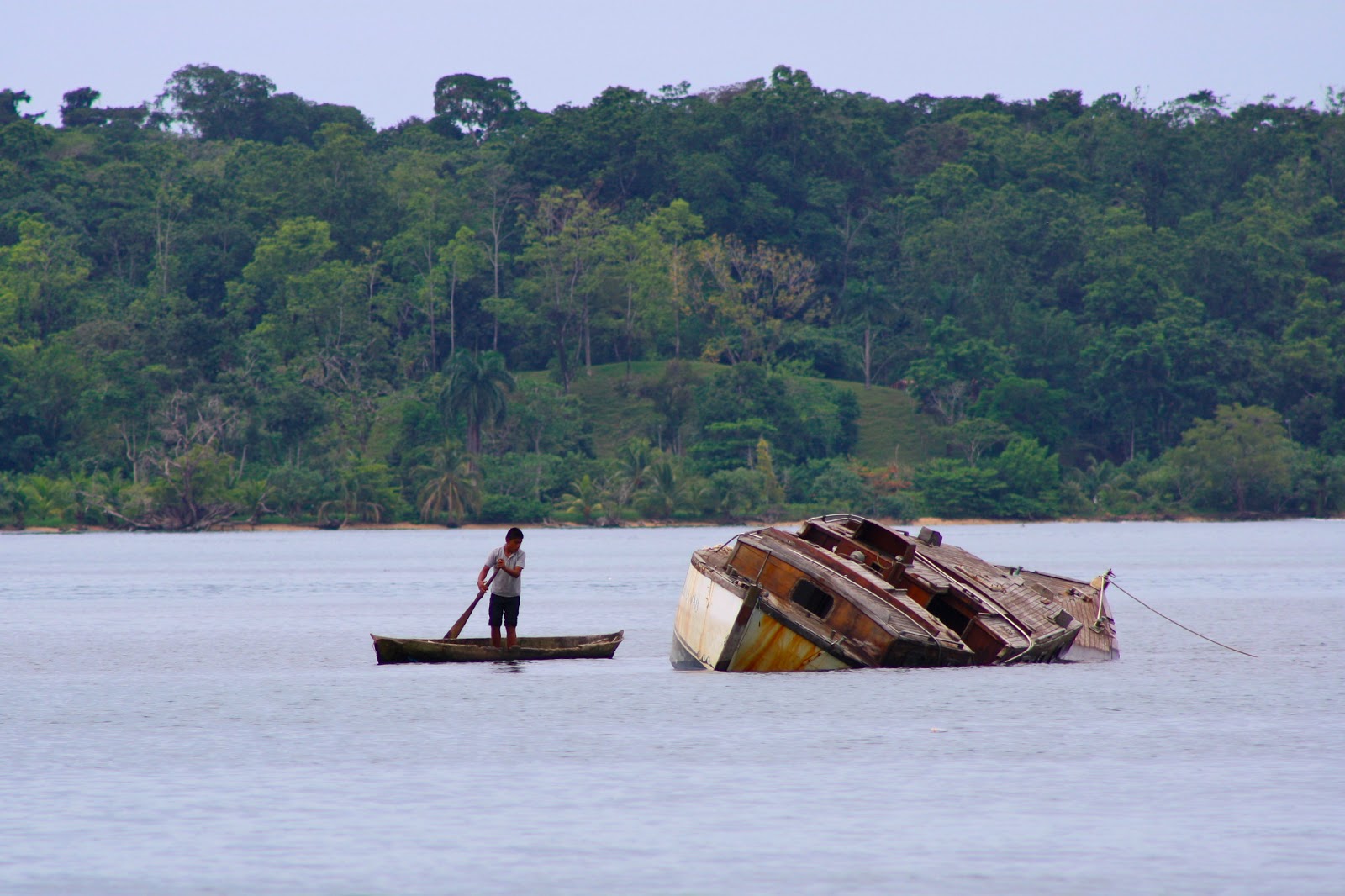
Day 13: Sunday in Panama, feeling Hemingway-esque on the back deck/dock of the Hotel Brisas. Everything is draped with a veil of humidity and the slow, forgotten air of what Pico Ayer calls “tropical classical.” Bocas in the off-season is a town of potted palms and old-fashioned furniture and mahogany bars built with grandiose notions, a place where you feel there should be literary ex-pats smoking cigars and drinking rum. But they aren't here. Instead the décor has become faded, dusty; half-crumbling but clean nonetheless in hope of attracting backpackers and sailors on the prowl for cheap drinks and beds where you can hear the waves lapping at a dock. Here at the back of the Hotel Brisas, a girl in a floral dress sketches at a table, Jesse and I sit reading and writing on a bench piled with pillows and a white-haired man with a paunch and a ponytail sings King of the Road while strumming a guitar. Several sailboats are anchored in our view, with pelicans landing on their masts, and a man in a dugout canoe poles his boat between million-dollar yachts looking for fish.


Day 15: Crossed the border back into Costa Rica and drove to the town of Manzanillo, then hiked 8K through the Gandoca-Manzanillo Wildlife Refuge to Punta Mona, where an 80-hectare experiment in low-impact, off-grid living and permaculture design welcomes guests to sleep under a thatched roof that brings ocean breeze, moonlight and the sounds of the jungle into your bed. It is one of our last nights here, and we are spending it the way we've come to like it: candlelight, mosquitos and the sound of water. 

 
Day 18: In the air en route to Atlanta, Jesse gets up to use the bathroom. Across the aisle sits a Swiss gentleman in a suit with a clean-shaven face and a wedding band and neatly clipped nails typing on a laptop. Then Jesse comes back to his seat, endearing in his one clean shirt, wrinkled khakis and hole-ridden Converse All-Stars, a month's beard sworling on his jawline, blue eyes bright in his tanned face, and I notice that at some point over the last month I have fallen in love with him.


Nature Blog Network